
Position, distance and displacement
Position specifies where a body is located in space at a particular time.
Displacement is the change in position, represented in one dimension by .
Distance is the total length of the path travelled.
Displacement depends only on the initial and final positions, whereas distance depends on the path taken.
A body can travel a non-zero distance and still have zero displacement if it returns to its starting position.
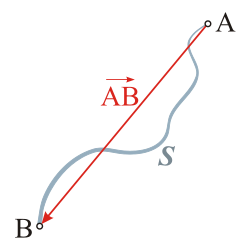
Distance measures the path travelled, whereas displacement describes the change from the initial to final position. The diagram helps distinguish a travelled path from the corresponding displacement vector.
Average and instantaneous values
Average velocity over a time interval is .
Average speed is total distance travelled divided by the elapsed time.
Average acceleration over a time interval is .
An instantaneous value gives velocity, speed or acceleration at one particular moment.
An instantaneous rate can be determined from the gradient of a tangent to the appropriate motion graph.
An average rate is determined over a finite time interval rather than at one instant.
Uniformly accelerated motion equations
Item | Expression or meaning | Exam use |
|---|---|---|
Symbols | : displacement; : initial velocity; : final velocity; : acceleration; : time | Maintain one sign convention |
Equation 1 | Does not contain | |
Equation 2 | Does not contain | |
Equation 3 | Does not contain | |
Equation 4 | Does not contain |
Projectile motion without fluid resistance
Projectile motion without fluid resistance can be separated into independent horizontal and vertical components.
The horizontal velocity component remains constant because horizontal acceleration is zero.
The vertical component has constant downward acceleration .
Apply the equations of uniformly accelerated motion separately in each direction using the same time .
The trajectory is parabolic when fluid resistance is absent; its trajectory equation is not required.
Quantitative problems use a constant value of close to Earth’s surface.
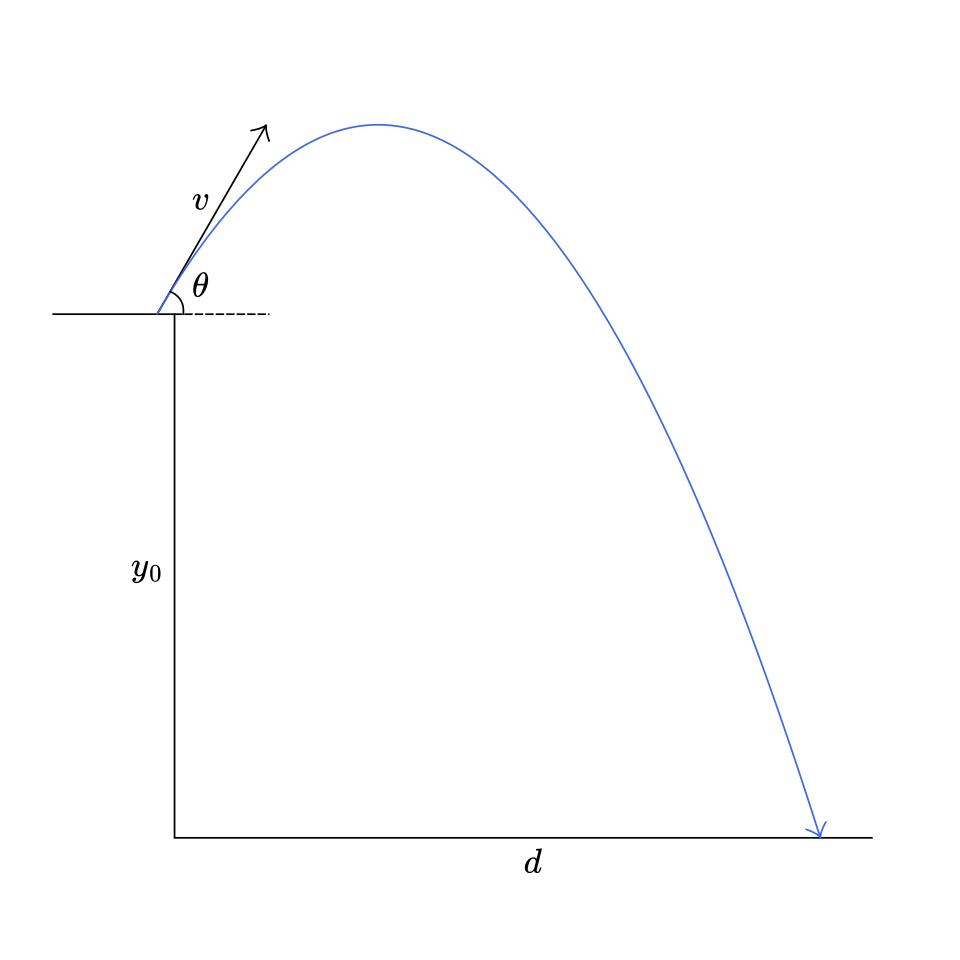
Without fluid resistance, projectile motion follows a parabolic trajectory. Horizontal and vertical motion can be analysed separately while sharing the same elapsed time.
Fluid resistance and terminal speed
Fluid resistance describes the effects of gases or liquids on the motion of a body.
With fluid resistance, projectile acceleration is non-uniform and the ideal parabolic model no longer applies.
The range is generally reduced and the trajectory becomes asymmetric compared with the no-resistance model.
The horizontal and vertical components of velocity both change, and the time of flight differs from the ideal prediction.
During prolonged downward motion, speed can approach a constant terminal speed, with acceleration approaching .
Effects on trajectory, velocity, acceleration, range, time of flight and terminal speed are treated qualitatively.
Velocity, speed and acceleration
Velocity is the rate of change of position.
Speed describes how fast a body moves without specifying direction, whereas velocity includes direction.
Acceleration is the rate of change of velocity.
Acceleration occurs whenever velocity changes, including a change in its magnitude or direction.
For one-dimensional calculations, choose a consistent positive direction so opposite directions are represented using opposite signs.
Motion graphs and rates of change
The gradient of a position–time graph gives velocity because velocity is the rate of change of position.
The gradient of a velocity–time graph gives acceleration because acceleration is the rate of change of velocity.
The signed area beneath a velocity–time graph gives displacement over the corresponding time interval.
A constant gradient represents a constant rate of change; a changing gradient indicates that the rate itself is changing.
Always interpret the gradient using both its magnitude and sign.
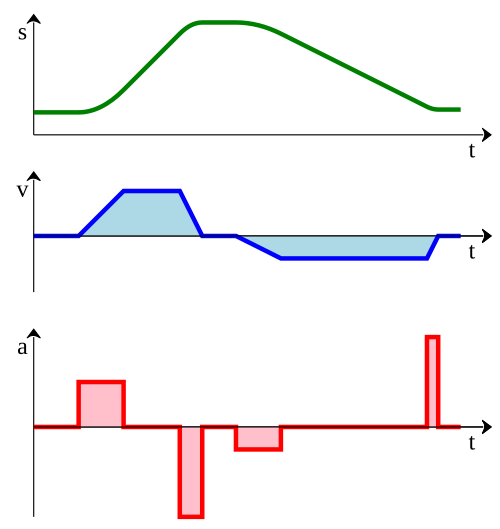
Compare the three graphs for the same motion. Changes in the gradient of the position graph correspond to velocity, while changes in the velocity graph correspond to acceleration.
Uniform and non-uniform acceleration
Uniform acceleration means remains constant, so equal time intervals produce equal changes in .
Non-uniform acceleration means changes with time.
On a velocity–time graph, uniform acceleration gives a constant gradient whereas non-uniform acceleration gives a changing gradient.
The equations in Box 5 apply to uniformly accelerated motion.
For non-uniform acceleration, analyse the changing rate of velocity rather than automatically applying constant-acceleration equations.
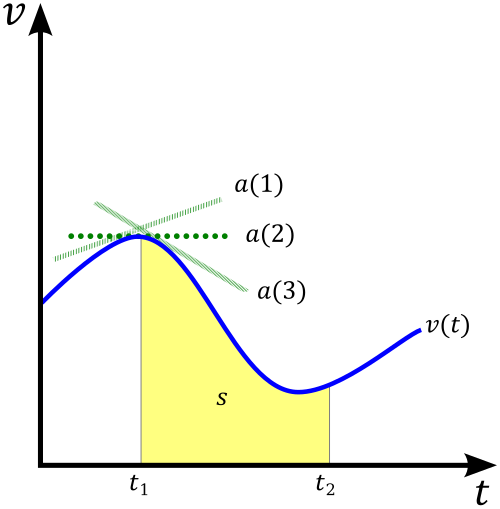
The changing gradient of the – curve represents changing acceleration. The highlighted area represents displacement, while tangent gradients illustrate instantaneous acceleration.
Resolving projectile motion
For launch speed at angle above the horizontal, the initial components are and .
For a horizontal launch, the initial vertical velocity component is .
For a launch below the horizontal, the vertical component initially points downward and its sign must match the chosen convention.
Use separate horizontal and vertical equations, but the elapsed time is common to both.
At the highest point, the vertical velocity component is while the horizontal component remains constant in the no-resistance model.
Projectiles launched horizontally, above the horizontal and below the horizontal are all required.
Checklist: can you do this?
Can you distinguish distance from displacement?
Can you distinguish speed from velocity?
Can you calculate and interpret average and instantaneous velocity and acceleration?
Can you interpret gradients and areas on motion graphs?
Can you select and apply the correct uniform-acceleration equation?
Can you distinguish uniform from non-uniform acceleration?
Can you resolve projectile motion into horizontal and vertical components?
Can you explain qualitatively how fluid resistance affects trajectory, time of flight, velocity, acceleration, range and terminal speed?