
HL Only: Reference frames
A reference frame specifies the frame from which events in space and time are described.
An inertial reference frame is non-accelerating.
Relativity compares descriptions of the same events made in different reference frames.
Keep the unprimed coordinates and primed coordinates clearly distinguished.
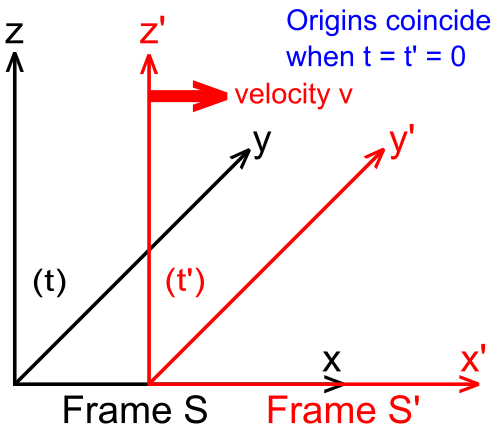
The diagram visualises two reference frames in relative motion. It provides the basic geometry needed before applying Galilean or Lorentz coordinate transformations.
HL Only: Special relativity requirements
Know the two postulates of special relativity as required syllabus knowledge.
The supplied syllabus names these postulates but does not provide their wording.
The postulates lead to the Lorentz transformation equations for event coordinates in two inertial reference frames.
They also lead to the relativistic velocity-addition equation.
Derivations of the Lorentz transformations and relativistic velocity-addition equation are not required.
HL Only: Relativistic velocity addition
The relativistic velocity-addition equation is .
Use it to transform the velocity of an object between two inertial reference frames.
The denominator distinguishes this relationship from the Galilean result .
Keep velocity directions and signs consistent when substituting values.
The derivation of the equation is not required.
HL Only: Proper time, proper length and relativistic effects
The proper time interval is represented by in the time-dilation equation.
Time dilation is given by .
The proper length is represented by in the length-contraction equation.
Length contraction is given by .
As increases, the measured time interval increases relative to , while the measured length decreases relative to .
Correct identification of the proper quantity is essential before using either equation.
HL Only: Relativity of simultaneity
Relativity of simultaneity means that simultaneity depends on the inertial reference frame used to describe events.
The Lorentz time transformation makes the transformed time depend on both and .
Therefore, two separated events with the same can have different values of .
Use space–time diagrams to visualise how simultaneity differs between relatively moving frames.
Relativity of simultaneity is a required consequence of special relativity alongside time dilation and length contraction.
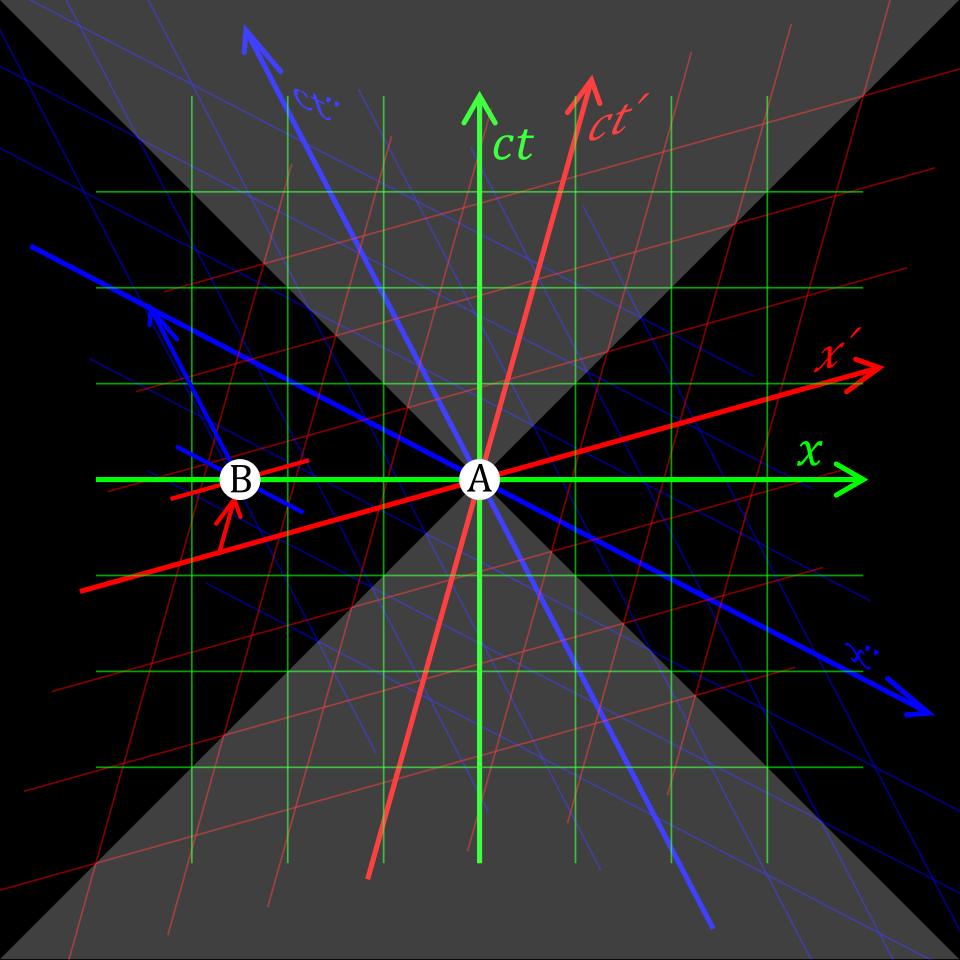
The diagram shows that two events judged simultaneous in one reference frame need not be simultaneous in another. It is a direct visual representation of the relativity of simultaneity.
HL Only: Galilean relativity and transformations
Galilean relativity states that Newton’s laws of motion are the same in all inertial reference frames.
For frames with relative velocity , position transforms as .
Time is unchanged in the Galilean transformation: .
The corresponding velocity-addition equation is .
Use these relationships to transform position, time and velocity between inertial frames.
HL Only: Lorentz transformations
The Lorentz factor is .
Position transforms according to .
Time transforms according to .
The Lorentz equations relate the coordinates of the same event in two inertial reference frames.
Both space and time coordinates are involved in the transformation.
The derivation of these equations is not required.
HL Only: Invariant space–time interval
The space–time interval between two events is an invariant quantity.
For one spatial dimension, .
The interval combines the temporal separation and spatial separation of the events.
Different inertial frames can assign different values to and .
The value of remains invariant when the same two events are described in different inertial frames.
HL Only: Space–time diagrams and world lines
The time axis of an IB space–time diagram is labelled .
A moving particle is represented by a world line; syllabus discussion is limited to constant velocity.
If is the angle between the world line and the time axis, .
Time dilation, length contraction and simultaneity can be visualised using space–time diagrams.
The scales on , , and are not the same for relatively moving frames.
Their scales are defined using lines of constant space–time interval.
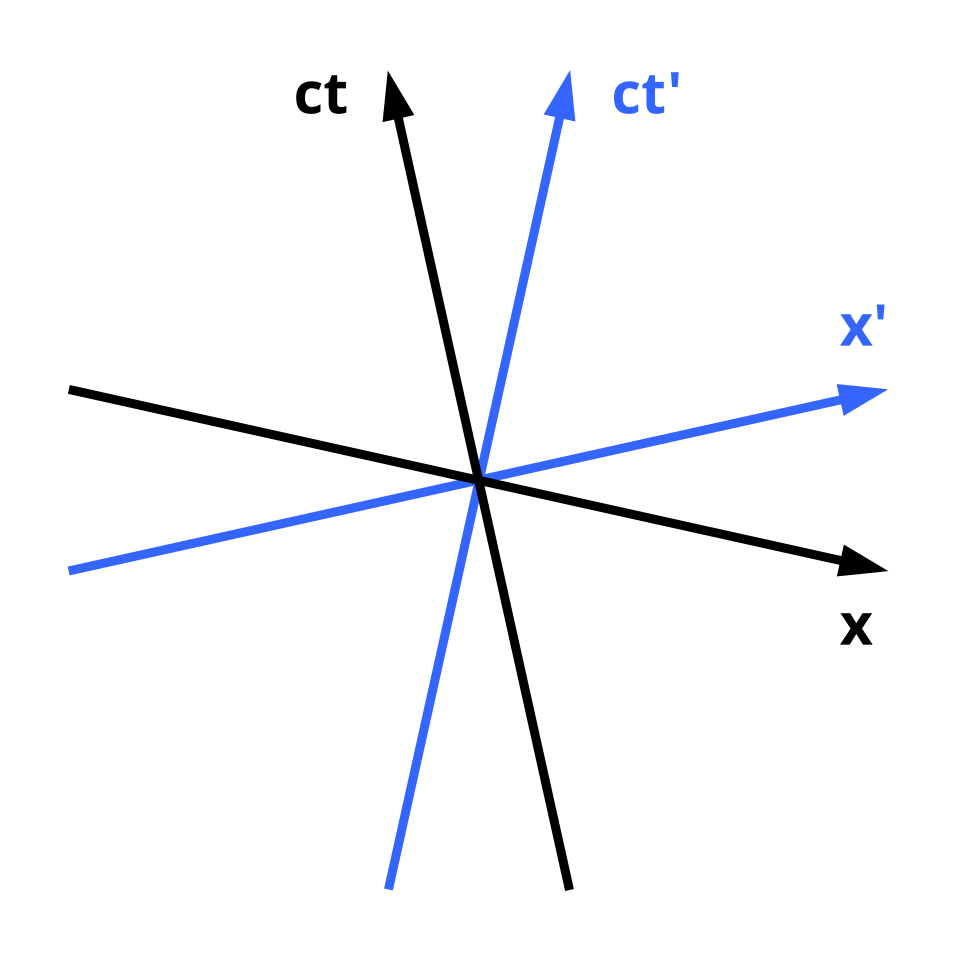
The Minkowski diagram shows different coordinate axes for the same events in two relatively moving frames. Use it to practise reading how space and time coordinates change between frames.
HL Only: Muon decay evidence
Muon decay experiments provide experimental evidence for time dilation and length contraction.
Use when interpreting the difference between proper and dilated decay-time intervals.
Use for the corresponding length-contraction description.
Muon experiments therefore connect measurable particle behaviour with predictions from special relativity.
In examination questions, link the experimental observation explicitly to the relevant relativistic effect.
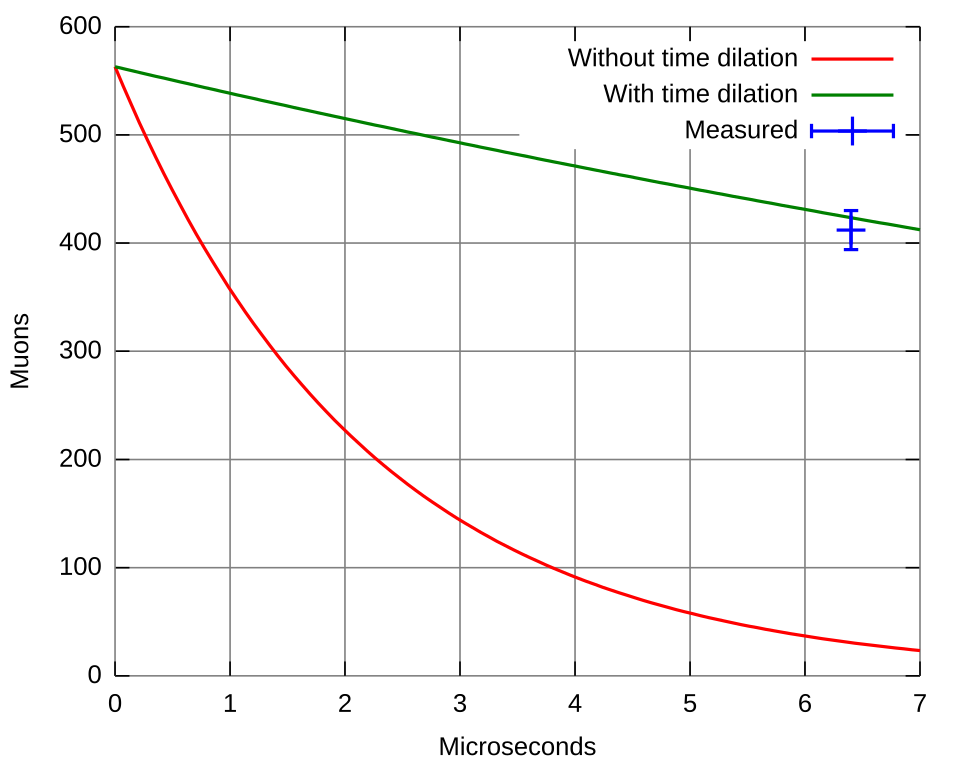
The graph presents data from the Frisch–Smith muon experiment. The observed muon behaviour is consistent with the relativistic time-dilation prediction, providing experimental evidence for special relativity.
HL Only: Checklist: can you do this?
Can you identify a reference frame and distinguish an inertial reference frame?
Can you apply , and in Galilean relativity?
Can you connect the two postulates of special relativity with the Lorentz transformations?
Can you calculate and apply the transformations for and ?
Can you use correctly?
Can you calculate the invariant interval using ?
Can you apply and ?
Can you interpret a space–time diagram, relativity of simultaneity and muon-decay evidence?