AP Syllabus focus:
‘Develop the quotient rule for derivatives from the limit definition applied to f(x)/g(x), assuming g(x) ≠ 0 and both functions are differentiable.’
The quotient rule arises naturally from examining how two differentiable functions interact when one is divided by the other, revealing structure in rates of change essential for advanced problem solving.
Understanding the Goal of Deriving the Quotient Rule
When differentiating a quotient, AP Calculus AB emphasizes understanding why the rule works, not just memorizing its final form. The derivative of a quotient measures how the ratio of two smoothly changing quantities evolves with respect to the input variable. Because both the numerator and denominator change simultaneously, we must carefully account for both changes by returning to the limit definition of the derivative, which provides the foundational framework for all derivative rules.
Before proceeding, it is important to recognize that the quotient rule applies only when the denominator function is nonzero and both functions involved are differentiable in a neighborhood of the point of interest.
Differentiable Function: A function is differentiable at a point if its derivative exists there, meaning the limit of its difference quotient exists and is finite.
A derivative encapsulates instantaneous change, and when applied to a quotient , this change must reflect the simultaneous variations of both and . This motivates a careful algebraic manipulation of the difference quotient.
Building the Derivative from the Limit Definition
To derive the quotient rule conceptually, we begin with the limit definition of the derivative, applied directly to the quotient of two differentiable functions. This approach shows how the resulting rule emerges from algebraic organization rather than memorization. Because the denominator changes with , we cannot treat it as a constant; instead, its role must be explicitly embedded in the derivative’s structure.
= Original function
= Increment in input
This expression is a difference quotient, representing the slope of a secant line through two nearby points on the graph of .
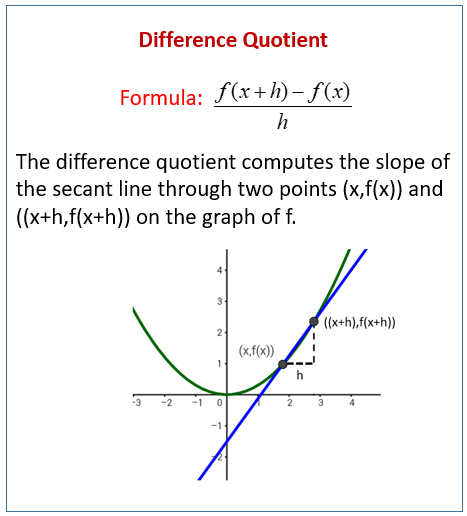
This figure illustrates the difference quotient as the slope of a secant line joining and . It visually connects the algebraic formula with the geometric picture of average rate of change. All content directly supports the introduction of the limit-based derivative used in the conceptual derivation of the quotient rule. Source.
The next step is to apply this foundational formula to the quotient , keeping in mind that both numerator and denominator vary with . After setting up the difference quotient, the expression involves a single rational term whose numerator contains a difference of fractions. To simplify effectively, we seek a common denominator and reorganize terms to isolate contributions from changes in both the numerator function and the denominator function.
Because this process inevitably introduces the product of functions inside the difference quotient, the derivation reflects a structure similar to that of the product rule. However, the division introduces an additional layer of algebraic coordination that ultimately produces the characteristic subtraction in the quotient rule’s numerator.
Key Ideas Underlying the Derivation
The conceptual derivation of the quotient rule hinges on several essential observations about how functions behave when combined through division:
The Need to Track Simultaneous Change
Both and change as changes. To capture this behavior accurately:
We must analyze how the whole fraction changes, not just the numerator.
The variation in the denominator affects the size of the ratio, even if the numerator remains constant.
The derivative must incorporate contributions from changes in both functions.
The Role of Algebraic Manipulation
During the derivation, algebraic restructuring is not merely a convenience but a necessity. Important steps include:
Introducing a common denominator to combine fractional expressions.
Rewriting terms strategically so that differences like and appear explicitly.
Factoring out quantities that resemble difference quotients, allowing limit transitions to reveal derivative expressions.
These algebraic moves expose the underlying structure of the rule: two competing effects—change in the numerator and change in the denominator—combine to determine the instantaneous behavior of their quotient.
Ensuring the Denominator Remains Nonzero
Because division by zero is undefined, the quotient rule requires near the point of differentiation. This condition guarantees:
The limit-based expression remains meaningful.
The resulting derivative, which contains in its denominator, is defined.
The interpretation of the derivative as a rate of change of a ratio remains valid.
Conceptual Form of the Quotient Rule
Once the algebraic and limit-based reasoning is complete, the derivative of the quotient emerges with a structure reflecting joint changes in numerator and denominator. The rule expresses the derivative as a difference: the derivative of the numerator times the original denominator minus the original numerator times the derivative of the denominator. This difference is then divided by the square of the denominator, capturing how the denominator's magnitude moderates the rate of change of the entire quotient.
= Numerator function
= Denominator function
Collecting these pieces and taking the limit gives the quotient rule, which expresses entirely in terms of , , and their derivatives at .
Geometrically, as the secant line through and approaches the tangent line at , whose slope is the derivative.
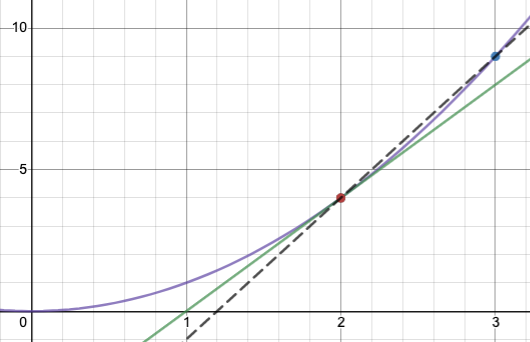
This figure compares a secant line with the tangent line it approaches as the second point moves toward the first. As the separation shrinks, the slope of the secant converges to the slope of the tangent—representing the derivative. The diagram is general but directly visualizes the limiting secant-to-tangent idea used in the conceptual derivation of the quotient rule. Source.
Practice Questions
Question 1 (1–3 marks)
Let a function h be defined by h(x) = f(x) / g(x), where f and g are differentiable at x = 2 and g(2) is not zero.
Explain briefly why the derivative h′(2) must involve both f′(2) and g′(2).
Question 1
• 1 mark: States that h′(2) depends on the rate of change of both numerator and denominator.
• 1 mark: Explains that both f and g vary with x, so changes in each affect the overall ratio.
• 1 mark: Notes that because g is not constant, its derivative contributes to how the quotient changes.
Question 2 (4–6 marks)
A function is defined by H(x) = p(x) / q(x), where p and q are differentiable for all real x and q(x) is never zero.
Starting from the limit definition of the derivative, derive an expression for H′(x) that shows how the quotient rule arises from the behaviour of p and q as x changes.
Question 2
• 1 mark: Correctly writes the limit definition for H′(x) using (p(x)/q(x)).
• 1 mark: Forms a single rational expression by combining the two fractions in the numerator.
• 1 mark: Identifies and rearranges terms to produce expressions resembling difference quotients for p and q.
• 1 mark: Recognises that the limit produces p′(x) and q′(x).
• 1 mark: Shows division by q(x) squared as a consequence of the algebraic manipulation.
• 1 mark: Arrives at a correct final expression for H′(x) in the structure [p′(x)q(x) − p(x)q′(x)] / [q(x)]².
FAQ
Even though the interval is small, the denominator still changes with x, and this change affects the ratio’s behaviour.
Ignoring the variation in the denominator would incorrectly assume that only the numerator contributes to the change in the quotient.
A proper derivation must account for both changing components; otherwise, the resulting expression fails to match the true instantaneous rate of change.
The subtraction arises naturally from expanding the combined fraction in the limit definition.
When the two terms are rewritten with a common denominator, one term reflects the numerator’s change while the other reflects the denominator’s change.
These contributions operate in opposite directions: a rising denominator makes the ratio smaller, producing the negative sign.
When the difference quotient is formed, both fractions being subtracted share a common denominator involving the product g(x+h)g(x).
After simplification and taking the limit, this product becomes g(x) squared.
The squared denominator ensures the final expression accurately reflects the combined scaling effect of the changing denominator.
No. The structure that resembles the product rule emerges organically from expanding and rearranging the difference quotient.
Students may notice similarities, but the derivation can be followed without prior knowledge of the product rule’s formula.
It helps to see that multiplication appears simply because the expressions involve products of numerators and denominators during simplification.
The derivation relies on the limits of expressions such as f(x+h) − f(x) and g(x+h) − g(x) behaving predictably as h approaches zero.
If either function were not differentiable, these limits might not exist or might not match the expected instantaneous change.
Differentiability guarantees the formation of meaningful difference quotients for both the numerator and the denominator.