

AP Syllabus focus:
‘Decide whether to use the quotient rule directly or to simplify an expression algebraically before differentiating, aiming for efficient and accurate calculations.’
Efficient differentiation requires choosing methods strategically. This subsubtopic develops judgment about when the quotient rule is necessary and when algebraic simplification produces cleaner, more accurate derivatives with less computational effort.
Understanding the Strategic Choice
Choosing between the quotient rule and algebraic simplification is a skill that supports accuracy, reduces algebraic complexity, and strengthens conceptual understanding of how expressions behave under differentiation. Students must recognize structural features of functions that make one method preferable over another.
When the Quotient Rule Is Appropriate
The quotient rule is designed for functions expressed as one differentiable function divided by another.
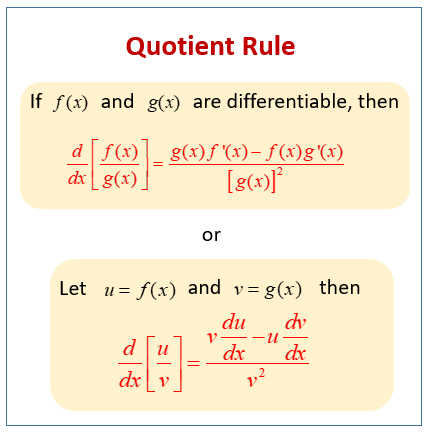
This diagram summarizes the quotient rule for differentiating a function written as a quotient of two differentiable functions. It visually reinforces the pattern over and highlights that the denominator is always squared. The image includes only the core formula, with no extra content beyond what AP Calculus AB students need. Source.
It is especially suitable when the numerator and denominator are both nontrivial expressions that do not simplify cleanly.
= numerator function
= denominator function
and = derivatives of numerator and denominator
After understanding the formal structure, students should consider the characteristics of a function before deciding on this rule. The quotient rule is generally the most efficient choice when:
The denominator is a sum, difference, or composition that cannot be factored or rewritten into a simpler form.
Rewriting would introduce more complicated expressions such as negative exponents that obscure relationships between terms.
The quotient form is essential for interpretation in later steps of a larger problem.
A sentence describing the reasoning process helps reinforce the strategic nature of this choice: the quotient rule preserves structure when simplification is either impossible or more cumbersome.
When Algebraic Simplification Is More Efficient
Simplification often converts a quotient into a power function or sum of simpler terms, which is ideal for applying previously learned rules such as the power rule, constant multiple rule, and sum rule.
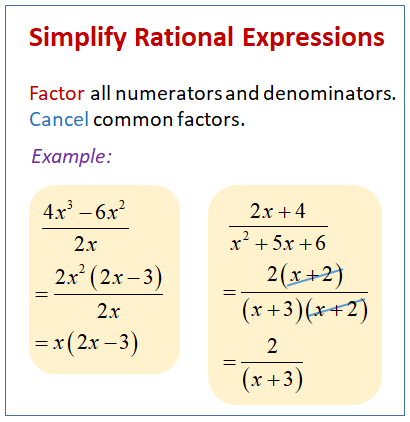
This image illustrates how to simplify rational expressions by factoring and canceling common factors in the numerator and denominator. The worked examples show a quotient of polynomials rewritten into a simpler form, mirroring the algebraic preparation students should perform before differentiating. The image includes only simplification steps, without extending into differentiation or topics beyond this subsubtopic. Source.
Algebraic Simplification: The process of rewriting an expression into an equivalent but structurally simpler form before applying differentiation rules.
Simplification is generally preferred when:
The denominator is a single monomial that can be distributed across terms in the numerator.
The entire quotient can be rewritten using negative exponents, leading to a direct application of the power rule.
Factoring or canceling yields an expression with fewer operations and reduced risk of sign errors.
There is a critical conceptual sentence to clarify the reasoning: simplification minimizes the algebraic burden, which decreases opportunities for mistakes and reveals differentiation patterns clearly.
Key Indicators Favoring Simplification
Students should develop pattern recognition to decide whether rewriting is beneficial.
Common signals include:
A polynomial divided by a monomial.
Expressions where factoring creates cancellation that removes the quotient structure entirely.
Rational expressions where distributing the denominator produces simple power functions.
Key Indicators Favoring the Quotient Rule
In contrast, some expressions resist simplification. Students should notice when:
The denominator has multiple terms and cannot be factored meaningfully.
Simplifying yields more complicated exponents or introduces extraneous steps.
The function’s structure will be used later, making the quotient form valuable beyond differentiation.
Balancing Efficiency and Accuracy
The primary goal of this subsubtopic is cultivating the ability to decide which technique leads to the most reliable computation. While both methods ultimately produce correct derivatives, their efficiency differs. Students must evaluate the complexity of each path before beginning differentiation.
Benefits of Selecting Simplification
Choosing to simplify can:
Reduce the number of differentiation steps.
Match expressions to familiar derivative rules.
Improve clarity and reduce the risk of algebraic mistakes.
Benefits of Using the Quotient Rule
The quotient rule remains indispensable when simplification is either impossible or counterproductive. Its structure gives a systematic, formulaic approach that avoids excessive rewriting and preserves relationships vital in symbolic or contextual interpretations.
Developing Skill Through Reasoned Decision Making
The essential learning objective is knowing when to use each technique. This involves analyzing the structure of a given function, anticipating future steps, and selecting the method that leads to efficient and accurate results. Students should learn to:
Inspect numerator and denominator for factorization or cancellation opportunities.
Identify whether rewriting introduces complexity.
Evaluate which rule aligns most naturally with the function’s structure.
Through this focused reasoning, students strengthen fluency in differentiation and build confidence in choosing the most effective strategy for a wide range of rational expressions.
Practice Questions
Question 1 (1–3 marks)
A function is defined by h(x) = (4x² + 8x) / x.
Without using the quotient rule, differentiate h(x).
Explain briefly why the quotient rule is unnecessary in this case.
Question 1
• 1 mark for rewriting h(x) as 4x + 8.
• 1 mark for correctly stating h'(x) = 4.
• 1 mark for explaining that the denominator is a monomial, so simplification avoids unnecessary use of the quotient rule.
Question 2 (4–6 marks)
A function is defined by
k(x) = (x³ + 5x − 2) / (x² − 1).
(a) Determine whether it is more efficient to simplify k(x) algebraically or to use the quotient rule to differentiate it. Justify your choice.
(b) Differentiate k(x) using the method you selected.
(c) State one potential error a student might make if they choose the less efficient method.
Question 2
(a)
• 1 mark for recognising that the denominator x² − 1 is not a monomial and cannot be distributed simply.
• 1 mark for stating that the quotient rule is the more appropriate method because simplification does not meaningfully reduce complexity.
(b)
• 1 mark for correctly applying the quotient rule structure.
• 1 mark for a correct derivative expression (not necessarily fully simplified).
(c)
• 1 mark for identifying a valid error, e.g. forgetting to square the denominator, incorrectly simplifying the rational expression before differentiating, or mixing terms in the derivative.
FAQ
A rapid inspection of the denominator is often the most efficient test. If it is a single term, simplification will almost always be quicker.
If the denominator has multiple terms or is part of a more complex expression, the quotient rule is usually the safer choice.
A good rule of thumb:
• Try a brief simplification in your head; if it does not immediately reduce the structure, default to the quotient rule.
The quotient rule requires two derivatives, careful ordering, and attention to signs, which creates multiple points of failure.
Simplifying removes layers of algebra, meaning fewer opportunities for mistakes.
By turning a rational expression into separate, simpler terms, students reduce the need for complex manipulation and gain clearer visibility of how each piece differentiates.
Yes. When simplification introduces awkward fractional or negative exponents, the resulting expression may be harder to differentiate cleanly.
Simplifying may also obscure relationships between numerator and denominator that become important in later parts of a question.
If simplification increases the number of terms or introduces additional steps, the quotient rule may be preferable.
If the numerator contains a factor also present in the denominator, cancellation often produces a far simpler function. This strongly favours simplification.
However, if factoring the numerator leads to no meaningful cancellation, and especially if the numerator remains a multi-term polynomial, the quotient rule often becomes the more efficient path.
Many students assume that any fraction automatically requires the quotient rule. This is not true and leads to unnecessary work.
Typical misconceptions include:
• Believing simplification is optional rather than strategic.
• Assuming the quotient rule is always “more correct”.
• Overlooking opportunities to rewrite a quotient as a sum of simpler power functions.
Recognising these misconceptions helps develop better decision-making in timed assessments.
