

AP Syllabus focus: ‘Construct Lewis diagrams using an established set of principles to represent valence electrons, bonds, and lone pairs; use the diagrams as models for molecular and ionic structures.’
Lewis diagrams are a compact way to track how atoms use valence electrons to bond and where lone pairs remain. A consistent construction method helps you avoid electron-count errors and build structures usable for later geometry and property predictions.
What a Lewis diagram represents
Lewis diagram (Lewis structure): a model that shows valence electrons as bonds (shared pairs) and lone pairs (unshared pairs) around atoms in a molecule or polyatomic ion.
A bonding pair is typically drawn as a line (or two dots) between atoms; a lone pair is drawn as two dots on a single atom.
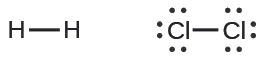
Examples of Lewis structures using both line-bond notation and electron-dot notation. The H–H example emphasizes a single shared pair (a bonding pair), while the Cl–Cl example shows how three lone pairs on each chlorine complete octets around both atoms. Source
Lewis diagrams focus on connectivity (which atoms are attached) and electron placement that satisfies stable electron arrangements.
Stability targets used in AP Chemistry
Octet rule: many main-group atoms tend to be surrounded by 8 electrons (counting bonding and lone-pair electrons).
Duet rule: H is stable with 2 electrons (one single bond).
Common terminal patterns (helpful checkpoints, not “rules”):
Halogens: 1 bond, 3 lone pairs
O: 2 bonds, 2 lone pairs
N: 3 bonds, 1 lone pair
C: 4 bonds, 0 lone pairs (typical)
Core principles for constructing Lewis diagrams (algorithm)
1) Count total valence electrons available
Add valence electrons for each atom (using periodic group numbers for main-group elements).
Adjust for overall charge:
Negative charge: add electrons
Positive charge: subtract electrons
Keep the total as a “budget” you must exactly spend in the diagram.
2) Choose a reasonable skeletal arrangement
Pick a central atom (often the least electronegative element, never H).
Connect surrounding atoms to the central atom with single bonds first.
For molecules with more than one central atom (common in hydrocarbons), connect atoms to match typical bonding capacities (C forms chains).
3) Account for electrons used in single bonds
Each single bond represents 2 electrons from your budget.
Subtract these immediately so you know how many electrons remain for lone pairs and additional bonding.
4) Complete octets (or duets) on terminal atoms
Give each terminal atom (not central) enough lone pairs to reach an octet (or duet for H).
Typical order: fill outer atoms first because central atoms are more flexible in bonding.
5) Place remaining electrons on the central atom
Put leftover electrons as lone pairs on the central atom.
Check whether the central atom has an octet (count all electrons in bonds around it plus its lone pairs).
6) If the central atom lacks an octet, form multiple bonds
Convert a lone pair from a neighbouring atom into an additional bonding pair:
One conversion makes a double bond
Two conversions make a triple bond
Recheck octets after each change while staying within the total electron budget.
7) Final checks (must always be true)
Total electrons drawn equals your counted budget.
Each H has one bond (duet).
Most non-hydrogen atoms reach an octet when possible.
The drawn structure is chemically reasonable (no atom exceeds its typical number of bonds for introductory AP use unless clearly required by the formula/charge context).
Representing molecular vs ionic structures with Lewis diagrams
Molecules and polyatomic ions
Molecules: draw the structure without brackets.
Polyatomic ions: enclose the entire structure in square brackets and write the overall charge outside (top right).
Lone pairs and bonds are still shown the same way; the bracketed charge indicates the electron count differs from the neutral atom sum.
Monatomic ions and ionic compounds
For a monatomic ion, show the element symbol with an octet (when appropriate) in brackets and the ion charge.
For an ionic compound, Lewis diagrams typically show separate ions rather than a single covalent network:

Lewis-dot diagrams showing electron transfer and the resulting separate ions in ionic compounds (e.g., NaCl), with charges indicated on bracketed ions. This reinforces the convention that ionic compounds are represented as discrete cations and anions rather than a shared-electron network. Source
Cations often shown with no dots (lost valence electrons).
Anions shown with a full octet.
Using Lewis diagrams as models
They predict which atoms are connected and where electron pairs reside (inputs for later shape reasoning).
They encode bond multiplicity (single/double/triple), which qualitatively relates to stronger/shorter vs weaker/longer bonds.
They are simplified models: they track electron pairs, not 3-D shape or actual electron density distributions.
Practice Questions
(1–3 marks) Draw the Lewis diagram for the ammonium ion, , showing all bonds and any lone pairs.
Correct total valence electrons for (8 electrons in bonds) (1)
N central with four single N–H bonds (1)
Overall charge shown as with brackets; no lone pairs on N (1)
(4–6 marks) Construct the Lewis diagram for ethyne, . Your answer must include the correct arrangement of atoms, all bonds, and any lone pairs.
Correct skeletal arrangement H–C–C–H (1)
Correct total valence electrons (10) consistent with the diagram (1)
Triple bond between the two carbon atoms (1)
Single bond from each carbon to hydrogen (1)
No lone pairs on carbon; all atoms satisfy duet/octet as appropriate (1)
FAQ
Hydrogen can form only one bond (a duet). A central atom must typically form multiple bonds to connect several atoms, which hydrogen cannot do.
Use these tie-breakers: least electronegative (excluding H), the atom that appears once, or the atom capable of forming the most bonds based on typical patterns (C, then N, then O).
If, after filling terminal octets and placing remaining electrons, the central atom has fewer than 8 electrons, convert a neighbouring lone pair into a bonding pair to make a double/triple bond.
In AP-level Lewis diagrams, a coordinate bond is usually drawn as a normal single bond line; sometimes an arrow is used in teaching, but it typically isn’t required for marking.
Write an explicit electron “budget” and tick off electrons as you add:
2 per bond
2 per lone pair
Then verify the final total matches the counted valence electrons including the ion charge adjustment.
