AP Syllabus focus:
‘Population policies may promote or discourage population growth, including pronatalist and antinatalist approaches.’
Governments use pronatalist and antinatalist population policies to influence birth rates, shaping demographic patterns, labor needs, and long-term population stability across varying economic and social contexts.
Understanding Pronatalist and Antinatalist Policies
Pronatalist and antinatalist policies are deliberate government actions designed to increase or decrease a nation’s birth rate. These policies reflect broader demographic goals such as managing workforce size, addressing population aging, or controlling rapid population growth. They can be implemented through economic incentives, legal regulations, cultural messaging, or expanded public services.
Pronatalist Policy: A government strategy designed to encourage higher birth rates, typically through incentives, benefits, or supportive family programs.
Governments frequently adopt pronatalist approaches when facing population aging, labor shortages, or declining national competitiveness linked to shrinking populations.
Pronatalist Policies: Encouraging Population Growth
Pronatalist policies seek to raise fertility by reducing the economic, social, or structural obstacles to having children. These efforts vary widely in form and intensity.
Common Strategies Used in Pronatalist Policies
Financial incentives, such as cash bonuses, tax deductions, or monthly child allowances.
Subsidized child care that lowers the cost and logistical burden of parenting.
Paid parental leave, supporting long-term employment stability for parents.
Housing benefits for families with multiple children.
Campaigns promoting family life, emphasizing cultural or national values tied to larger families.
Examples of Pronatalist Approaches
Although specific cases differ by country, the underlying motivations remain consistent. Nations experiencing low fertility, such as those in Europe or East Asia, often use:
Generous maternity and paternity leave programs to support work–life balance.
Family-friendly labor policies aimed at reducing workplace discrimination against mothers.
Financial bonuses that scale with the number of children.
These measures reflect a government’s effort to encourage citizens to have more children in order to stabilize population size.

This photograph shows the bronze Médaille de la Famille française, historically awarded to parents with large families in France. It demonstrates how states may use awards and public recognition as pronatalist incentives to encourage higher fertility. The medal includes specific cultural details not required by the syllabus but clearly illustrates a pronatalist mechanism. Source.
Antinatalist Policies: Reducing Population Growth
Antinatalist policies aim to discourage high fertility rates where rapid growth strains resources, infrastructure, and development. These policies have been implemented in countries facing resource scarcity, limited land availability, or rapid urbanization.
Antinatalist Policy: A government strategy designed to reduce birth rates, typically through disincentives, regulation, or expanded access to family planning.
These policies may emerge in contexts where population pressure exceeds the country’s carrying capacity, creating challenges for sustainable growth.
Common Strategies Used in Antinatalist Policies
Family planning programs that provide contraceptives and reproductive health education.
Public campaigns encouraging smaller families.
Economic disincentives, such as reducing benefits for larger families.
Legal restrictions, including limits on family size or requirements for birth spacing.
Expanded education for women, which strongly correlates with declining fertility.
Normal sentence: Antinatalist strategies are often paired with broader development policies that improve health care and reduce infant mortality.
Examples of Antinatalist Approaches
Countries experiencing rapid population growth may use:
Nationwide family planning initiatives, particularly in rural areas.
Government-sponsored contraception distribution to reduce unintended pregnancies.
Urban housing restrictions or economic policies that make large families less financially feasible.
These measures reflect an effort to align population size with economic capacity and environmental stability.

This poster shows a Chinese couple with one child, symbolizing the ideal family structure promoted under China’s one-child policy. It illustrates how antinatalist strategies often use positive visual messaging to encourage smaller families. The specific Chinese historical context is beyond syllabus requirements but effectively demonstrates an antinatalist approach. Source.
Why Governments Implement Pronatalist or Antinatalist Policies
Population policies are closely aligned with national development goals and demographic pressures.
Motivations for Pronatalist Policies
Addressing workforce shortages in aging societies.
Supporting economic growth by maintaining a stable labor pool.
Preserving cultural identity in nations concerned about declining population.
Ensuring long-term sustainability of social welfare programs that rely on younger workers.
Motivations for Antinatalist Policies
Reducing strain on natural resources, public services, and infrastructure.
Managing rapid urbanization, which can lead to overcrowding and inadequate housing.
Improving maternal and child health outcomes by promoting birth spacing and smaller family sizes.
Encouraging economic development, as high fertility can slow household and national progress.
Evaluating the Effectiveness of Population Policies
The success of pronatalist and antinatalist policies varies widely based on cultural acceptance, economic conditions, and policy design.
Factors Influencing Policy Effectiveness
Cultural norms surrounding family size, gender roles, and marriage.
Economic stability, which affects individuals’ willingness to have or limit children.
Quality of public services, including education, health care, and child care.
Political commitment and enforcement, shaping how consistently policies are applied.
Normal sentence: Policy outcomes often unfold over generations, making demographic shifts slow and complex.
Measuring Outcomes
Governments track several indicators to evaluate whether their policies are achieving the intended demographic effects:
Total fertility rate (TFR) changes following policy implementation.
Age structure shifts, especially in working-age and dependent populations.
Population growth rates, indicating broader demographic trends.
These measures help geographers assess whether pronatalist or antinatalist strategies successfully influence demographic change.
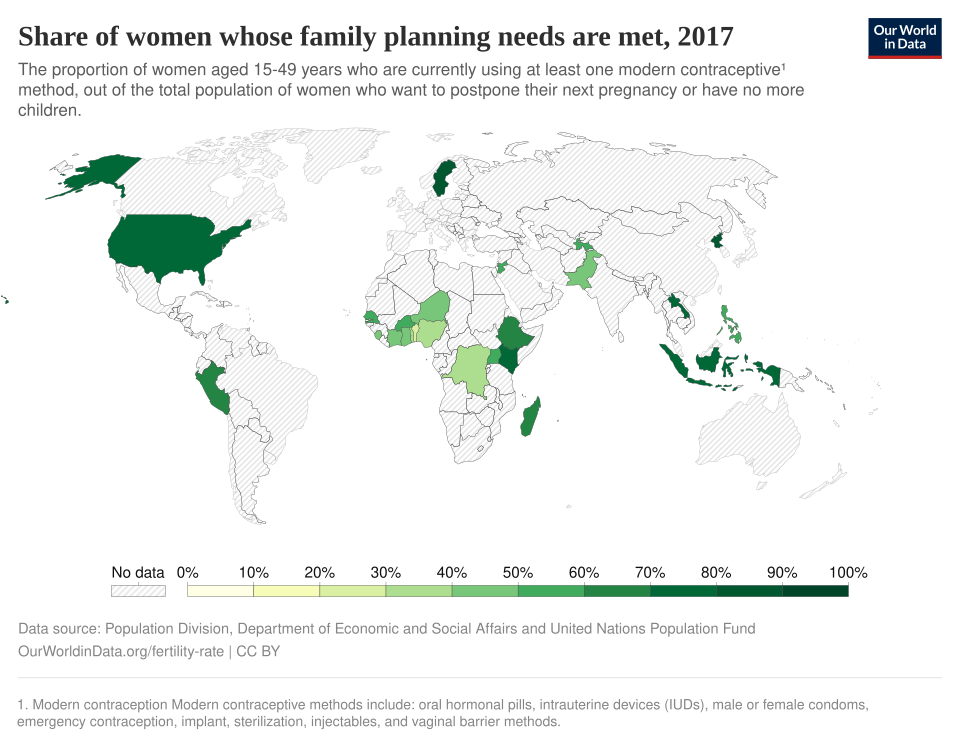
This world map shows the 2017 share of married women aged 15–49 whose need for family planning is satisfied. It illustrates how geographers use quantitative indicators of contraceptive access to evaluate the reach and impact of population policies. The map contains additional country-level detail beyond syllabus requirements but directly supports understanding of antinatalist mechanisms. Source.
Practice Questions
Question 1 (1–3 marks)
Explain one way in which a government might implement a pronatalist population policy.
Mark Scheme
1 mark for identifying a valid pronatalist strategy (e.g., financial incentives, parental leave, subsidised childcare).
1 mark for describing how the strategy encourages higher birth rates.
1 mark for linking the strategy to the broader goal of increasing population growth.
Question 2 (4–6 marks)
Evaluate how antinatalist population policies can influence both social and economic outcomes in a country.
Mark Scheme
1 mark for identifying at least one social impact (e.g., smaller family norms, improved maternal health).
1 mark for explaining the identified social impact.
1 mark for identifying at least one economic impact (e.g., reduced strain on resources, slower labour force growth).
1 mark for explaining the identified economic impact.
1–2 marks for evaluative commentary, such as acknowledging variable effectiveness, cultural resistance, or unintended consequences.
FAQ
Cultural norms surrounding family size, gender roles, and expectations for parenting strongly shape whether citizens accept or reject population policies.
Pronatalist policies are more effective where large families are culturally valued, whereas antinatalist policies succeed when smaller families already align with social expectations.
Governments often adapt messaging to fit cultural narratives to improve compliance.
Antinatalist measures can sometimes create gender imbalances when families prefer male children, particularly in societies with strong son preference.
They may also encourage unregistered or hidden births if families seek to avoid penalties.
Long-term effects can include reduced labour force size and accelerated population ageing.
Financial incentives often cannot fully overcome high living costs, demanding work cultures, or limited housing space that discourage larger families.
In many countries, delayed marriage and shifting lifestyle priorities reduce the effectiveness of pronatalist spending.
Low fertility can persist even with substantial benefits because social norms prioritise careers and personal autonomy.
Evaluation relies on demographic indicators such as changes in birth rates, fertility rates, and the average age at first birth.
Governments also track behaviours, including increased use of parental leave or enrolment in subsidised childcare.
Long-term assessment examines whether population decline slows or stabilises.
Governments frequently use advertising campaigns, public posters, and social media messaging to reinforce preferred family-size norms.
Media can frame large or small families as modern, patriotic, responsible, or aspirational, depending on policy goals.
This messaging helps normalise behavioural change by embedding population objectives into everyday life.