AP Syllabus focus: ‘Scarcity occurs because resources are limited, forcing individuals and societies to make choices about how to allocate economic resources.’
Scarcity is the starting point of macroeconomics: it explains why economies must choose how to use limited inputs to meet unlimited wants.
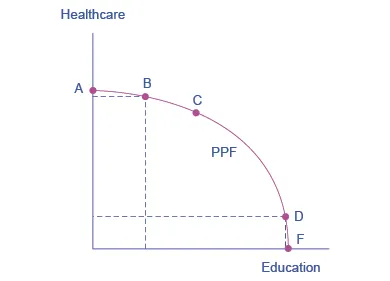
This production possibilities frontier (PPF) shows the maximum feasible combinations of two broad categories of output (here, healthcare and education) given limited resources and current technology. Points on the curve represent productive efficiency, while moving along the curve illustrates the tradeoff (opportunity cost) of producing more of one good by producing less of the other. The diagram also helps distinguish feasible but inefficient choices (inside the frontier) from unattainable choices (outside it). Source
Clear definitions of resources and constraints make later models meaningful.
What scarcity means in economics
Scarcity is not the same as “rare” or “expensive.” It is a universal condition that exists whenever human wants exceed available resources at a given time and place. Because of scarcity, every economy faces constraints: using resources for one purpose prevents their use elsewhere, so allocation matters.
Scarcity: the fundamental economic problem that arises because resources are limited relative to wants, requiring choices about how to allocate those resources.
Scarcity applies to individuals (time and income limits), firms (limited productive capacity), and governments (limited tax revenue and borrowing capacity). Even “rich” economies face scarcity because wants expand with incomes and possibilities.
Needs, wants, and the role of choice
Economic analysis typically treats wants as unlimited because new preferences and new goods continually arise. Scarcity turns wants into practical decisions, such as:
what to produce
how to produce
for whom to produce
These are allocation questions, not moral judgements, and they appear in all economic systems.
What “resources” are
Resources are the inputs used to produce goods and services. The amount and quality of available resources determine an economy’s productive capacity and constrain what can be produced in the short run.
Resources (factors of production): the inputs used to produce goods and services, commonly grouped as land, labour, capital, and entrepreneurship.
Resources are scarce because they are finite (e.g., a limited skilled workforce) or limited in effective use (e.g., time, usable energy, suitable land, or machine hours).
The main categories of resources
Land (natural resources): raw materials and environmental inputs (e.g., arable land, water, oil, sunlight).
Labour: human effort, skills, and knowledge used in production (quantity and human capital quality matter).
Capital: produced goods used to make other goods and services (machines, tools, factories, software, infrastructure).
Entrepreneurship: the ability to organise resources, innovate, and bear risk in pursuit of production.
Resource categories are interconnected. For example, more capital may raise labour productivity, while better human capital can make existing capital more effective.
Why limited resources force allocation
Because resources are limited, using them in one sector reduces availability elsewhere. Allocation involves deciding how much of each resource goes to competing uses, including:
consumer goods vs. capital goods
private consumption vs. public services
current production vs. maintenance and replacement of capital
Allocation decisions happen through different mechanisms (such as prices, rules, or planning), but the underlying cause is always scarcity: the economy cannot do everything at once with limited inputs.
Constraints that make scarcity binding
Scarcity becomes visible through constraints like:
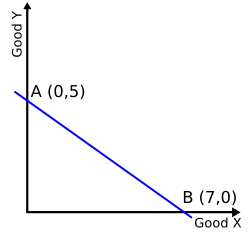
A budget constraint shows all combinations of two goods that are affordable given a fixed income and given prices. Its straight-line shape emphasizes that scarcity creates a hard limit: getting more of one good requires giving up some of the other. The intercepts represent the maximum you could buy if you spent all income on just one good. Source
time constraints (limited labour hours)
budget constraints (limited income, profits, or public revenue)
capacity constraints (limited plant, equipment, or infrastructure)
natural constraints (finite deposits, environmental limits, climate conditions)
When constraints tighten (for example, a drought reduces usable water), scarcity intensifies and allocation becomes more difficult.
Distinguishing scarcity from related ideas
Shortage is a situation where quantity demanded exceeds quantity supplied at a given price; scarcity exists even without shortages.
Poverty is low income or consumption; scarcity exists for everyone, including high-income households and nations.
Rationing is any method of allocating scarce resources (price rationing is one method, but not the only one).
Understanding these distinctions prevents confusion later when analysing markets and policy: scarcity is the permanent condition; other outcomes depend on institutions and decisions.
Practice Questions
Question 1 (3 marks) Define scarcity and explain, in one sentence, why it forces choices in an economy.
1 mark: Correct definition of scarcity (limited resources relative to wants).
1 mark: Identifies that resources have alternative uses / cannot satisfy all wants simultaneously.
1 mark: Clear link to choice/allocation (must decide how to use resources).
Question 2 (6 marks) Explain what economists mean by “resources (factors of production)” and discuss how limited resources constrain what an economy can produce.
2 marks: Defines resources/factors of production as inputs used to produce goods and services.
2 marks: Correctly identifies and describes categories (any two well-explained: land, labour, capital, entrepreneurship).
2 marks: Explains constraint mechanism: limited inputs limit productive capacity, requiring allocation among competing uses.
FAQ
No. Scarcity also applies to non-physical constraints like skilled labour, managerial time, suitable data, and institutional capacity.
Scarcity is defined at a point in time. Resources can expand, but they remain finite relative to wants, so choices still exist.
Capital is produced, but once created it becomes an input that is scarce in use (limited machine hours, limited factory space).
Yes. It reflects scarce decision-making ability: coordinating inputs, innovating, and bearing risk are limited and affect output.
Quality affects effective supply: one highly skilled worker-hour may be equivalent to several low-skilled hours, so scarcity depends on both quantity and quality.