AP Syllabus focus: ‘Because most resources are scarce, individuals and societies must make choices, which leads to trade-offs in economic decision-making.’
Scarcity is the starting point of economics: limited resources cannot satisfy unlimited wants. This constraint forces households, firms, and governments to choose among alternatives and accept trade-offs in every decision.
The logic of scarcity → choice → trade-offs
Scarcity creates a binding constraint
Resources are limited relative to what people want, so not all desired goods and services can be produced or consumed at once.
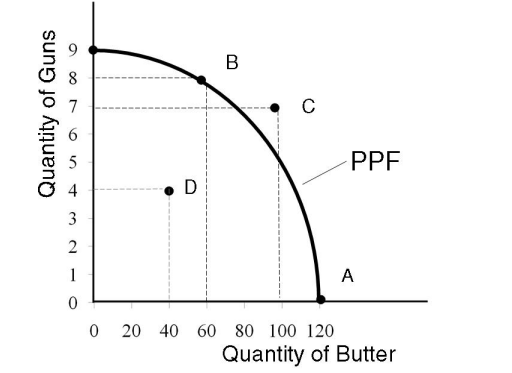
A production possibilities frontier (PPF) shows the maximum attainable combinations of two goods given limited resources and current technology. Points on the curve are productively efficient, while points outside are unattainable, making the trade-off from moving along the frontier an explicit picture of opportunity cost. Source
Scarcity: the condition that arises because limited resources are insufficient to satisfy unlimited wants, requiring choices about allocation.
Because scarcity is unavoidable, decision-makers must prioritise some goals over others rather than pursuing everything simultaneously.
Choice is unavoidable at every level
When resources are scarce, using them for one purpose prevents using them for another. Choice appears in:
Households deciding how to allocate income (spend, save, pay down debt)
Firms choosing what to produce and which technologies to use
Governments allocating budgets across programs (education, defence, healthcare)
Choice: selecting one option among alternatives when constraints prevent doing all options.
Choices are shaped by incentives, prices, and preferences, but scarcity is the underlying reason choices must be made in the first place.
Trade-offs follow directly from choice
Selecting one option means giving up another. This “giving up” is the core trade-off created by scarcity.
Trade-off: the benefit gained from one option is accompanied by the cost of forgoing another option due to scarce resources.
Trade-offs can be:
Immediate vs. future (consume now vs. save/invest for later)
Private vs. public (individual consumption vs. taxes funding public goods)
Equity vs. efficiency (redistribution goals vs. output and incentives)
Opportunity cost: the economic way to express trade-offs
Why economists emphasise the next-best alternative
Trade-offs become measurable when framed as the value of what is given up. This helps compare choices using a common yardstick.
Opportunity cost: the value of the next-best alternative that must be given up when a choice is made.
Opportunity cost is not “all alternatives forgone”; it is the best single alternative sacrificed. Scarcity makes opportunity cost unavoidable, even when no money changes hands (for example, time spent studying cannot be used for paid work or leisure).
Private vs. social trade-offs
Scarcity forces choices that may create different costs for the decision-maker and for society:
Private trade-off: borne by the individual or firm making the choice
Social trade-off: includes spillover effects on others (for example, congestion or pollution) When social trade-offs differ from private trade-offs, societies still face scarcity but may debate which choices are “best.”
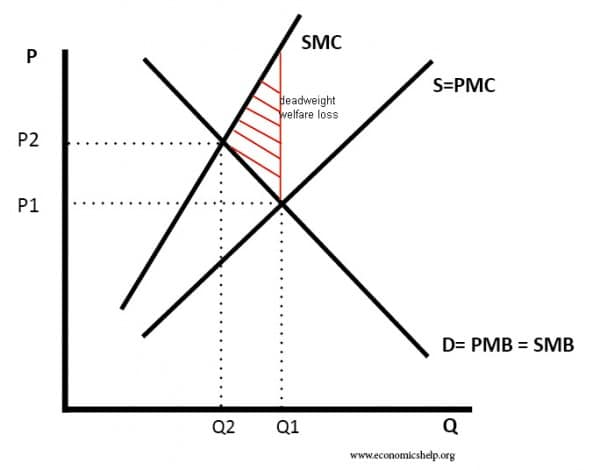
This externality diagram contrasts the private-market outcome with the socially efficient outcome when marginal social cost (SMC) differs from private marginal cost (PMC). The gap between SMC and PMC represents spillover costs borne by society, and the shaded region highlights the deadweight welfare loss from producing at the privately chosen quantity rather than the socially efficient quantity. Source
How scarcity shapes economic decision-making
Marginal thinking under scarcity
Because resources are limited, most real decisions are about “a little more” or “a little less,” not all-or-nothing. Decision-makers compare:
Marginal benefit: added gain from one more unit of an activity
Marginal cost: added trade-off from one more unit given scarcity Scarcity ensures marginal costs exist: extra resources used in one direction must be pulled away from another.
Allocation mechanisms reflect scarcity
Different systems channel scarce resources toward particular uses:
Prices and markets: willingness to pay helps ration scarce goods
Rules and queues: non-price rationing when prices are restricted or undesirable
Authority and budgets: organisations allocate via plans, priorities, and limits No mechanism eliminates scarcity; each simply determines how choices and trade-offs are made.
Policy choices are scarcity choices
Public policy debates often look like disagreements about values, but they are also responses to scarcity:
Limited tax revenue and borrowing capacity constrain spending
Expanding one programme usually requires cutting another, raising taxes, or increasing deficits
Choosing stability (lower inflation) can involve trade-offs with employment in the short run In all cases, scarcity forces choice, and choice creates trade-offs in economic decision-making.
Practice Questions
(2 marks) Explain why scarcity forces households to make choices.
1 mark: Scarcity means resources/income are limited relative to wants.
1 mark: Therefore households must choose between alternatives, implying something is forgone (a trade-off/opportunity cost).
(5 marks) Using economic reasoning, explain how scarcity leads to trade-offs for (i) a firm and (ii) a government, and identify one opportunity cost in each case.
1 mark: Firm faces scarce inputs/capacity, so cannot produce all desired outputs.
1 mark: Firm trade-off explained (more of one good/activity means less resources for another).
1 mark: Correct firm opportunity cost stated as next-best alternative forgone.
1 mark: Government faces scarce budget/resources, so must allocate among competing uses.
1 mark: Correct government opportunity cost stated as next-best alternative forgone.
FAQ
Not necessarily. Scarcity means limited relative to wants; even common goods can be scarce if demand exceeds available supply at a given time.
Technology can reduce scarcity for particular goods, but it cannot remove scarcity entirely because wants expand and time, attention, and other resources remain limited.
Because many scarce resources are not money (time, labour, land). The cost is the next-best use of those resources, even if no payment is made.
A trade-off is the necessary sacrifice due to scarcity; consequences include all outcomes (intended or unintended). Trade-offs focus on what is given up to choose.
Constraints may be similar, but preferences, information, risk tolerance, and expectations differ, so the perceived best alternative and opportunity cost can vary.