AP Syllabus focus: ‘Scarcity exists because society has limited resources but unlimited wants and needs, so every economy must make choices.’
Scarcity is the starting point for all microeconomic thinking: because resources are limited, people and societies cannot have everything they desire. This page clarifies scarcity and distinguishes needs from wants.
Scarcity as the central economic problem
What scarcity means
In economics, scarcity is not the same as rarity; it is the condition that available resources are insufficient to satisfy all desired uses at once.
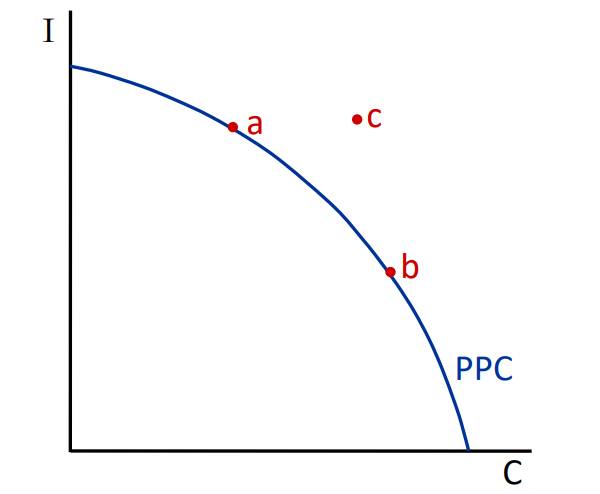
This Production Possibilities Curve (PPC) shows the boundary of what an economy can produce with current resources and technology. Points on or inside the curve are attainable, while points outside the curve are unattainable—this is scarcity in visual form. Moving along the curve illustrates that choosing more of one output requires giving up some of the other (a trade-off). Source
Scarcity: the condition in which limited resources cannot meet unlimited human wants and needs, requiring choices about how resources are used.
Scarcity exists at every level of analysis:
Individuals (limited time, income, and attention)
Firms (limited budgets, workers, and equipment)
Governments/society (limited tax revenue, land, and administrative capacity)
Why scarcity forces choice
Because resources can be used in alternative ways, using a resource for one purpose means it is not available for another. This is why the syllabus emphasises that every economy must make choices:
what is produced for consumers
which goods/services are not produced
how limited resources are directed among competing uses
Scarcity is persistent even when living standards rise, because human desires expand along with income, technology, and social expectations.
Needs and wants: distinguishing categories of desires
Needs
A need is a desire tied to basic functioning and minimal well-being. The boundary can vary by context, but needs are typically non-negotiable for survival or basic participation in society.
Need: a good or service required for basic survival or essential well-being (e.g., adequate food, shelter, basic healthcare), given a society’s circumstances.
Needs are often framed as essentials, but economics still treats them as subject to scarcity: even essential goods require limited resources to produce and distribute.
A key implication is that “needing” something does not guarantee it will be provided; allocation depends on how an economy organises production and distribution.
Wants
A want is a desire that goes beyond basic necessity. Wants can be material (products) or non-material (experiences), and they expand with changing preferences and social norms.
Want: a desire for a good or service that is not strictly necessary for basic survival, often shaped by preferences, advertising, culture, and income.
Wants are described as “unlimited” in economics because:
new products continually create new desires
preferences evolve over time
comparisons with others can increase perceived desire
there is no natural stopping point where all wants are fully satisfied
How scarcity connects needs, wants, and economic decision-making
Limited resources versus unlimited desires
The syllabus statement links two ideas:
Limited resources: there are constraints on what can be produced and provided.
Unlimited wants and needs: people can always identify additional things they would like or require.
This mismatch is what makes economics necessary: choices must be made about allocating resources among competing needs and wants.
Choices occur even when needs are prioritised
Even if a society prioritises needs, it must still choose:
which needs to address first (e.g., housing versus healthcare capacity)
the quantity and quality of need-based provision
how much to devote to needs relative to wants
Because resources are limited, meeting more of one category (often needs) reduces what is available for other uses (often wants), and vice versa.
Scarcity is about trade-offs, not just money
Scarcity applies to any constraint, not only income:
Time scarcity: hours spent studying cannot be used for work or leisure
Space scarcity: land used for housing cannot simultaneously be used for parks
Attention scarcity: consumers cannot evaluate every option perfectly
Recognising scarcity helps explain why decision-makers must prioritise and why not all desires—whether labelled needs or wants—can be fully satisfied simultaneously.
Practice Questions
(2 marks) Define scarcity and explain why it means an economy must make choices.
1 mark: Correct definition of scarcity (limited resources relative to wants/needs).
1 mark: Explains that limited resources force choices about how resources are used (cannot satisfy all desires).
(5 marks) Distinguish between needs and wants and explain how scarcity affects the satisfaction of each.
1 mark: Defines needs (essential for basic survival/well-being).
1 mark: Defines wants (non-essential desires beyond basics).
1 mark: States wants/needs are unlimited relative to resources.
1 mark: Explains scarcity forces prioritisation/allocation among competing uses.
1 mark: Explains that even needs cannot all be fully met due to limited resources, so choices must still be made.
FAQ
Needs are more bounded conceptually, but in practice “needs” can expand with social standards (e.g., internet access for schooling). Economics treats both as potentially expanding relative to resources.
Technology can reduce scarcity for particular goods by raising output, but it does not remove scarcity overall because time, land, attention, and other inputs remain limited, and desires expand.
Because both create claims on limited resources. Even if needs are morally prioritised, they still require choices about quantity, quality, and distribution.
No. Higher income changes which constraints bind, but does not remove constraints. Wealthier societies still face limits on labour time, land use, and public budgets.
Preferences shape perceived necessity. Over time, goods can shift categories due to habit, work requirements, or social expectations, even though the economic logic of scarcity remains unchanged.