AP Syllabus focus: ‘Scarcity creates constraints and trade-offs, although some resources, such as established knowledge, may be non-rival and not scarce.’
Scarcity shapes every economic decision by limiting what people and firms can do with available resources. Understanding constraints and trade-offs clarifies why choices have costs, and why some ideas behave differently from typical scarce goods.
Scarcity Creates Constraints
Scarcity means resources are limited relative to desired uses, so decision-makers face limits that prevent them from achieving all objectives at once.
Constraint: A limit on the feasible set of choices, created by scarce resources (such as time, income, inputs, or technology).
Constraints show up in many forms:
Budget constraints: limited income restricts consumption bundles.
Input constraints: limited labor hours, land, or machines restrict output.
Time constraints: limited time restricts production, consumption, and learning.
Technological constraints: current know-how limits how efficiently inputs become output.
A key implication is that constraints force prioritisation: choosing more of one option typically requires giving up some of another option.
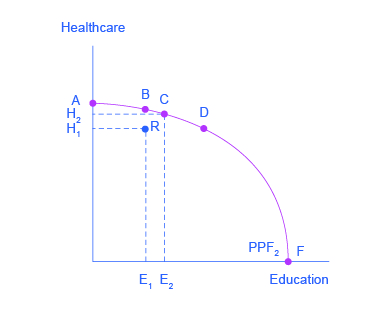
A production possibilities frontier (PPF) shows the maximum feasible combinations of two outputs given scarce resources and existing technology. Points on the curve are productively efficient, while points inside the curve represent underused resources (inefficiency). Moving along the curve makes the trade-off explicit: producing more of one good requires producing less of the other. Source
Trade-Offs and Opportunity Cost
Because constrained resources must be allocated, scarcity generates trade-offs across competing ends.
Trade-off: A situation where gaining more of one desirable outcome requires giving up some of another due to limited resources.
Trade-offs are not only about money; they include foregone time, alternative uses of inputs, and lost flexibility. In microeconomics, trade-offs are captured by opportunity cost, the value of the next-best alternative not chosen. Opportunity cost is the mechanism that connects scarcity to rational choice: even “free” actions can be costly if they use scarce time or resources.
Common places trade-offs appear:
Consumers: spending more on one good leaves less income for others.
Firms: using workers on Product A leaves fewer workers for Product B.
Society: devoting land to housing leaves less for recreation or agriculture.
When trade-offs are acknowledged, choices can be evaluated based on which option delivers the greatest net benefit given the constraint.
Non-Rival Knowledge and Why It May Not Be Scarce
Most goods are scarce because one person’s use prevents another’s use. Some resources, however, do not behave this way—especially established knowledge.
Non-rival: A characteristic of a good where one person’s consumption does not reduce the amount available for others to consume.
Established knowledge (for example, a proven formula, a software algorithm, or a scientific insight) can be shared widely without being “used up.” This matters because:
The marginal cost of an additional user can be very low (sometimes near zero), unlike for physical goods.
Knowledge can expand what is feasible by improving methods, designs, and coordination.
Scarcity may shift from the idea itself to complements needed to apply it (devices, skilled labor, data access, or infrastructure).
Even if knowledge is non-rival, it may still be limited by access (paywalls, patents, secrecy, or capacity constraints in distribution). So “not scarce” in this context usually means the knowledge itself is not depleted by use, not that it is automatically available to everyone.
How These Ideas Fit Together
Scarcity produces constraints, constraints force trade-offs, and trade-offs imply opportunity costs. Non-rival knowledge is a special case because it can loosen certain scarcity pressures: using an idea in one place need not prevent using it elsewhere. Still, many real-world decisions remain constrained by scarce complementary resources, so trade-offs persist even in knowledge-rich settings.
Practice Questions
(2 marks) Explain how scarcity leads to trade-offs for economic decision-makers.
1 mark: Defines scarcity as limited resources relative to unlimited wants/needs.
1 mark: Explains that limited resources mean choosing more of one option requires giving up another (trade-off/opportunity cost).
(5 marks) Using economic reasoning, discuss why established knowledge may be considered non-rival and how this affects scarcity, constraints, and trade-offs.
1 mark: Defines non-rival: one person’s use does not reduce availability to others.
1 mark: Identifies established knowledge as a relevant example (e.g., an idea, method, formula).
1 mark: Explains why this makes it “not scarce” in the sense of not being depleted by use.
1 mark: Links to constraints: knowledge can relax a constraint by improving productivity or feasibility.
1 mark: Links to trade-offs: trade-offs may fall for some choices, but still exist due to scarce complements (e.g., skilled labour, equipment, access).
FAQ
Access can be restricted (subscriptions, patents, secrecy), and applying knowledge often requires scarce complements.
Examples of complements:
skilled labour
hardware/software
time to learn and implement
Not necessarily. Non-rival describes consumption; a public good is typically both non-rival and non-excludable.
Knowledge can be made excludable via paywalls, licensing, or intellectual property, so it may not be a public good in practice.
Established knowledge is already created, verified, and codified, so additional users can adopt it with little additional production of the idea itself.
By contrast, creating new knowledge can require substantial scarce resources (research time, funding, expertise).
Many digital goods embed knowledge and are close to non-rival in consumption because copying/distribution can be very low cost.
However, congestion (bandwidth), platform capacity, and legal restrictions can reintroduce practical scarcity.
Using knowledge typically requires scarce inputs (time, attention, capital), so choices still involve giving up alternatives.
The opportunity cost often shifts away from the idea itself toward implementation resources and foregone alternative projects.