

AP Syllabus focus: ‘Measurements made in one reference frame can be converted to measurements in another reference frame.’
Converting measurements between reference frames lets you describe the same motion from different observers’ viewpoints. The key is being consistent about coordinate origins, positive direction, and the relative motion of the frames.
Core idea: converting the “same event” between frames
A measurement (position, displacement, velocity) depends on the reference frame you choose. Two observers can assign different numerical values while still describing the same physical motion, as long as they use a consistent conversion.
What must be specified before converting
The two frames (often labelled A and B)
Each frame’s positive direction in 1D
The relative motion of the frames (constant speed and direction)
Any offset between coordinate origins at a chosen
Frame speed (relative to another frame): the velocity of frame B’s origin as measured in frame A, including sign in the chosen 1D axis.
A frame speed is not the object’s speed; it is the “background” motion you subtract or add to translate one observer’s measurements into the other’s.
Position and displacement conversions (1D, constant frame speed)
In AP Physics 1, conversions are typically Galilean (non-relativistic): time is treated the same for both observers, and coordinates differ by a shift that grows linearly with time if the frames slide past each other.
= position measured in frame B (m)
= position measured in frame A (m)
= frame speed of B relative to A (m/s)
= time since the chosen zero (s)
= initial origin offset: B’s origin position in A at (m)
This equation encodes two ideas: (1) a fixed shift between origins (), and (2) a changing shift due to relative sliding ().
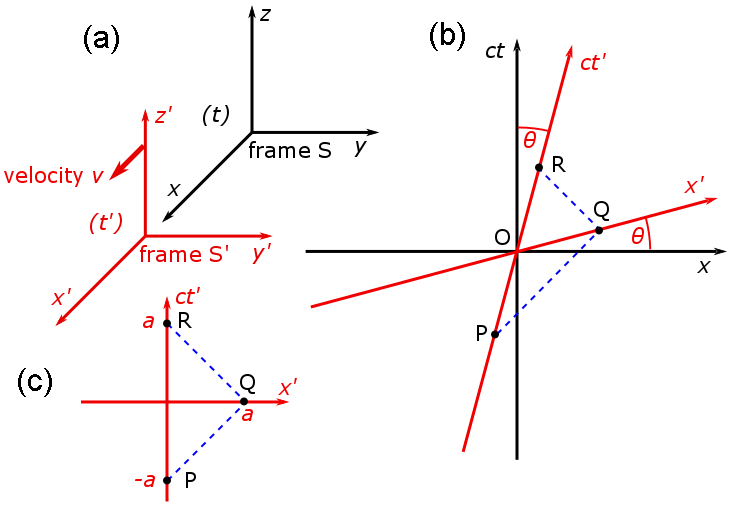
The top-left panel presents a Galilean reference-frame sketch: two coordinate systems aligned with a relative translation that grows linearly in time due to constant relative speed. Visually, the same event is located by different coordinate readouts because the origins do not coincide except at the chosen alignment time. This supports interpreting position conversion as “subtract the frame’s drift plus any initial origin offset.” Source
Displacement is often simpler than position
If you compare two events at times and , the origin offset cancels. With constant frame speed:
Convert positions if you need where something is relative to a particular origin.
Convert displacements if you only need the change in position between two times.
Velocity conversions
Velocity measurements differ between frames by the frame speed (with sign).
Conceptually: the observer in B “removes” the background motion of B relative to A.
Practical sign-check for 1D
If frame B moves in the + direction relative to A, then is positive.
If an object’s velocity in A equals the frame speed, then the object is at rest in B (its converted velocity becomes zero).
If your converted velocity flips sign unexpectedly, re-check the chosen + direction for each frame and keep it consistent.
A reliable conversion workflow (no calculation tricks)
Choose one axis direction (e.g., +x to the right) and stick to it in both frames.
Write down with a sign.
Decide whether you need:
a position conversion (needs origin offset information), or
a displacement/velocity conversion (often does not).
Check limiting cases:
If , both frames must give the same measurements.
If the object is stationary in A, then in B it should move opposite the direction that B moves relative to A.
Practice Questions
A cart moves with velocity in reference frame A. Reference frame B moves at relative to frame A along the same line. Determine the cart’s velocity in frame B.
States or uses a correct conversion consistent with Galilean frames: subtract frame speed (1 mark)
Correct substitution with signs: (1 mark)
Correct final answer with unit: (1 mark)
Frame B moves at constant speed relative to frame A. At , the origin of B is located at in frame A. A drone’s position in frame A is (SI units). Find an expression for and the drone’s position in frame B at .
Identifies the correct position conversion including origin offset: (1 mark)
Uses with correct sign (1 mark)
Substitutes and to obtain (1 mark)
Simplifies to (1 mark)
Evaluates at to get (1 mark)
FAQ
Because different observers can place $x=0$ in different locations. If the origins do not coincide at $t=0$, converting absolute position requires that initial separation.
Read the needed quantity (position or velocity) from the graph, then apply the relevant conversion. For position–time graphs, you typically adjust the line by a time-dependent shift set by $v_{B/A}$ and any initial offset.
Write a sentence like “Frame B’s origin moves in the +x direction of frame A.” Then assign $v_{B/A}$ accordingly and keep the same +x direction when interpreting all velocities and positions.
Both can be correct because speed/velocity are frame-dependent measurements. They should agree on frame-independent facts like whether two events occur at the same location in a given frame, once conversions are applied.
They break down if the frame speed changes with time (accelerating frame) or if speeds approach the speed of light (relativistic effects). In those cases, the conversion must be modified.
