

AP Syllabus focus: ‘Acceleration is the same in all inertial reference frames; unless stated otherwise, assume inertial frames and one-dimensional relative velocity.’
Motion measurements depend on the observer, so choosing a reference frame is a core modelling decision. This page sets the rules AP Physics 1 uses for inertial frames and the allowed scope of relative motion.
Inertial reference frames (what “inertial” means)
An inertial frame is one that is not accelerating; within it, free objects do not “mysteriously” speed up or turn without a real interaction.
Inertial reference frame: a reference frame in which an object with no net force moves at constant velocity (including possibly zero), so Newton’s first law holds without adding fictitious forces.
Recognising inertial vs non-inertial frames
A frame is inertial if it moves at constant velocity relative to another inertial frame (it may be moving, but not speeding up, slowing down, or rotating).
A frame is non-inertial if it accelerates or rotates.
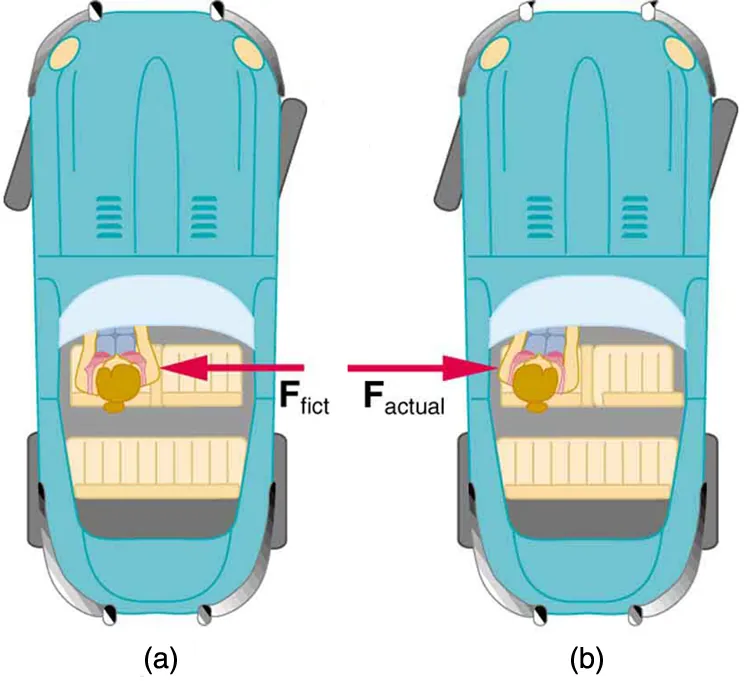
Two observers describe the same turning-car situation using different frames: the car’s accelerating frame introduces a labeled fictitious force, while the Earth (approximately inertial) frame explains the motion using only real interaction forces. The diagram makes clear that the “extra” force is an artefact of the accelerating/rotating frame choice, not a new physical interaction. Source
In non-inertial frames, you may observe apparent accelerations that are artefacts of the frame choice unless you introduce fictitious (pseudo) forces; AP Physics 1 typically avoids that complexity unless explicitly stated.
Key AP limit: acceleration agreement across inertial frames
The syllabus statement “Acceleration is the same in all inertial reference frames” is a Galilean (non-relativistic) result. If two observers are in inertial frames moving at constant relative velocity:
They can disagree about position and velocity values.
They agree on acceleration for the same object at the same moment.
This matters because Newton’s second law uses acceleration: in any inertial frame you can apply without needing extra correction terms.
Relative motion in one dimension (the permitted scope)
For AP Physics 1 Algebra, relative motion is typically restricted to a single line (one dimension). You choose a positive direction, then treat velocities and accelerations as signed quantities.
A compact way to express one-dimensional relative velocity is:
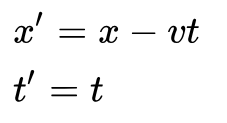
These Galilean transformation relations summarize how coordinates and time are related between two inertial frames moving at constant relative speed. Differentiating the position relation produces the velocity-offset idea used in , while a second differentiation shows why acceleration is unchanged between inertial frames under AP’s non-relativistic assumptions. Source
= velocity of object A as measured in B’s frame, in
= velocity of A measured in a chosen inertial “ground” frame, in
= velocity of B measured in the same ground frame, in
Use this with consistent sign conventions:
If right is positive, leftward velocities are negative.
Subtraction already handles “opposite directions” if signs are correct.
What changes and what doesn’t when switching inertial frames
Between inertial frames moving at constant relative velocity:
Velocity transforms by addition/subtraction (a constant offset).
Acceleration does not change: for inertial B.
Time intervals are treated as the same (non-relativistic assumption in AP Physics 1).
“Unless stated otherwise”: default assumptions you must apply
AP questions often omit frame details; the syllabus instruction sets defaults:
Assume the observer’s frame is inertial unless the problem explicitly describes accelerating/rotating motion of the frame.
Assume one-dimensional relative motion unless motion in two directions is clearly required.
Treat the Earth/ground frame as inertial for typical lab-scale problems (small errors from Earth’s rotation are ignored).
Practice Questions
Q1 (1–3 marks) A train moves east at relative to the ground. A passenger walks west at relative to the train. Determine the passenger’s velocity relative to the ground.
Uses relative-velocity relationship (e.g. ) (1 mark)
Substitutes with correct signs (1 mark)
Correct final answer: (east) (1 mark)
Q2 (4–6 marks) Observer B is in a car moving at constant velocity on a straight road. Object A moves along the same line. In the ground frame, A has velocity and acceleration .
(a) State whether B’s frame is inertial and justify.
(b) Write an expression for in terms of and .
(c) Determine in terms of , and state the AP Physics 1 principle used.
(a) States inertial because car velocity is constant (no acceleration) (1 mark)
(a) Justification linked to Newton’s first law / no fictitious forces needed (1 mark)
(b) with correct sign structure (1 mark)
(c) (1 mark)
(c) Cites principle: acceleration is the same in all inertial reference frames (1 mark)
FAQ
Velocities differ by a constant offset equal to the relative frame speed.
Because acceleration is the rate of change of velocity, subtracting a constant does not change the rate of change, so accelerations match.
Look for language indicating changing speed or direction of the frame itself:
“speeding up”, “slowing down”
“turning”, “curving”, “rotating”
“starting”, “stopping”
Any of these implies acceleration of the frame, so it is non-inertial.
You may predict incorrect causes for motion (e.g. an object appears to accelerate with no net force).
To make Newton’s laws work in a non-inertial frame, you must introduce fictitious forces; AP Physics 1 generally avoids this unless explicitly required.
Nearly always for AP Physics 1 contexts (carts, cars, elevators at constant speed), the ground is treated as inertial.
Exceptions would need to be clearly stated (e.g. accelerating reference frame analysis).
It limits transformations to signed numbers rather than vectors in 2D.
This reduces relative motion to simple addition/subtraction along a line, avoiding component methods and angle reasoning unless a problem explicitly demands them.
