

AP Syllabus focus: 'Thermal processes spontaneously transfer energy from higher-temperature systems to lower-temperature systems.'
This principle gives thermodynamics a preferred direction: when systems at different temperatures interact, thermal energy naturally moves in the way that reduces the temperature difference between them.
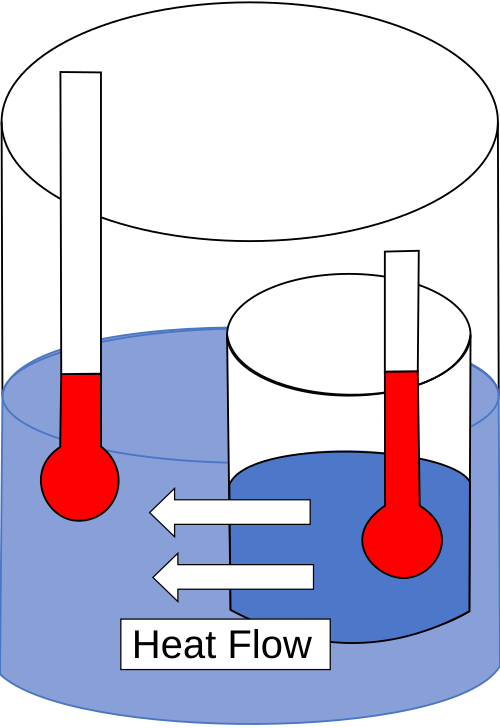
A labeled schematic showing heat flowing from a hot region to a cold region. The arrow emphasizes that the spontaneous net transfer is from higher temperature to lower temperature, consistent with the thermodynamic “preferred direction.” Source
Core idea
If two systems are able to exchange energy by a thermal process, the hotter system transfers energy to the colder system without needing any outside push. This is what makes a cup of coffee cool down in a room or an ice cube warm up in water. The direction is not arbitrary. It is set by the systems’ temperatures.
Spontaneous thermal energy transfer: Energy transfer by a thermal process that occurs naturally from a higher-temperature system to a lower-temperature system, without external intervention.
This idea is about direction, not speed. Energy may transfer quickly or slowly depending on the situation, but the natural direction remains the same: from higher temperature to lower temperature.
Why temperature determines the direction
Temperature tells us which system is thermally “hotter” and which is thermally “colder.” A higher temperature means the system is in a state that tends to give up thermal energy to a lower-temperature system. A lower temperature means the system tends to gain thermal energy from a higher-temperature system.
The important comparison is:
which system has the higher temperature
which system has the lower temperature
whether the systems are able to exchange energy thermally
The direction does not depend simply on which object is larger, heavier, or contains more total energy. A large cooler object can still gain energy from a small hotter object. The spontaneous direction is always determined by the temperature difference between the interacting systems.
The same rule applies whether the systems are solids, liquids, gases, or mixtures. The labels hotter and colder come from the temperature comparison alone.
Spontaneous means no outside energy input
In physics, spontaneous means a process happens on its own under the given conditions. No engine, battery, or other external energy source is required to make the transfer occur in that direction.
That is why everyday heating and cooling have a consistent pattern:
a warm object in a cool room cools down
a cold object in a warm room warms up
a system does not naturally become hotter than its surroundings by thermal transfer alone
If energy is observed moving from a lower-temperature system to a higher-temperature system, that transfer is not spontaneous. Some external mechanism must be involved to make it happen.
What this rule does and does not tell you
This rule tells you where thermal energy goes naturally, but it does not by itself tell you exactly how much energy transfers in a certain time. Two systems with a very small temperature difference and two systems with a very large temperature difference both follow the same directional rule.
It also does not say that temperatures become equal instantly. Real systems usually change over time, so direction is identified first, and later the temperatures gradually shift. Whenever a temperature difference remains, the spontaneous direction remains unchanged. This is true for objects in direct contact and for systems that can still exchange thermal energy across space.
Net transfer and the approach to equal temperatures
At the microscopic level, energy exchange is not perfectly one-way at every instant.
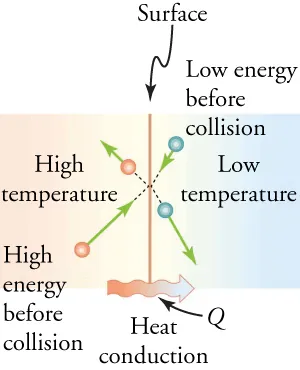
A particle-level diagram of collisions across a hot–cold boundary, where faster (higher kinetic energy) particles on the hot side transfer energy to slower particles on the cold side. It links the macroscopic statement “net thermal energy transfer is from hot to cold” to a microscopic model of kinetic-energy exchange. Source
However, when many interactions are considered together, the net thermal energy transfer is from the higher-temperature system to the lower-temperature system.
This distinction matters. Net transfer means the overall balance of energy movement. Even if tiny amounts of energy move in both directions during countless microscopic interactions, the greater overall flow is from hot to cold as long as a temperature difference exists.
As energy is transferred:
the higher-temperature system loses thermal energy
the lower-temperature system gains thermal energy
the temperature difference becomes smaller
Eventually, the systems can reach the same temperature.
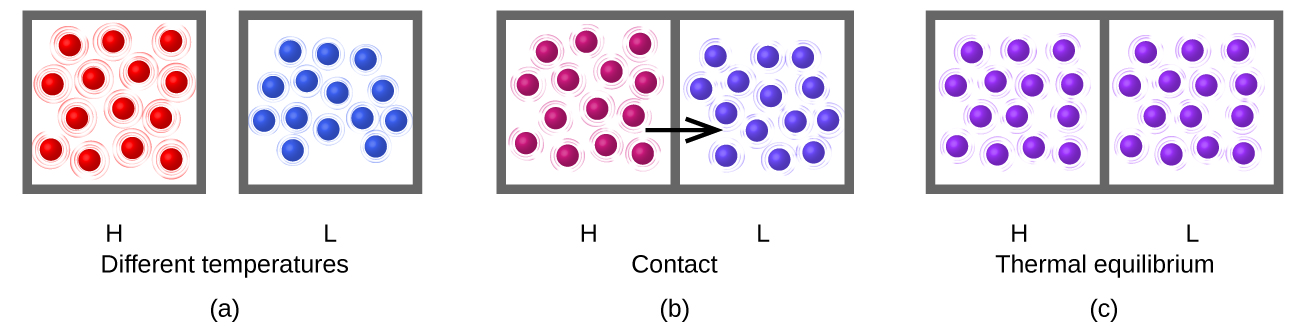
A three-stage model: two systems start at different temperatures, are placed in contact so energy transfers from the hotter system to the cooler system, and finally reach thermal equilibrium. The final panel illustrates that equal temperatures imply no net thermal energy transfer, even though microscopic motion continues. Source
Thermal equilibrium: A state in which interacting systems have the same temperature, so there is no net thermal energy transfer between them.
At thermal equilibrium, thermal interactions can still occur at the microscopic level, but there is no overall preferred direction of energy transfer between the systems.
How to reason through questions on this topic
For AP Physics 2 Algebra, the most useful habit is to identify the two systems and compare their temperatures before describing anything else. Once the higher-temperature and lower-temperature systems are identified, the direction of spontaneous thermal energy transfer follows immediately.
A good reasoning pattern is:
identify the systems in thermal interaction
compare their initial temperatures
state that energy transfers spontaneously from the higher-temperature system to the lower-temperature system
describe how that transfer reduces the temperature difference
Be careful with language. Physically, energy is what is transferred. “Cold” is not a substance that flows from one object to another. Saying that an object “gets cold” only means it loses thermal energy to something at a lower temperature.
Common misconceptions
A frequent mistake is to assume that the colder object “pulls in coldness.” The correct description is that the hotter object transfers energy away, while the colder object gains that energy.
Another common mistake is to think that the direction depends on what material is involved. Different materials may change the rate of thermal transfer, but not the spontaneous direction for a given pair of temperatures.
A third mistake is to think that once two systems interact, the final outcome is unpredictable. For this subtopic, the prediction is very clear: spontaneous thermal energy transfer acts to reduce temperature differences, not increase them.
Practice Questions
A metal spoon at 70°C is placed in a cup of tea at 20°C. State the direction of spontaneous thermal energy transfer and explain why.
1 mark: States that thermal energy transfers from the spoon to the tea.
1 mark: Explains that spontaneous thermal energy transfer goes from the higher-temperature system to the lower-temperature system.
Two objects, A and B, are placed in thermal contact. Object A is initially at 80°C and object B is initially at 30°C.
(a) State the direction of spontaneous thermal energy transfer.
(b) Describe what happens to the temperature of each object over time.
(c) State what happens to the net thermal energy transfer when both objects reach the same temperature.
1 mark: States that thermal energy transfers from object A to object B.
1 mark: States that object A loses thermal energy or cools down.
1 mark: States that object B gains thermal energy or warms up.
1 mark: States that the temperature difference decreases over time.
1 mark: States that when both objects reach the same temperature, there is no net thermal energy transfer.
FAQ
The surfaces may touch first, but the entire objects usually do not reach the same temperature instantly.
As long as any temperature difference remains between regions that can interact thermally, net energy transfer continues in the hot-to-cold direction.
Yes. If one part of an object is warmer than another part, thermal energy can transfer internally from the warmer region to the cooler region.
So the hot-to-cold rule applies not only between separate systems, but also between different regions of the same system.
That process is not spontaneous. A refrigerator uses external energy, usually electrical energy, to run a compressor.
The added work allows thermal energy to be moved from the colder interior to the warmer surroundings, which would not happen by thermal transfer alone.
Insulation affects how easily thermal energy moves, so it changes the rate of transfer.
But if one side is still at a higher temperature than the other, the spontaneous direction remains the same: net transfer is still from the higher-temperature side to the lower-temperature side.
Yes. A very small temperature difference still gives a preferred net direction of transfer from higher temperature to lower temperature.
In practice, the transfer may be very slow, so it can be harder to measure, but the thermodynamic direction does not reverse just because the difference is small.
