

AP Syllabus focus: 'Charging typically transfers electrons to or from a system. Net charge remains constant unless charge is transferred. Grounding connects a charged system to a larger, approximately neutral system.'
This subtopic explains how objects become charged by electron transfer, why total charge is conserved, and how grounding lets excess charge move between a small object and a much larger neutral reservoir.
Electron Transfer and Net Charge
In ordinary charging situations, electrons are the particles that usually move from one object to another. Electrons in atoms can sometimes be transferred or shared, while protons remain tightly bound inside atomic nuclei. When electrons move, the object’s net charge changes.
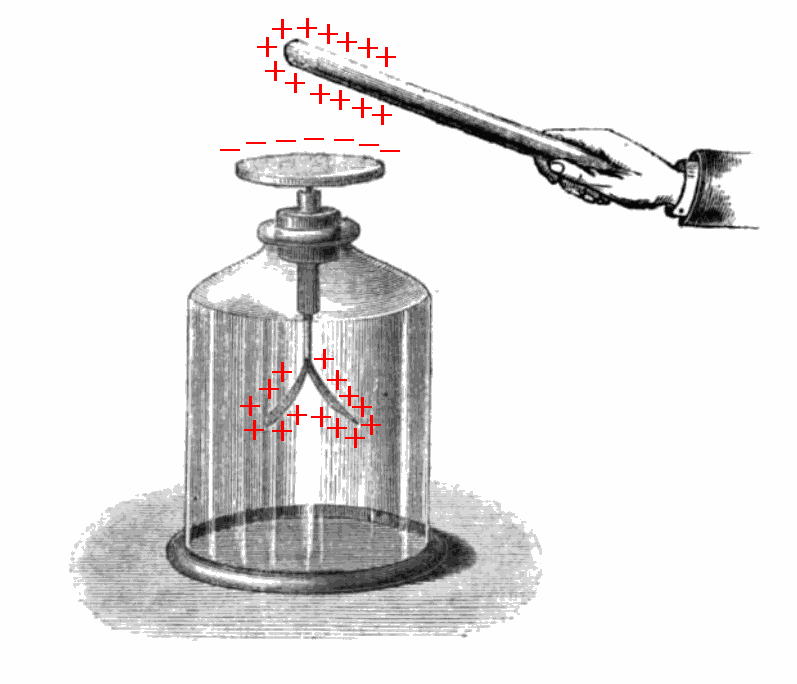
Gold-leaf electroscope induction diagram: a nearby charged rod causes mobile electrons in the electroscope to redistribute, leaving opposite signs on different parts of the conductor. The labeled +/− regions make clear that the electroscope can show separation of charge even before any charge is added or removed from the overall system. Source
Net charge: The overall charge of an object or system, found by combining all positive and negative charge present.
A neutral object is not empty of charge. Instead, it has equal amounts of positive and negative charge. If the object gains extra electrons, it becomes negatively charged. If electrons are removed, it becomes positively charged. This language is important because it connects the sign of the charge directly to electron transfer.
Why electrons are transferred
Electrons are much easier to move than protons in ordinary materials.
Charging changes the balance of charge already present in matter.
A negative net charge means an excess of electrons.
A positive net charge means a deficit of electrons.
A common mistake is to say that positive charge “moves” in the same way electrons do during everyday charging. For this course, the safer explanation is usually that electrons were transferred away, leaving an electron deficit behind.
Conservation of Electric Charge
The key accounting rule is conservation of charge. If one part of a system becomes more negative, some other part must become equally more positive, or charge must have entered from outside the system.
Charge conservation: The principle that the total electric charge of an isolated system remains constant.
This means an individual object can change its charge, but the total charge of the larger isolated system does not change unless charge crosses the system boundary. In physics reasoning, the word system matters. If two objects exchange electrons, each object may change charge, but the total charge of the two-object system stays the same.
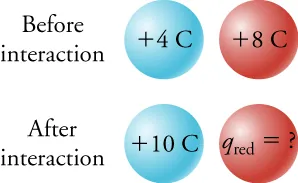
Two-sphere “before and after interaction” diagram illustrating conservation of charge at the system level. The charges on the individual spheres change after interaction, but the figure is set up so the total charge before equals the total charge after, emphasizing conservation as an accounting rule. Source
Charge conservation is an accounting idea, not a statement that nothing changes. Charge can move, separate, or spread out differently. What cannot happen is the spontaneous creation or destruction of net charge inside an isolated system.
Tracking charge in a process
Identify which objects belong to the system.
Compare the total charge before and after the interaction.
If one object gains electrons, another object or the surroundings must lose electrons.
If charge appears to change for a chosen object, look for where the transferred charge came from or went.
This way of thinking prevents many sign errors. Saying “the object became negatively charged” should immediately lead to “electrons were transferred to it.”
Grounding
Grounding is a process in which a charged object is connected to a much larger, approximately neutral body, usually Earth. Because that larger body is enormous compared with the object, it can supply or accept electrons with little noticeable change to its own overall state.
Grounding: Connecting an object to a larger, approximately neutral system so electrons can be transferred between them.
A grounding connection provides a path for electron transfer.
If an object has excess electrons, some electrons can flow from the object to ground. If an object has too few electrons, electrons can flow from ground to the object. In either case, the object’s charge changes because electrons moved through the connection.
Grounding does not destroy charge. Instead, it transfers charge between the smaller object and the larger neutral system. The total charge of the combined object-plus-ground system remains constant, so charge conservation still holds exactly.
Earth is often treated as an almost unlimited charge reservoir in introductory physics. That model is useful because the amount of charge transferred in typical problems is tiny compared with the total charge associated with Earth. As a result, the grounded object may change noticeably while Earth remains approximately neutral.
What grounding can and cannot do
Grounding gives electrons a path to move.
Grounding can reduce or remove the net charge on a small object.
Grounding does not create charge or make charge disappear.
Grounding is most useful when the larger connected system is much bigger than the charged object.
A grounded object is not automatically “special” unless charge can actually move through the connection. The key idea is always transfer of electrons between the object and the larger neutral system.
Common Reasoning Patterns
When analyzing problems in this subtopic, ask a simple question: where did the electrons go? That question usually reveals the correct sign of the final charge and keeps the reasoning tied to physical transfer rather than memorized rules.
Another helpful habit is to separate the charge of one object from the charge of the full system. A small object may become charged or neutralized, while the total charge of the broader system remains unchanged. This is exactly what conservation of charge predicts.
Frequent misconceptions
Neutral does not mean no charges are present.
Positive charging usually means electrons were removed.
Negative charging usually means electrons were added.
Ground is not a place where charge vanishes.
A change in one object’s charge must be matched by transferred charge elsewhere.
Practice Questions
A neutral metal sphere gains electrons from another object. What is the sign of the sphere’s final charge, and why?
1 mark: States that the sphere becomes negatively charged.
1 mark: Explains that gaining electrons gives the sphere an excess of negative charge.
A small metal sphere is initially positively charged. It is then connected to Earth by a conducting wire and later disconnected.
(a) Describe the direction of electron flow while the sphere is connected to Earth.
(b) Explain why the sphere can become neutral after grounding.
(c) Use conservation of charge to explain why this process does not violate charge conservation.
(d) Explain why Earth is still treated as approximately neutral after the process.
1 mark: Electrons flow from Earth to the positively charged sphere.
1 mark: The sphere has an electron deficit, so incoming electrons reduce its positive net charge.
1 mark: The sphere can become neutral if enough electrons are transferred to balance its positive and negative charges.
1 mark: Total charge of the combined sphere-Earth system remains constant; charge is transferred, not created or destroyed.
1 mark: Earth is so large that the transferred charge is negligible compared with its total charge, so it remains approximately neutral.
FAQ
Protons are locked inside atomic nuclei, and nuclei are strongly bound within matter.
Removing or transferring protons would require nuclear-scale changes, not the small interactions involved in everyday static electricity. Electrons are much less tightly confined, so they are the charges that usually move.
Yes. Real grounding is sometimes imperfect.
Possible reasons include:
poor electrical contact
a very short grounding time
insulating materials interrupting the path
nearby charged objects affecting electron flow
In idealized AP Physics problems, grounding often neutralizes the object, but real systems may retain a small residual charge.
Grounding connects an object to Earth or another very large neutral reservoir.
Bonding connects two objects to each other so charge can redistribute between them.
Bonding can make connected objects reach the same electrical state relative to each other, while grounding specifically involves charge exchange with a much larger system.
If the charge difference is large enough, electrons can move suddenly rather than gradually.
That rapid transfer can ionize nearby air, creating a brief conductive path. The visible spark and snapping sound are signs of a fast discharge, not of charge being destroyed.
A small resistance slows the rate of electron transfer.
This helps by:
preventing sudden sparks
protecting sensitive electronics from rapid discharge
improving user safety by limiting current
So the goal is still grounding, but in a controlled way rather than an instant discharge.
