

AP Syllabus focus: 'Two systems are in thermal contact when they can transfer energy by thermal processes.'
Thermal contact describes when two systems are able to exchange energy because a thermal pathway exists between them. This idea is foundational for understanding energy transfer between systems in thermodynamics.
What Thermal Contact Means
When two systems are in thermal contact, there is a physical way for energy to move between them because of a temperature-related interaction. The key idea is ability, not necessarily an immediately observed change.
Thermal contact: A condition in which two systems can transfer energy between them by a thermal process.
In thermodynamics, thermal contact is determined by the nature of the boundary between systems.
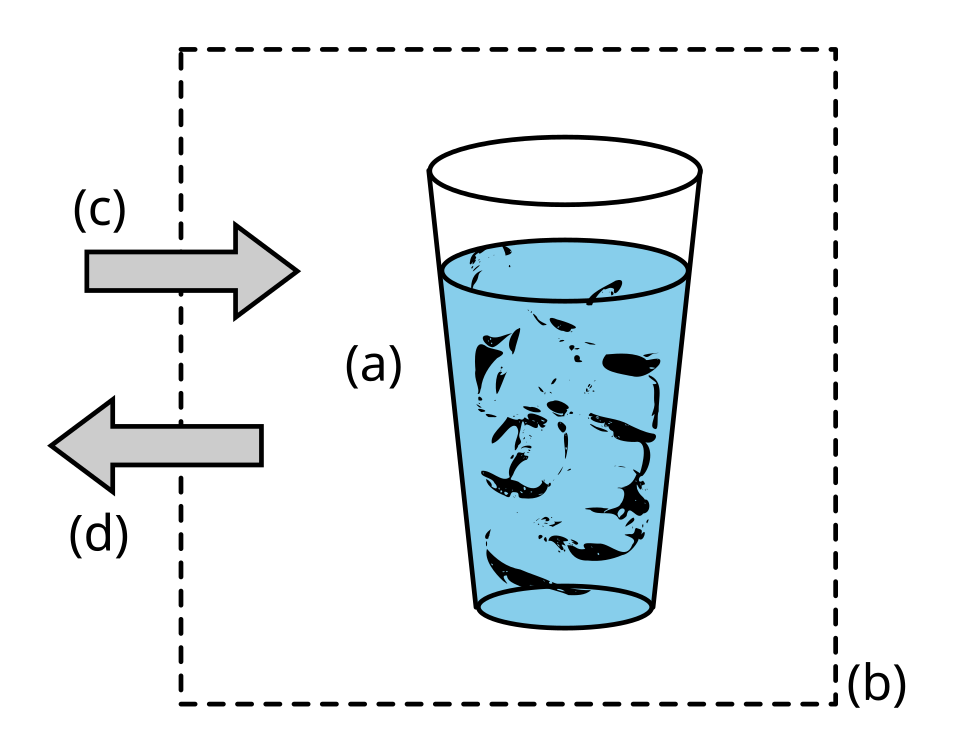
A minimalist diagram of a thermodynamic system with a marked boundary and arrows indicating transfer across that boundary. It reinforces that ‘thermal contact’ depends on boundary permeability to energy transfer, not on whether the systems are merged into one object. This is especially useful for explaining cases where mass transfer is blocked but heat transfer is allowed. Source
If that boundary allows thermal energy to pass, the systems are in thermal contact. If the boundary blocks thermal energy transfer, they are not.
Thermal contact can exist whether the systems are solids, liquids, gases, or combinations of these. The important question is not what the systems are made of, but whether energy can cross the boundary by a thermal process.
System and Boundary
In AP Physics 2, you usually start by choosing the system you want to analyze and identifying what lies outside it.
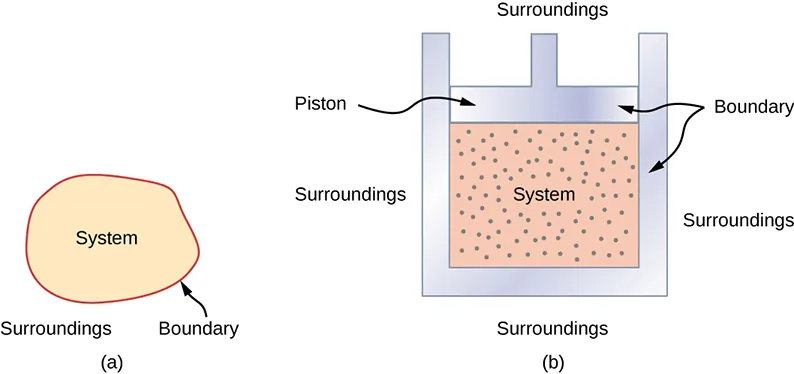
A thermodynamic “system–boundary–surroundings” diagram, showing that the boundary is the dividing surface you choose for analysis. It helps students see that energy transfer (including heat) is defined by what crosses the boundary, not by whether the system is a separate object. This supports consistent reasoning when deciding whether two regions are in thermal contact. Source
System: The collection of matter or region of space chosen for analysis.
Everything outside the chosen system is part of the surroundings. Thermal contact describes a relationship between the system and some part of the surroundings, or between two systems treated separately.
A boundary can be real or imaginary. For example, the wall of a container is a real boundary, while an imaginary surface drawn around a region of gas is a model boundary. In either case, the question stays the same: can energy pass through that boundary by a thermal process?
This is why a sealed container can still be in thermal contact with its environment. Matter may not cross the wall, yet energy can.
How to Identify Thermal Contact
To decide whether two systems are in thermal contact, ask:
Is there a thermal pathway connecting them?
Does the material between them allow energy transfer?
Is there insulation designed to prevent thermal transfer?
Does the problem statement say the systems are thermally isolated?
If the answer shows energy can pass thermally, then thermal contact exists.
Direct touching is common, but it is not the only possibility. Two systems can be in thermal contact through a wall, divider, or container if that barrier permits energy transfer. A gas and a metal piston, water and a glass beaker, or a solid block and a metal plate can all be in thermal contact.
On the other hand, if an ideal insulating layer separates systems, AP Physics usually treats thermal transfer as impossible across that boundary. In that model, the systems are not in thermal contact.
The phrase thermal contact is therefore about the properties of the interface between systems. It tells you what kind of interaction is allowed in the model before you analyze any change in temperature.
What Thermal Contact Does Not Mean
Thermal contact does not mean the systems are the same object. Distinct systems can remain separate while still exchanging energy.
It also does not mean mass must move from one system to the other. A sealed bottle in water is a useful model: the liquid inside and the water outside can be in thermal contact even though the liquids do not mix.
Thermal contact is also different from mechanical contact. Two objects can push on each other without being treated as thermally connected, especially if the model says the interface is insulating. Likewise, an object can be in electrical contact without that being the main issue in a thermal analysis.
Most importantly, thermal contact describes what is possible, not how fast transfer happens. Some boundaries allow rapid thermal transfer, while others allow it slowly. Both cases still count as thermal contact if energy can cross by a thermal process.
Idealizations in AP Physics 2
AP Physics 2 often uses simplified models. A container wall may be treated as perfectly conducting or perfectly insulating even though real materials are neither.
These idealizations help you decide quickly whether to include thermal transfer in an energy analysis. If a problem says a system is insulated, assume no thermal contact with the surroundings unless the problem states otherwise. If a wall is thin and conducting, assume thermal contact is present.
Be careful with everyday intuition. A boundary that looks “closed” does not automatically prevent thermal contact, and a boundary that allows contact forces does not automatically imply thermal contact. Always rely on the model described in the problem, not only on appearance.
Common AP Reasoning Patterns
When reading a problem, strong reasoning usually includes the following:
Name the two systems clearly.
Identify the boundary between them.
State whether the boundary allows thermal energy transfer.
Distinguish transfer of energy from transfer of matter.
Use the phrase in thermal contact only when the model allows thermal processes across the boundary.
This type of language makes thermodynamics arguments much clearer and prevents confusion when problems involve containers, insulating materials, or multiple interacting systems.
Practice Questions
A sample of gas is sealed inside a rigid metal cylinder that is placed in warm water. The gas cannot leave the cylinder. Is the gas in thermal contact with the water? Explain.
1 mark: States that the gas and water are in thermal contact.
1 mark: Explains that energy can transfer through the metal wall by a thermal process even though the gas remains sealed inside.
A student analyzes the following pairs of systems:
A. Soup and the metal pot holding it
B. Gas inside a sealed glass flask and the air outside the flask
C. Ice inside an ideal foam cooler and the room air
D. Juice inside a sealed aluminum can immersed in water
For each pair, state whether the systems are in thermal contact and justify your answer.
1 mark: A is in thermal contact because energy can transfer between the soup and the pot at their boundary.
1 mark: B is in thermal contact because energy can pass through the glass flask even though matter does not cross.
1 mark: C is not in thermal contact because the ideal foam cooler is modeled as insulating and blocks thermal transfer.
1 mark: D is in thermal contact because energy can transfer through the aluminum can wall.
1 mark: Gives the general principle that thermal contact depends on whether the boundary allows thermal energy transfer, not on whether the systems mix or exchange matter.
FAQ
A diathermal wall is a boundary that allows thermal energy to pass through it.
It may still block matter from crossing, so two systems can be separated physically while remaining in thermal contact. In thermodynamics, this idea is useful because it separates “energy can cross” from “matter can cross.”
Yes. Physics models often divide one object into smaller regions and treat those regions as separate systems.
This is helpful when the object is not at one uniform temperature. Each region can be analyzed as a system, and adjacent regions can be described as being in thermal contact across an internal boundary chosen by the model.
Yes. A thermometer must be able to exchange energy thermally with the system, or it cannot respond to the system’s temperature.
In practice, good measurement also requires the thermometer to disturb the system as little as possible. That is why small thermometers or sensors are often preferred: they can come into thermal contact without greatly changing the system being measured.
Yes, if the boundary still allows thermal energy transfer.
A small area usually affects how noticeable or how fast the transfer is, not whether thermal contact exists at all. In idealized AP models, the existence of thermal contact and the rate of transfer are treated as separate questions.
Experimental setups often reduce thermal contact by limiting pathways for energy transfer.
Common methods include:
using foam or vacuum insulation
minimizing the area touching supports
suspending objects with thin strings or low-conductivity mounts
adding reflective surfaces to reduce transfer across gaps
These methods do not create perfect isolation, but they can make outside thermal effects small enough to ignore in a model.
