

AP Syllabus focus: 'Heating transfers energy into a system, while cooling transfers energy out of a system by thermal processes.'
Heating and cooling are ways energy crosses a system boundary. In AP Physics 2, the key idea is to identify the system, the direction of transfer, and the physical meaning of that transfer.
Identifying the system
In thermodynamics, the choice of system matters because heating and cooling are always described from the perspective of whatever object or collection of matter you decide to study.
System: The object or collection of objects being studied, separated conceptually from the surroundings.
The boundary of the system may be a real surface, like the wall of a container, or an imaginary one chosen for analysis. What matters is whether energy crosses that boundary.
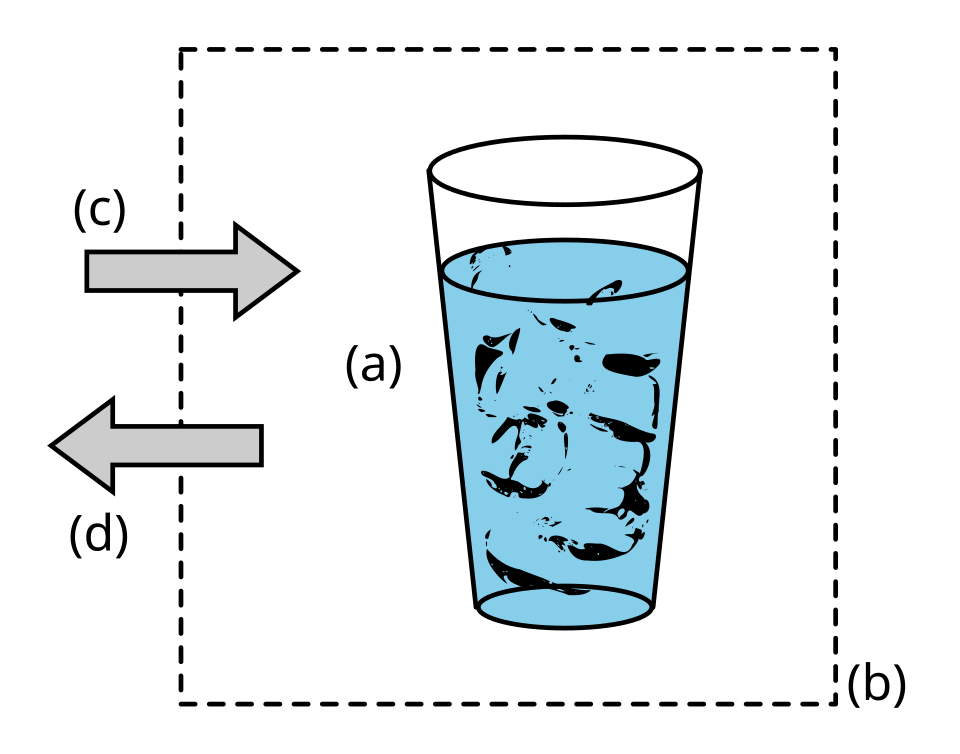
Diagram of a thermodynamic system with an explicit system boundary and arrows indicating transfer into and out of the system. This reinforces that heating/cooling are not “things inside” an object, but labels for energy transfer across a boundary whose direction depends on the system definition. Source
If the system gains energy from its surroundings, that transfer is described differently than if the system loses energy. The same physical interaction can therefore look like heating for one system and cooling for another.
Direction of energy transfer
Physicists use heating and cooling to describe the direction of energy transfer, not simply whether something feels hot or cold.
Heating and cooling: Heating is energy transferred into a system by thermal processes. Cooling is energy transferred out of a system by thermal processes.
This wording is important. A warmer object does not “contain heating,” and a cooler object does not “contain cooling.” Instead, heating and cooling happen only while energy is crossing the boundary between a system and its surroundings.
When a system receives energy this way, the system is being heated. When energy leaves the system this way, the system is being cooled. From the surroundings’ point of view, the description reverses.
What makes a process thermal
A thermal process is the kind of process responsible for this transfer of energy.
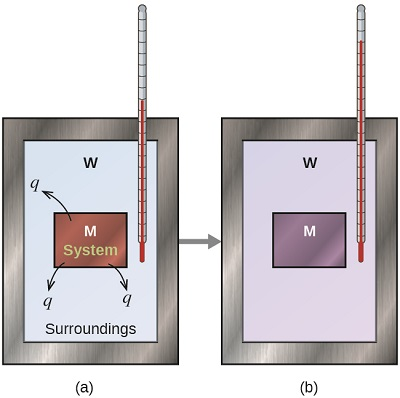
Calorimetry schematic showing heat flowing from a hotter object to a cooler one until thermal equilibrium is reached. The figure explicitly labels which part is treated as the system versus the surroundings, making the sign/direction idea concrete and helping students separate “direction of transfer” from “temperature change.” Source
Thermal process: A process in which energy is transferred between a system and its surroundings because of a temperature difference.
This means heating and cooling are tied to temperature differences between systems or between a system and its environment.
If there is no temperature difference, there is no net heating or cooling by thermal processes.
Not every energy transfer is heating
A system can gain or lose energy in more than one way, so it is important not to label every energy change as heating or cooling. The AP definition is narrower than everyday language. Heating and cooling refer only to energy transfer caused by a thermal process.
For example, a system might gain energy because an external force compresses it, or it might lose energy because it pushes on its surroundings. In those cases, energy crosses the system boundary, but the transfer is not called heating or cooling unless the transfer occurs because of a temperature difference. This distinction keeps thermodynamic language precise.
Heating and cooling are processes, not stored quantities
A major idea in thermodynamics is that temperature describes the state of a system, while heating and cooling describe what is happening during an interaction. Temperature is a property a system has at a given moment. Heating and cooling are not properties the system keeps; they are descriptions of energy transfer taking place.
This distinction helps avoid a common mistake. Students often say that an object “has a lot of heat.” A more precise statement is that an object may have a high temperature, or that energy is being transferred into or out of it by a thermal process. In AP Physics 2, careful wording matters because it keeps process ideas separate from state ideas.
What changes when heating or cooling occurs
When energy enters a system by heating, the system’s microscopic energy changes. The particles in the system may move more vigorously, or the energy associated with their arrangement may change. When energy leaves by cooling, the microscopic energy of the system decreases.
In many situations, heating raises temperature and cooling lowers temperature. However, temperature change is not the definition of heating or cooling. The definition depends only on the direction of energy transfer. That is why you should identify the system first, then determine whether energy is entering or leaving it.
A useful way to think about this is to separate cause from effect:
Heating and cooling describe the cause: energy transfer by a thermal process.
A temperature increase, temperature decrease, or some other change is the effect the system may show.
Perspective matters
Because the system can be chosen in different ways, the label “heating” or “cooling” depends on perspective. Suppose two objects interact thermally. If you choose the first object as the system, energy might be leaving it, so that object is cooling. If you choose the second object as the system, energy is entering it, so that object is heating.
This does not mean the physics is changing. Only the bookkeeping changes. The transfer itself is one exchange of energy, but its description depends on which side of the boundary you call the system.
Common misconceptions to avoid
Several misconceptions can interfere with clear reasoning about this topic:
Heating is not a material substance. Nothing called “heating” is poured into a system.
Cooling is not the addition of coldness. Cooling simply means energy leaves the system by a thermal process.
A hotter-feeling object is not automatically heating everything around it. You must compare temperatures and specify the system.
A temperature change is not the same thing as heating or cooling. Temperature is a state property; heating and cooling are transfer processes.
The words depend on the chosen system. One object’s cooling is another object’s heating.
Clear thermodynamic language starts with three questions: What is the system? Is energy crossing the boundary? If so, is it entering or leaving by a thermal process? Once those questions are answered, the description of heating or cooling becomes straightforward.
Practice Questions
A sample of gas in a sealed container is chosen as the system. The container is placed in a warmer environment, and energy is transferred from the environment to the gas by thermal processes.
State whether the gas is being heated or cooled, and state the direction of the energy transfer. [2 marks]
1 mark: States that the gas is being heated.
1 mark: States that energy is transferred into the system, or from the surroundings to the gas.
A metal sphere is placed in contact with a solid block. Initially, the sphere is at and the block is at .
(a) If the sphere is chosen as the system, state whether it is being heated or cooled. [1 mark]
(b) If the block is chosen as the system, state whether it is being heated or cooled. [1 mark]
(c) Explain why the same interaction can be described using two different terms. [2 marks]
(d) A student says, “The sphere has more heat than the block.” State whether this statement is correct and justify your answer. [1 mark]
(a) 1 mark: Sphere is being cooled.
(b) 1 mark: Block is being heated.
(c) 1 mark: The description depends on which object is chosen as the system.
(c) 1 mark: Energy leaves the sphere and enters the block during the same thermal interaction.
(d) 1 mark: Statement is incorrect; heating is energy transfer by a thermal process, not a quantity stored in an object. A correct idea is that the sphere has a higher temperature and transfers energy to the block.
FAQ
The symbol $Q$ is often used for energy transferred by thermal processes. It does not mean a system stores “heat” as a substance.
In many sign conventions, $Q>0$ means energy is transferred into the system and $Q<0$ means energy is transferred out. Always check the convention being used in your class or problem.
Yes. During evaporation, some of the fastest-moving particles escape from the liquid surface and carry energy away with them.
That leaves the remaining liquid with a lower average particle energy, so the liquid cools. This is why sweating can cool your skin even when nothing cold is touching you.
Your skin loses energy to both materials if they are cooler than your body. Metal usually makes that transfer happen much faster than wood does.
Because energy leaves your hand more quickly, metal produces a stronger sensation of cooling even when both objects start at the same temperature.
Yes. A system can gain energy by one thermal interaction and lose energy by another at the same time.
What matters physically is the net transfer. If energy enters faster than it leaves, the system is heated overall. If energy leaves faster than it enters, the system is cooled overall.
A thermometer is also a physical system. It must itself be heated or cooled by thermal processes before its reading matches the object being measured.
That takes time because energy transfer is not instantaneous. A stable reading usually means the thermometer’s temperature has adjusted enough that there is little or no further net thermal transfer affecting it.
