

AP Syllabus focus: 'Energy can transfer between systems at different temperatures through conduction, convection, and radiation.'
Thermal energy does not move in just one way. In AP Physics 2, conduction, convection, and radiation describe the main mechanisms by which systems at different temperatures exchange energy.
Why different mechanisms exist
Thermal energy transfer depends on how energy moves between particles or through space. The mechanism that matters most depends on the state of matter, whether the material can flow, and whether electromagnetic waves can be emitted and absorbed.
The same physical situation can involve more than one mechanism at the same time. A hot object may transfer energy to what it touches, cause nearby air or liquid to circulate, and also emit energy outward as radiation.
Conduction
In conduction, energy passes through direct microscopic interactions between neighboring particles. The material itself does not move from place to place as a whole. Instead, faster-moving or more strongly vibrating particles transfer energy to nearby particles.
Conduction: Transfer of thermal energy through direct interactions between particles or regions in contact, without bulk motion of the material.
In a solid, atoms are closely packed, so collisions and vibrations can pass energy along the material.
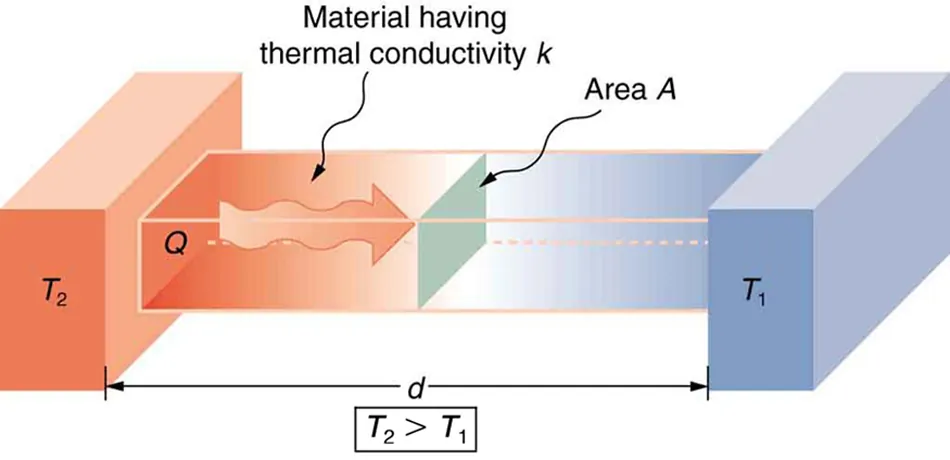
Conduction is modeled here as heat flow through a solid “slab” from the hot side () to the cold side (). The diagram highlights the geometric factors that control conductive transfer—cross-sectional area and thickness —while the material property is represented by the thermal conductivity . Source
This makes conduction especially important in solids, such as a metal pan, a spoon in hot soup, or a wall separating regions at different temperatures.
Conduction can also occur in liquids and gases, but it is usually less effective there because particles are farther apart and interact less often. In metals, mobile electrons help carry energy, so metals are often very good thermal conductors.
Convection
When a fluid—a liquid or a gas—can move, convection can transfer thermal energy. Instead of energy being passed only from particle to particle, part of the transfer happens because warmer regions of the fluid move to new locations.
Convection: Transfer of thermal energy by the bulk motion of a fluid.
A temperature difference within the fluid can create density differences. A warmer region often expands and becomes less dense, while a cooler region remains denser. That difference can produce convection currents, in which the fluid circulates and carries energy from one place to another.
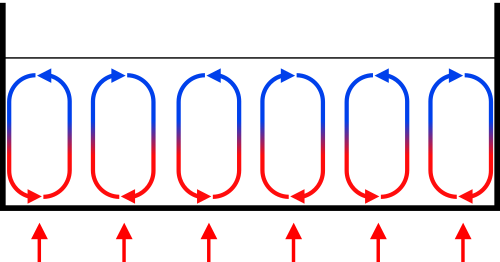
This schematic shows a convection cell: heating from below makes fluid warmer and less dense so it rises, while cooler, denser fluid sinks to replace it. The closed-loop circulation illustrates how convection transports thermal energy by bulk motion rather than solely by particle-to-particle transfer. Source
Convection is therefore a bulk motion process. It does not occur in rigid solids because solids do not flow. Convection may be natural, driven by density differences, or forced, driven by a fan, pump, or stirring.
Radiation
Energy can also transfer by radiation, which does not require matter to be present between systems. Radiation is especially important when objects are separated by empty space or when contact is limited.
Radiation: Transfer of thermal energy by electromagnetic waves.
All objects emit electromagnetic waves because of the thermal motion of charges in matter. For everyday temperatures, much of this thermal radiation is in the infrared part of the spectrum. A surface that absorbs radiation gains energy, while a surface that emits radiation loses energy.
This makes radiation different from conduction and convection, both of which rely on matter. Radiation can occur across a vacuum, which is why energy from the Sun reaches Earth.
Comparing the mechanisms
What makes them different
Conduction requires particles to interact while remaining in roughly fixed overall positions.
Convection requires a moving fluid that transports energy with the motion of the material itself.
Radiation requires electromagnetic waves and can occur without any material medium.
These mechanisms are not mutually exclusive. In many real systems, one mechanism starts the transfer and another redistributes the energy afterward.
Recognizing the dominant process
To decide which mechanism is most important, ask a few questions:
Are two materials touching? If so, conduction may be important.
Is a liquid or gas free to circulate? If so, convection may matter.
Is energy crossing empty space or a gap without direct contact? If so, radiation may be significant.
The dominant process also depends on the material and the surroundings. A thick metal object can transfer energy efficiently by conduction. Air often conducts poorly, but moving air can make convection important. Radiation becomes easier to notice when contact is weak or when objects are exchanging energy without touching.
Common physical situations
A single system can show all three mechanisms at once. A hot cup can transfer energy by conduction to the table, by convection to the surrounding air, and by radiation to nearby surfaces. Identifying each path separately helps explain why cooling can happen in several ways at the same time.
Insulation works by limiting one or more transfer mechanisms. Foam and fibers trap pockets of air, reducing fluid motion and therefore reducing convection. Vacuum insulation reduces conduction and eliminates convection through the gap, while reflective surfaces reduce radiative transfer.
Thinking about the mechanism, rather than only the temperature change, is the key idea for this topic. The important question is not just whether energy is transferred, but how that transfer takes place.
Practice Questions
A student holds a hand near, but not touching, a hot electric heater and feels warmth.
Identify the dominant method of energy transfer and explain why it can occur without contact.
[2 marks]
1 mark for identifying radiation.
1 mark for explaining that radiation transfers energy by electromagnetic waves and does not require matter or direct contact.
A pot of soup is heated on a stove.
(a) Explain how energy is transferred through the metal base of the pot.
[1 mark]
(b) Explain how energy is transferred through the soup after the bottom layer is heated.
[2 marks]
(c) A person standing nearby feels warmth from the pot without touching it. Identify and explain the transfer mechanism.
[1 mark]
(d) Explain why convection is not the main mechanism for transferring energy through the solid metal handle.
[1 mark]
(a) 1 mark for stating that conduction transfers energy through the metal by particle interactions/collisions.
(b) 1 mark for stating that warmer soup becomes less dense and rises.
(b) 1 mark for stating that cooler soup sinks, creating convection currents that redistribute energy.
(c) 1 mark for identifying radiation and explaining that the hot pot emits electromagnetic waves.
(d) 1 mark for explaining that convection requires bulk motion of a fluid, and the handle is a solid, so it does not flow.
FAQ
Natural convection depends on buoyancy. On Earth, warmer fluid usually becomes less dense and rises while cooler, denser fluid sinks.
In microgravity, that upward and downward sorting is greatly reduced, so the fluid does not circulate as strongly. Thermal energy then spreads much more by conduction unless fans or pumps create forced convection.
An infrared camera does not need visible light from the object. It detects thermal radiation emitted by the object itself.
Any object above absolute zero emits electromagnetic radiation. If the camera is designed to sense infrared wavelengths, it can form an image from differences in emitted radiation, even in a dark room.
Stirring creates forced convection. It moves warmer liquid from the middle of the drink to the surface and brings cooler liquid back into the interior.
That mixing reduces temperature differences within the drink and can increase the rate at which energy leaves to the cup and surrounding air. Without stirring, transfer within the liquid may be slower and less uniform.
The metal conducts energy from the hot source into the fins. Once the fins are warm, they transfer energy to the surroundings.
Thin fins greatly increase surface area, which improves energy transfer to the air by convection and also increases radiative exchange. The design helps a compact object release thermal energy more efficiently.
Yes. Convection does not require fluid to enter or leave the container. It only requires that the fluid inside be free to move.
If one region inside the sealed container is heated more than another, density differences can still develop. The fluid can then circulate internally, forming convection currents even though the total amount of fluid stays the same.
