

AP Syllabus focus: 'In collisions between atoms from different systems, energy most likely transfers from higher-energy atoms to lower-energy atoms.'
Microscopic collisions explain how thermal energy moves between systems. Although each interaction is random, large numbers of collisions create a clear statistical pattern: energy is usually passed from more energetic atoms to less energetic atoms.
Interpreting the syllabus statement
When two systems touch or otherwise allow atoms to interact, atoms from one system collide with atoms from the other. In each collision, forces act for a short time, so the atoms can exchange energy.
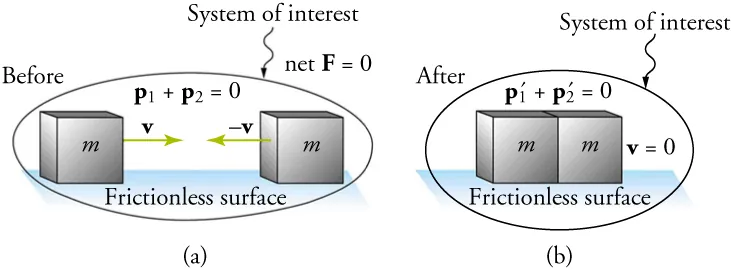
One-dimensional inelastic collision diagram showing two equal-mass objects colliding and sticking together. The “before” and “after” panels emphasize that momentum is conserved while kinetic energy decreases, with the “lost” kinetic energy transforming into internal/thermal energy—an energy-transfer pathway analogous to microscopic collisions. Source
Atomic collision: A brief interaction in which atoms exert forces on one another and can exchange energy and momentum.
The key AP idea is probability, not certainty. A collision between a higher-energy atom and a lower-energy atom is more likely to reduce the energy difference between them than to increase it. As a result, the higher-energy atom usually gives up some energy, while the lower-energy atom usually gains some.
This does not mean energy transfer is one-way in every single event. Some collisions transfer very little energy, and some can even go the opposite way. The syllabus statement uses most likely because the correct microscopic description is statistical.
Why the higher-energy atom usually loses energy
Collisions tend to redistribute energy
During a collision, the interacting atoms push on each other. Their individual energies after the collision depend on their motions before the collision and on how the interaction unfolds. Even though the exact outcome varies, collisions commonly make the energy distribution less uneven.
If one atom begins with much more kinetic energy than the other, there are many possible collision outcomes in which some of that energy is shared. There are fewer outcomes in which the already energetic atom ends with even more while the lower-energy atom ends with even less. Because of this imbalance, energy transfer from higher to lower energy is statistically favored.
This is the microscopic reason thermal energy transfer occurs. The process does not require atoms to "know" which object is hotter. It follows naturally from many random interactions governed by conservation laws and probability.
Single collisions versus many collisions
An important AP Physics 2 distinction is the difference between an individual collision and the overall result of many collisions.
Net energy transfer: The overall change in energy between systems after many collisions, taking all individual transfers into account.
A single lower-energy atom can sometimes gain even more energy from a collision, but it can also sometimes lose energy to a higher-energy atom. Both directions are possible in isolated events. However, when huge numbers of collisions occur, the preferred direction becomes clear.
If the atoms in one system have higher energies on average, then collisions involving those atoms are more likely to send energy outward. Random exceptions still happen, but they do not dominate the total. On the macroscopic scale, what matters is the net energy transfer, not one unusual collision.
Why averages matter
Systems contain a range of atomic energies
Not every atom in a system has the same energy. Even in a cooler system, some atoms may briefly have relatively high kinetic energy. Likewise, not every atom in a warmer system is equally energetic.
Because of this spread, a few collisions can transfer energy from the lower-average-energy system to the higher-average-energy system.
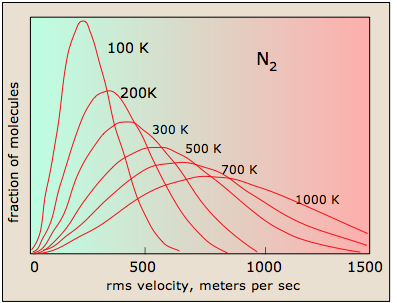
Maxwell–Boltzmann speed distributions for the same gas at multiple temperatures. As temperature increases, the curve shifts to higher speeds and becomes broader, showing that a hotter system has a larger fraction of high-speed (higher kinetic-energy) particles available to transfer energy in collisions. Source
That is not a contradiction. The important point is that, overall, the higher-average-energy system contains more atoms capable of giving up energy in collisions.
This is why physicists describe the process with phrases such as on average, more likely, and net transfer. These phrases reflect the real behavior of large collections of atoms better than absolute statements such as "energy always moves this way in every collision."
Factors that influence how much energy is exchanged
The direction favored by probability is the main idea, but the amount of energy exchanged in a collision can vary. It depends on several microscopic details:
the difference in the atoms' initial energies
the relative speeds and directions of motion
the masses of the colliding atoms
how often collisions occur between the systems
A very energetic atom may transfer only part of its energy in one collision. Often, substantial transfer requires many repeated collisions. This repeated exchange is why energy transfer at the atomic level is usually gradual rather than all at once.
At a boundary between two systems, more collisions mean more opportunities for this redistribution to occur. Fewer collisions mean a slower overall transfer, even if the preferred direction of transfer is unchanged.
How to express this idea on the AP exam
For AP responses, focus on a microscopic explanation. State that atoms from the two systems collide, and that collisions between higher-energy and lower-energy atoms are more likely to transfer energy so that the lower-energy atom gains energy and the higher-energy atom loses energy.
Strong responses usually include these ideas:
energy transfer happens through collisions between atoms
the higher-energy atom is more likely to lose energy
the lower-energy atom is more likely to gain energy
the statement applies to many collisions, not necessarily every individual collision
the important result is the net transfer of energy between systems
Practice Questions
A high-energy atom from System A collides with a lower-energy atom from System B. State the most likely direction of energy transfer and explain why this statement is probabilistic rather than certain.
1 mark: States that energy most likely transfers from the higher-energy atom to the lower-energy atom.
1 mark: Explains that individual collisions can vary, so this trend applies statistically over many collisions rather than in every single collision.
Two solid objects are in contact. At the boundary, atoms in object X have greater average kinetic energy than atoms in object Y. Use an atomic-collision model to explain why object Y gains energy overall. Your answer should refer to individual collisions, many-collision behavior, and net energy transfer.
1 mark: States that atoms at the boundary collide with atoms from the other object.
1 mark: States that higher-energy atoms in X are more likely to transfer energy to lower-energy atoms in Y.
1 mark: Explains that not every individual collision must transfer energy from X to Y.
1 mark: Explains that many collisions produce an overall or net transfer of energy to Y.
1 mark: Explains that the average energy imbalance causes collisions from X to Y to dominate overall.
FAQ
A perfectly elastic collision keeps the total kinetic energy of the two-atom system constant, but that does not mean each atom keeps the same kinetic energy.
One atom can lose kinetic energy while the other gains the same amount. The total stays constant, but the energy is redistributed between the atoms.
That is why elastic collisions can still produce energy transfer between systems.
Mass strongly affects how efficiently energy is exchanged.
If the two atoms have similar masses, a collision can transfer a relatively large fraction of energy.
If one atom is much heavier, the lighter atom often changes speed more dramatically.
A very heavy atom may gain or lose only a small fraction of its energy in a single collision.
So mass does not change the favored direction of transfer by itself, but it can change how much energy moves per collision.
This mechanism requires atoms or molecules from different systems to collide.
In a vacuum, there are too few particles between separated objects for frequent collisions to occur. Without collisions, this specific microscopic transfer process cannot operate across the gap.
Other transfer mechanisms may still exist, but collision-based transfer needs particles that can actually interact.
On the microscopic scale, two surfaces that look like they touch may actually meet only at a small number of points.
That means:
fewer atoms are close enough to interact strongly
fewer cross-boundary collisions occur
the overall rate of energy redistribution drops
Air gaps can also separate many surface atoms, reducing the number of effective collisions even more.
Usually not. Most collisions transfer only part of the energy because the outcome depends on mass, direction, and relative motion.
A very large transfer can happen under special conditions, especially when the atoms have similar masses and the collision geometry is favorable. But in most real systems, energy exchange happens through many partial transfers.
That is why macroscopic energy transfer is usually the result of enormous numbers of collisions rather than one dramatic event.
