

AP Syllabus focus: 'After many atomic collisions, the most probable state has both systems at the same temperature, with no net thermal energy transfer.'
Thermal equilibrium describes the final state reached when systems in thermal contact have exchanged energy for long enough that their temperatures match and large-scale thermal change no longer occurs.
Meaning of Thermal Equilibrium
The key idea is thermal equilibrium.
Thermal equilibrium: The state in which two systems in thermal contact have the same temperature, so there is no net thermal energy transfer between them.
When two systems interact, random atomic collisions allow energy to be exchanged. At first, one system may have a higher temperature, meaning its atoms have a greater average kinetic energy.
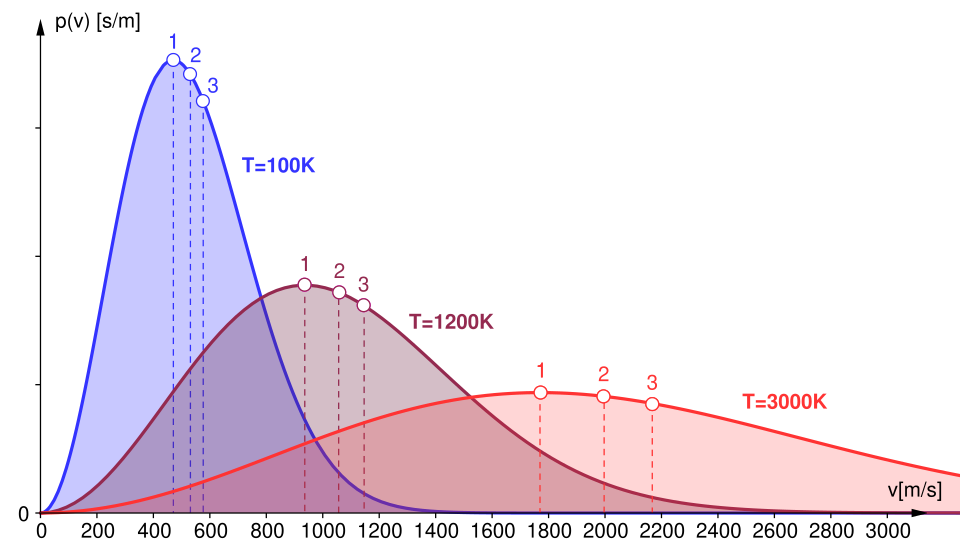
Maxwell–Boltzmann speed distributions for the same gas at several different temperatures. As temperature increases, the distribution broadens and shifts toward higher speeds, showing that “temperature” refers to a statistical spread of molecular speeds rather than all particles having the same energy. Source
As collisions continue, energy is redistributed between the systems. Eventually, the temperature difference disappears, and the systems reach a shared final state.
The most important condition is equal temperature. If one system were still slightly warmer on average, collisions would still favor an overall transfer that reduced that difference. Because of this, thermal equilibrium is not just a convenient description of the end of a process. It is the specific state in which neither system is more likely to gain thermal energy than lose it overall.
Why Equilibrium Is the Most Probable State
A Statistical Result
The phrase most probable state shows that thermal equilibrium is a statistical idea. In any real system, enormous numbers of atoms are moving and colliding. The details of individual collisions are unpredictable, but the overall pattern is not. There are far more microscopic ways for the combined systems to share energy so that they have the same temperature than there are ways for one system to remain noticeably hotter while still interacting for a long time.
Because the equal-temperature arrangement can occur in so many more microscopic ways, the systems naturally settle into it. This is what makes thermal equilibrium the most probable state.
It is not chosen by a single collision or by a rule applied to individual atoms. It emerges from the combined effect of many collisions over time.
Not every collision moves the systems closer to balance. Some individual collisions transfer energy in the opposite direction. However, when huge numbers of collisions are considered together, those temporary reversals do not prevent equilibrium. The overwhelmingly likely outcome is that the overall temperature difference disappears.
Dynamic Balance at the Atomic Level
At thermal equilibrium, atoms do not stop moving. They also do not stop exchanging energy. Collisions continue constantly, and energy can still pass in either direction during individual interactions. The equilibrium state is therefore dynamic, not motionless.
What changes is the overall balance. Once equilibrium is reached, the amount of energy transferred from system A to system B is matched, on average, by the amount transferred from system B to system A. That is why the specification says there is no net thermal energy transfer. The word net is essential: microscopic transfers still occur, but they cancel out overall.
This point helps explain why thermal equilibrium is compatible with constant atomic activity. A system can be very active at the particle level and still show no overall thermal change at the macroscopic level.
Conditions and Signs of Thermal Equilibrium
What Must Be True
For thermal equilibrium to be reached, the systems must be able to exchange energy by thermal processes and must remain in contact long enough for many collisions to occur. If contact is too brief, the systems may not fully reach the same temperature. Thermal equilibrium is therefore a final state that depends on both interaction and time.
The systems also do not need to be identical. They can be different substances, different sizes, or contain different numbers of atoms. Thermal equilibrium does not require matching masses or matching internal structures. The only requirement is that the systems end up at the same temperature with no overall thermal energy transfer continuing between them.
What You Can Observe
At the macroscopic level, thermal equilibrium is recognized by stable temperature readings. If a measuring device is placed in contact with a system and enough time passes, the device and the system come to the same temperature. Once that reading stops changing, there is no net thermal energy transfer between them.
This does not mean the system is perfectly unchanging at every instant. Small random fluctuations can still exist because atomic motion is always present. Those fluctuations do not contradict thermal equilibrium, because equilibrium describes the most probable overall state, not the behavior of every single atom in every moment.
Common Misunderstandings
Thermal equilibrium does not mean all atoms have the same energy. Individual atomic energies still vary.
It does not mean the systems contain equal amounts of energy. Equal temperature and equal total energy are different ideas.
It does not mean collisions stop. Continuous microscopic collisions are what maintain the balanced state.
It does not mean that no single transfer of energy can happen. It means the net transfer over time is zero.
It is not a temporary pause before more change begins. If conditions remain the same, the equilibrium state persists.
Practice Questions
Two systems are placed in thermal contact and left together for a long time. State the condition that shows they have reached thermal equilibrium, and state what happens to the net thermal energy transfer between them.
1 mark: States that the systems have the same temperature.
1 mark: States that there is no net thermal energy transfer between the systems.
A hot gas sample is placed in thermal contact with a cooler solid block. After a long time, the gas and the block reach a final state.
Explain why this final state is thermal equilibrium. Your answer should describe the role of many atomic collisions, why the final state is the most probable one, and what is still happening microscopically after equilibrium is reached.
1 mark: Explains that many atomic collisions allow energy to be exchanged between the two systems.
1 mark: States that the systems approach the same temperature.
1 mark: Explains that the equal-temperature state is the most probable state after many collisions.
1 mark: States that at equilibrium there is no net thermal energy transfer.
1 mark: Explains that microscopic collisions and energy exchanges still continue, but opposite transfers balance on average.
FAQ
A thermometer works by reaching thermal equilibrium with the sample it touches. If the sample is very small, the thermometer may have a comparable or even larger thermal capacity than the sample.
As energy is exchanged, both objects move toward a common temperature. In that case, the thermometer does not just read the sample’s temperature; it can noticeably alter it while equilibrium is being established.
Several factors affect the time required:
how large the initial temperature difference is
how easily energy can pass across the boundary
how much matter is involved
how well mixed the materials are
In general, stronger thermal interaction and more frequent particle collisions lead to faster approach to equilibrium. Weak contact or poor energy exchange makes the process slower.
Yes. If each system has the same temperature as the others, then no pair has a reason for net thermal energy transfer when they are in contact.
This idea is important because it allows temperature to be compared consistently. It also explains why one measuring device can be used to compare many different systems.
In very small systems, the number of particles is much smaller, so random variations matter more. A few energetic collisions can change the average behavior by a noticeable amount.
In large systems, those random changes are still present, but they are averaged over enormous numbers of particles. That makes the equilibrium state appear much steadier on the macroscopic scale.
Yes. Equilibrium lasts only while the relevant conditions stay unchanged. If energy is added, energy is removed, or the systems are brought into contact with something at a different temperature, the balance is broken.
Once disturbed, the systems will again exchange energy through many collisions until a new equilibrium state becomes the most probable one.
