

AP Syllabus focus: 'A system's net charge can change through friction or contact between systems, but any net charge change is due to charge transfer with the surroundings.'
Charging by friction and charging by contact explain how objects gain or lose net charge through direct interaction. The essential principle is conservation: charge is transferred between objects or between a system and its surroundings.
Core Idea
In AP Physics 2, charging is understood by tracking where charge goes. An object can become more positive or more negative after rubbing or touching another object, but that does not mean charge has been created. It means charge has been transferred. The net charge of an object is the overall balance of positive and negative charge on that object.
When the specification refers to a system, the chosen boundary matters. A single object may gain or lose net charge during an interaction. A larger system that includes both interacting objects may have no net change at all.
System: The object or collection of objects chosen for analysis.
If the total net charge of the chosen system changes, the change must be explained by charge crossing the system boundary from the surroundings. This idea is the key to interpreting friction and contact correctly.
Why the system boundary matters
A common mistake is to say that rubbing "creates" charge. A better statement is that rubbing allows charge to move between materials. If both materials are included in the system and no outside transfer occurs, the system's total net charge stays constant even though each object's individual charge can change.
The same logic applies to touching. If object A touches object B, each object may finish with a different net charge than it had before. However, the total for the combined A + B system can still remain unchanged.
Charging by Friction
Charging by friction occurs when two materials are rubbed together and charge is transferred during their interaction.
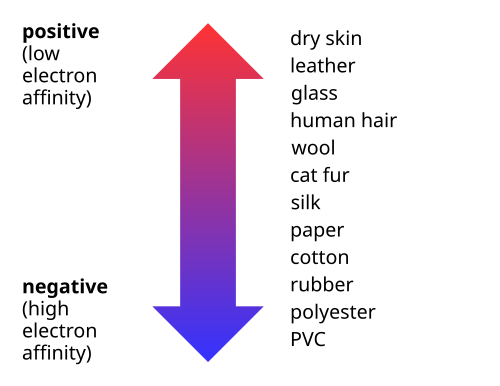
A triboelectric series ranks common materials by their tendency to lose electrons (becoming positive) or gain electrons (becoming negative) during frictional contact. It visually reinforces that the sign of the final net charge depends on the material pair, consistent with charge transfer rather than charge creation. Source
The rubbing increases the number and area of surface interactions, so transfer becomes more likely.
Charging by friction: A process in which two materials are rubbed together and charge is transferred, changing the net charge of one or both objects.
After frictional charging, the two objects often end up with opposite signs of net charge. One object becomes more negative and the other more positive if the two-object system is isolated. The amount of charge transferred depends on the materials and on the details of the rubbing process, such as surface condition and extent of contact.
Friction is therefore not the source of charge. Instead, friction is the mechanism that helps transfer charge. The total charge involved must already exist in the interacting objects or must enter or leave through the surroundings.
Important features of frictional charging
The objects must interact at their surfaces.
Rubbing usually causes repeated contact and separation.
Either object may end up positive or negative depending on the material pair.
If the analyzed system includes only one object, its net charge can change.
If the analyzed system includes both objects and they are isolated, the total net charge does not change.
Charging by Contact
Charging by contact happens when objects touch and charge is transferred directly between them.
This process does not require rubbing; simple contact can be enough.
Charging by contact: A process in which charge is transferred between objects because they touch.
A charged object brought into contact with another object can leave some charge on that second object. A neutral object may become charged after contact, and two initially charged objects may redistribute charge when they touch. Contact may be brief or extended; what matters is that the objects interact directly in a way that permits transfer.
After the objects separate, each may retain a new net charge. The important AP idea is not the exact microscopic path of the transfer, but the fact that the final net charges result from charge moving between objects rather than charge appearing spontaneously.
What contact charging tells you
When two objects touch, look for evidence of direct transfer. If one object becomes less positive while the other becomes more positive, or if one becomes less negative while the other becomes more negative, charge has moved between them. The total change for the pair must still be consistent with conservation of charge.
Contact charging can also change the net charge of a chosen system if the other object is treated as part of the surroundings. That is why AP Physics problems often depend on clearly identifying what is inside and outside the system boundary.
Conservation of Charge in These Processes
The specification emphasizes a subtle but important point: any net charge change is due to charge transfer with the surroundings. This means the phrase "net charge changed" is never an excuse to ignore conservation of charge.
Suppose two objects are rubbed together. If you analyze just one object, its net charge may increase or decrease. If you analyze both together, their total charge remains unchanged unless charge also entered or left the pair. The same reasoning applies to charging by contact.
In free-response reasoning, it is important to distinguish between the charge on an individual object and the total charge of the full system. Many incorrect explanations mix these two ideas and end up violating conservation without noticing it.
Reasoning strategy for AP problems
When solving conceptual questions on this topic, use a short chain of logic:
Identify the system.
Decide whether the interaction is friction or contact.
Determine whether charge was transferred only between objects in the system or also between the system and the surroundings.
Apply conservation of charge to the full situation.
Describe the result in terms of one object gaining charge and another losing charge, rather than charge being created.
Language that avoids common errors
Useful phrases in written explanations include:
"Charge was transferred from one object to another."
"The object's net charge changed during the interaction."
"The total charge of the system remained constant."
"Any net change for the system requires charge transfer with the surroundings."
This wording makes the physics clear and keeps the explanation consistent with conservation of charge.
Practice Questions
A student says, "Rubbing two objects together creates charge on both objects." State whether this statement is correct and explain your reasoning.
1 mark: States that the statement is incorrect because charge is transferred, not created.
1 mark: States that the total charge of the two-object system remains constant unless charge is transferred with the surroundings.
Object A is initially neutral. Object B has a negative net charge. B touches A and is then removed. Later, A is rubbed with cloth C, and A ends with a larger negative net charge than it had after touching B.
(a) Explain how A could become charged during the contact with B. (2 marks)
(b) Explain how A could become more negatively charged during rubbing with C without violating conservation of charge. (2 marks)
(c) Under what condition could the net charge of the system consisting of A and C change? (1 mark)
(a)
1 mark: States that charge is transferred from B to A during contact.
1 mark: States that A can become negatively charged while B's charge changes correspondingly.
(b)
1 mark: States that friction allows charge transfer between A and C and does not create charge.
1 mark: States that if A becomes more negative, then C or the surroundings must become more positive by an equal amount for the relevant isolated system.
(c)
1 mark: States that the net charge of A and C can change only if charge is transferred between that system and the surroundings.
FAQ
Water molecules in humid air and thin moisture layers on surfaces give charge an easier path to leak away.
As a result, objects often do not keep their net charge for long after rubbing or touching. In dry air, charge remains localized longer, so the effects of frictional or contact charging are easier to observe.
Different materials have different tendencies to give up or retain charge at their surfaces during contact.
A pair with a larger difference in that tendency usually shows a larger transfer. Surface roughness, cleanliness, oils, and contamination also matter, so the same material pair may not behave exactly the same way every time.
Yes. The key process is repeated surface contact and separation, not how dramatic the motion looks.
Even light rubbing or repeated gentle contact can transfer charge if the materials and conditions are favorable. Stronger rubbing often increases the effect simply because it increases the number of surface interactions.
A spark can happen when charge transfers very rapidly over a short time.
That sudden redistribution can heat the nearby air enough to produce light and sound. The spark is not charge being made; it is existing charge moving quickly from one place to another.
Yes, if they begin with different net charges. Touching can redistribute charge between them.
If the objects are truly identical and isolated, the final charge is often shared more evenly than before. If they already start with the same net charge, touching may produce little or no noticeable change.
