

AP Syllabus focus: 'Induced charge separation occurs when electrostatic forces alter charge distributions within systems, causing polarization of one or both systems; it can occur in neutral systems.'
Induced charge separation explains how nearby charges can rearrange charges within an object without changing its total net charge. This idea is central to understanding polarization, attraction, and charging behavior in many materials.
Induced Charge Separation
A nearby charged object can cause different parts of another system to experience different electrostatic forces.
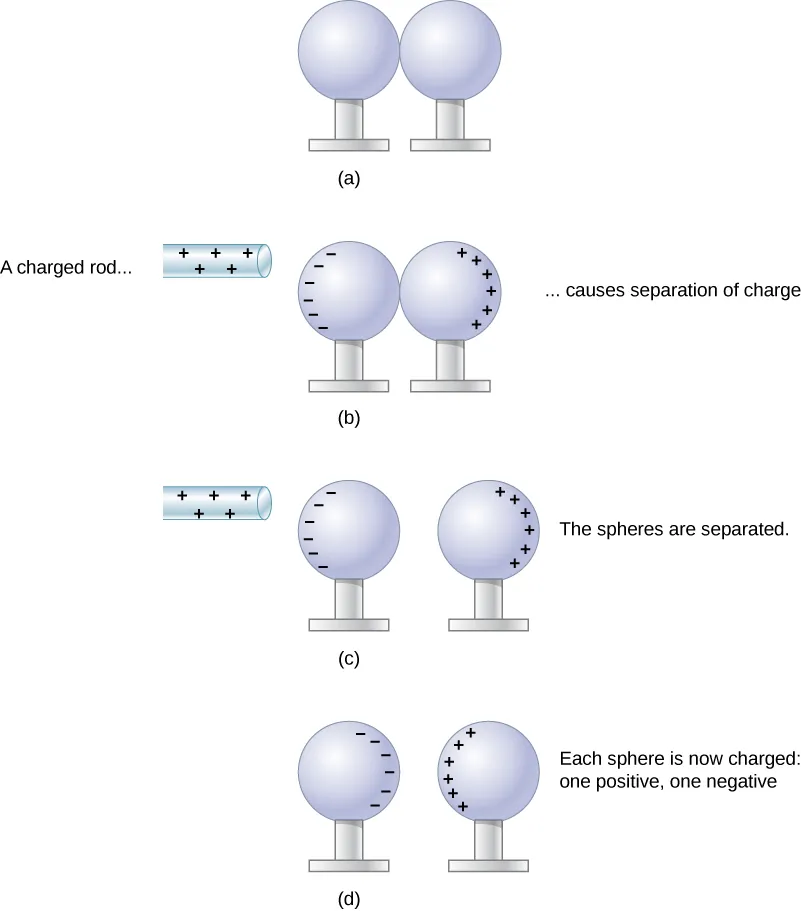
Two initially neutral conducting spheres polarize when a positively charged rod is brought nearby, causing electrons to crowd toward the nearer side and leaving positive charge on the far side. Separating the spheres while the rod remains nearby “locks in” the separated charge regions, illustrating how induction begins with redistribution before any object necessarily ends up with a new net charge. Source
That difference can shift existing charges into an uneven arrangement.
Induced charge separation: A rearrangement of positive and negative charge within a system caused by electrostatic forces from another system.
This is an internal redistribution of charge, not the creation of new charge. If the system starts neutral, the total positive and negative charge can still remain equal after the separation occurs. What changes is where those charges are located.
A neutral object therefore can develop a side that is relatively more negative and a side that is relatively more positive. The word relatively matters: the object has separated charge regions, but its overall charge may still be zero.
What causes the separation?
Because opposite charges respond in opposite ways to a nearby charged system, they do not remain distributed symmetrically. The external electrostatic influence pulls one kind of charge closer and pushes the other kind farther away, or shifts the centers of positive and negative charge within the system.
The effect depends on distribution, not contact. Two systems do not need to touch for induced charge separation to occur. The presence of a nearby charged system is enough to distort the charge arrangement in another system.
Polarization
When induced charge separation produces distinct regions of opposite charge within a system, the system is said to be polarized.
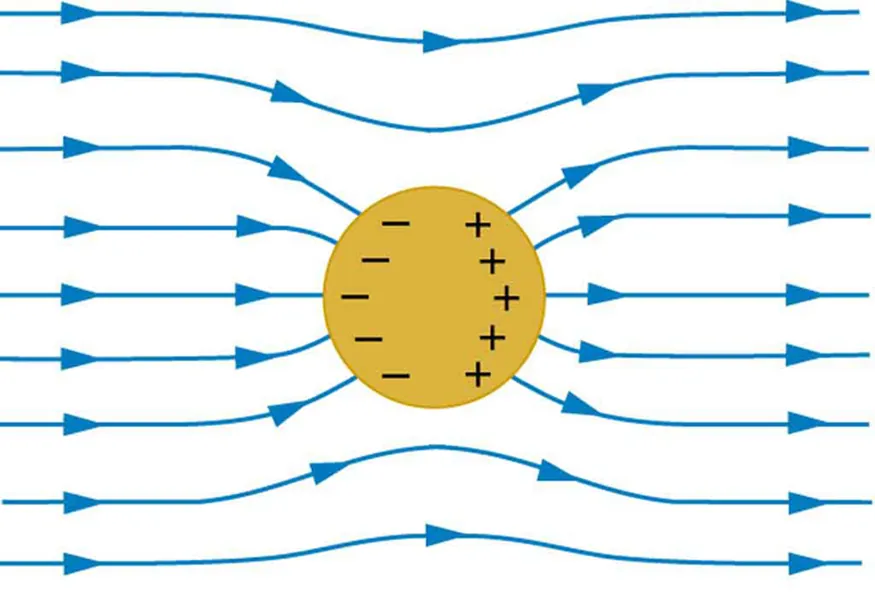
A neutral conducting sphere placed in a uniform external electric field develops separated surface charge: negative charge accumulates on one side and positive on the other. The field lines distort so they meet the conductor’s surface perpendicularly, and the electric field inside the conductor is zero at electrostatic equilibrium—showing polarization without changing the object’s overall neutrality. Source
Polarization: A condition in which positive and negative charge within a system become separated, creating an uneven charge distribution.
Polarization can happen in one system, or in both interacting systems. That is an important reading point in AP Physics 2: the specification does not limit the effect to one object. If system A changes the charge distribution in system B, system B can also alter the distribution in system A.
In many cases, polarization is partial rather than complete. The charges do not separate into isolated chunks; instead, the distribution becomes shifted or distorted. The system keeps its identity as a single object, but its charge arrangement is no longer uniform.
Neutral Systems Can Polarize
A common misconception is that only charged objects can be affected by electrostatic forces. In fact, a neutral system can still respond because neutrality means equal total positive and negative charge, not an absence of charge.
If a neutral system is placed near a charged object, electrostatic forces can act differently on the positive and negative charges already present in the neutral system. That creates induced charge separation even though no net charge has been added or removed.
This idea explains why a neutral object can interact strongly with a charged object. The key point is that internal charge distribution matters, not just total net charge.
Why attraction can occur
After polarization, the side of the neutral system closer to the external charged object usually has charge of the opposite sign induced on that side. The farther side has charge of the same sign.
Because the closer interaction is stronger than the farther interaction, the attraction can outweigh the repulsion. As a result, a neutral system can be pulled toward a charged system even while remaining neutral overall.
That does not violate charge conservation. No net charge has to be transferred for this attraction to occur; the charges only need to be redistributed within the system.
What to Look For in Problems and Diagrams
AP questions on this topic often describe a charged object brought near another object and ask what happens to the charge distribution. Focus on the language of redistribution, separation, and polarization.
Useful clues include:
one side of an object becoming relatively more positive or relatively more negative
a neutral object being attracted without touching a charged object
a statement that charges shift within an object rather than move between objects
both systems changing their internal distributions during the interaction
In diagrams, polarization is often shown by positive and negative symbols crowding toward opposite sides of an object. Even if the total number of positive and negative charges stays the same, the pattern becomes asymmetric, showing that the system has been altered by external electrostatic forces.
Distinguishing polarization from charging
Students often confuse polarization with an actual change in net charge. Keep these ideas separate:
Charging changes the total net charge of a system.
Polarization changes the arrangement of charge within a system.
A system can polarize while remaining neutral overall.
Induced charge separation is caused by electrostatic forces from another system.
Common mistakes to avoid
Do not say a neutral object has "no charges." It contains positive and negative charges that can shift relative to each other.
Do not assume attraction means the two objects have opposite net charges.
Do not assume contact is required before charge separation can happen.
Do not ignore the phrase one or both systems; either object, or both, may become polarized during an interaction.
Practice Questions
A positively charged rod is brought near a neutral object without touching it. State what happens to the object's charge distribution and name the process.
1 mark: States that charge redistributes within the object so the side nearer the rod becomes relatively negative and the farther side becomes relatively positive.
1 mark: Identifies the process as induced charge separation or polarization.
A charged balloon is brought close to a small neutral piece of paper. Explain why the paper can move toward the balloon even though the paper is neutral overall. In your answer, refer to induced charge separation, polarization, and whether one or both systems may have altered charge distributions.
1 mark: States that electrostatic forces alter the charge distribution in the paper.
1 mark: States that the paper becomes polarized or develops separated regions of positive and negative charge.
1 mark: States that the paper can remain net neutral overall.
1 mark: Explains that the side of the paper closer to the balloon becomes relatively opposite in sign to the balloon.
1 mark: Explains that the closer attraction is stronger than the farther repulsion, so the net force can be toward the balloon. Credit may also be given for noting that the balloon may also have a changed charge distribution.
FAQ
Induced polarization is created by an external charged influence that distorts an otherwise more symmetric charge distribution.
Permanent molecular polarity exists even when no nearby charged object is present, because the molecule's internal structure already gives it an uneven distribution of charge. A permanently polar molecule can still be further polarized by induction.
Yes. Net charge tells you the total amount of charge in the system, while polarization tells you how that charge is arranged in space.
A system may have an overall positive or negative charge and still have that charge distributed unevenly, so one side is more positive or more negative than another.
Usually it happens very quickly, but not truly instantaneously. Charges need a finite time to shift in response to changing electrostatic forces.
The response time depends on how easily the charges in the system can move or distort. In many AP-level situations, that delay is so small that the redistribution is treated as immediate.
Gases, liquids, and solids can all be polarized. The important idea is that the positive and negative parts of atoms or molecules can be shifted relative to each other.
In gases the effect is often weaker because particles are farther apart. In liquids, individual molecules can distort or reorient, so polarization can still be significant.
An atom contains a positively charged nucleus and a negatively charged electron cloud. In a nearby charged environment, the electron cloud can shift slightly relative to the nucleus.
That small shift creates an induced separation of charge within the atom. The atom may still be neutral overall, but it now has one side that is relatively more negative and another that is relatively more positive.
