

AP Syllabus focus: 'The electric potential energy of two point charges equals the work required by an external force to bring them from infinitely far away to their positions.'
This topic links energy to electric interactions by showing that arranging two charges in space requires energy transfer, even when no contact occurs between the objects.
Electric potential energy and charge arrangement
When two point charges are separated by some distance, the two-charge system can store energy because of the electric interaction between them. That stored energy is called electric potential energy. It is not just a feature of one charge by itself; it depends on the arrangement of both charges together.
Electric potential energy: The energy associated with the positions of interacting charged objects, measured relative to a chosen reference state.
A key idea is that electric potential energy is about configuration. If the relative positions of the charges change, the energy of the system can change. In this subtopic, the reference state is chosen so that the electric potential energy is zero when the two charges are infinitely far apart. From that starting point, bringing the charges to a finite separation creates a new energy state for the system.
Why work is involved
To place two charges at a specific separation, some external force must act while one or both charges move.
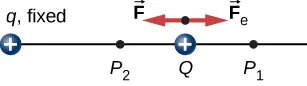
A positive test charge is moved toward a fixed positive source charge while an external applied force balances the electric repulsion at each point. This diagram reinforces the “controlled assembly” idea: the external agent sets the motion (slowly) so the energy transfer is accounted for as work that changes the two-charge system’s electric potential energy. Source
That outside agent could be a person, a tool, or any other force not part of the electric interaction between the two charges. The work done by that external force transfers energy into or out of the two-charge system.
If the charges are brought together in a controlled way so their kinetic energy does not change significantly, then the external work is equal to the change in electric potential energy.
= change in electric potential energy of the two-charge system, J
= work done by an external force while bringing the charges to their positions, J
This equation gives the central meaning of the syllabus statement. Electric potential energy is defined through the work needed to assemble the charge configuration from the chosen reference state. A larger required external work means a larger change in electric potential energy.
The role of the external force
The electric force between the charges may either resist the motion or assist it. The external force is what makes the final arrangement happen in a controlled way. This matters because AP Physics 2 Algebra treats electric potential energy as part of an energy model: energy is transferred by work as the system is assembled.
Why the reference point is infinitely far away
Electric potential energy is always measured relative to a reference point. For two point charges, the standard choice is that the energy is zero when the charges are infinitely far apart.
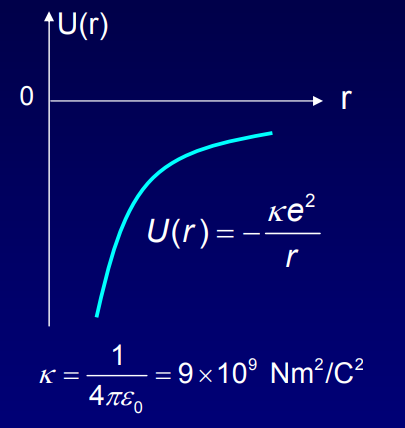
This plot shows a Coulomb potential-energy curve with varying as for an attractive interaction, approaching as . It visually encodes the reference choice and helps students interpret why configurations at smaller can correspond to lower (more negative) electric potential energy for unlike charges. Source
This is useful because, at an extremely large separation, the electric interaction becomes negligible.
The phrase “from infinitely far away” does not mean that a real experiment must begin at an actual infinite distance. It means that the zero of electric potential energy is defined at that limit. From there, the final electric potential energy is determined by the work required to create the actual arrangement being studied.
This reference choice also makes comparisons easier. Different arrangements can be compared by asking how much work an external agent must do to assemble each one from the same starting condition.
Interpreting the sign of the work
The sign of the external work tells you whether energy is added to or removed from the system.
Like charges resist being brought closer together. An external agent must push against the repulsive electric force, so the external work is positive. The electric potential energy of the system increases.
Unlike charges tend to move together on their own. If they are brought together slowly, the external agent must usually hold back the motion, so the external work is negative. The electric potential energy of the system decreases.
If a system has higher electric potential energy, that stored energy can later be converted into other forms if the charges are allowed to move.
The important idea is that electric potential energy tracks how much energy is associated with the arrangement of the charges, not simply whether the charges are moving.
What determines the change in electric potential energy
For two point charges, the change in electric potential energy depends on the pair of charges and their separation. Changing either the amount of charge involved or the distance between them changes how much external work is required to assemble the system.
A useful way to think about this is to imagine building the configuration step by step. Start with the charges so far apart that the interaction is effectively zero. Then move them into their final positions. The amount of work that must be supplied or removed during that process becomes the change in electric potential energy of the system.
Because electric interactions are conservative in electrostatics, the energy change depends on the initial and final positions, not on the path taken between them. That is why electric potential energy is a reliable quantity for describing charge arrangements.
Common misunderstandings
Electric potential energy is not the same as electric force. Force describes the interaction that can cause acceleration; potential energy describes stored energy due to position.
The work in this topic is external work. It is not automatically the same as the work done by the electric force itself.
Zero potential energy at infinity is a reference choice. It does not mean electric effects suddenly stop at a specific distance.
A negative change in electric potential energy is meaningful. It indicates that the system ends in a lower-energy arrangement than the reference state.
The energy belongs to the system of two charges. It is not assigned to only one charge acting alone.
Controlled assembly matters. If the charges speed up a lot while moving, some energy goes into kinetic energy instead of appearing only as a change in electric potential energy.
Practice Questions
State what is meant by saying that the electric potential energy of two point charges equals the work required by an external force to bring them from infinitely far away to their positions.
1 mark: States that the charges are brought from an initial state of infinite separation or effectively zero interaction.
1 mark: States that the work done by the external force equals the change in electric potential energy of the two-charge system.
Two point charges are assembled from infinity to the same final separation in two different cases.
Case A: and
Case B: and
For each case: (a) State whether the external work is positive or negative. (2 marks) (b) State whether the electric potential energy of the system increases or decreases. (2 marks) (c) Explain why infinity is used as the reference position for electric potential energy. (1 mark)
(a)
1 mark: Case A external work is positive.
1 mark: Case B external work is negative.
(b)
1 mark: Case A electric potential energy increases.
1 mark: Case B electric potential energy decreases.
(c)
1 mark: States that infinity is used as a convenient zero-reference where the interaction is negligible, so energy changes can be measured from a common starting point.
FAQ
The external force is any force applied by something outside the two-charge system.
Examples include:
a person pushing or holding a charged object
a lab device moving a charged particle
a mechanical support preventing motion
It does not refer to the electric force between the two charges themselves.
If the charges are moved slowly, their kinetic energy stays nearly constant.
That means:
the external work mainly changes the electric potential energy
the energy accounting is simpler
$W_{ext}$ can be matched directly to $\Delta U$
If the charges speed up noticeably, then some of the transferred energy goes into kinetic energy too.
No. For this idea, electric potential energy depends on the charge arrangement, not on mass.
Mass matters for how the objects respond when released:
larger mass means less acceleration for the same force
smaller mass means more acceleration
But the electric potential energy of the configuration is determined by charge and separation, not by inertia.
In electrostatics, no, as long as the initial and final positions are the same and the process is controlled.
This is because the electric interaction is conservative, so the energy change depends only on:
the starting arrangement
the ending arrangement
The path can change how the motion looks, but not the electric potential energy difference between the two positions.
Usually not in the way length or time is measured directly.
Instead, it is inferred from other measurable quantities, such as:
the work done by an external agent
changes in kinetic energy
the behavior of charges when released
So electric potential energy is often determined through an energy analysis rather than by reading one meter.
