

AP Syllabus focus: 'In electrostatic equilibrium, excess charge in an insulator is distributed throughout the interior and surface, and the electric field inside the insulator may be nonzero.'
This subsubtopic focuses on a key exception to a common electrostatics shortcut: a charged insulator in equilibrium does not have to place all excess charge on the outside or make its interior field zero.
Electrostatic Equilibrium in an Insulator
In this context, electrostatic equilibrium means the overall charge distribution has become stable and is no longer changing with time on the macroscopic scale. The object has settled into a steady arrangement of charge.
For an insulator, that steady arrangement can look very different from the charge arrangement in materials where charge moves freely through the whole object. In an insulator, charge is not free to redistribute everywhere with ease, so the final equilibrium pattern can include charge trapped in many locations.
That is the first major idea from the specification: an insulating object at electrostatic equilibrium can still contain excess charge inside the material. The interior is not required to become charge-free.
At the microscopic level, charge in an insulator is often associated with atoms, molecules, or defects in the material.
Because motion through the object is restricted, the material can hold charge in many regions instead of quickly rearranging it into one simple outer layer.
Where Excess Charge Can Be Found
Excess charge is charge added to or removed from an object so that the object has a nonzero net charge. For this subsubtopic, the important statement is that excess charge in an insulator can be found in more than one location.
In electrostatic equilibrium, excess charge in an insulator can be distributed:
throughout the interior
on the surface
in a pattern that may vary from one region to another
This means you should not assume that all extra charge must move to the outer boundary. That shortcut is too broad for AP Physics 2 when the material is an insulator. The official wording is specific: the excess charge is distributed throughout the interior and surface.
This also does not mean the charge must be spread uniformly. Some parts of the material may hold more charge than others. The essential point is simply that the interior can contain excess charge even after electrostatic equilibrium has been reached.
Electric Field Inside the Material
Because excess charge may exist inside the insulating material, the electric field inside the insulator may also be present.
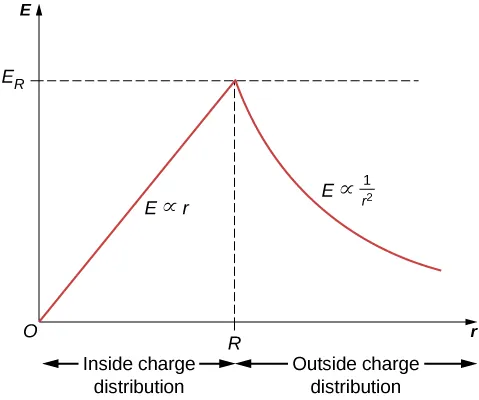
Electric field magnitude versus distance for a uniformly charged, non-conducting (insulating) sphere: inside the material, increases linearly with and reaches a maximum at the surface, then decreases as outside. This provides a concrete counterexample to the “field must be zero inside” shortcut that is only guaranteed for conductors in electrostatic equilibrium. Source
In other words, reaching electrostatic equilibrium does not force the internal field to vanish.
A nonzero internal field means a positive test charge placed at some interior point could experience an electric force. That does not violate equilibrium. The charge distribution can be stable while still producing an electric field inside the object.
The field at an interior point depends on the entire charge distribution in and around the material.

Diagrams for a sphere with charge distributed throughout its volume, showing the Gaussian-surface reasoning for the electric field inside and outside. The inside-field result illustrates that interior charge contributes to a stable equilibrium configuration while still producing a nonzero field at interior points. Source
Different interior points can therefore have different field magnitudes and directions. You should think of the internal field as a result of the charge arrangement, not as something that must automatically become zero just because the object has stopped changing.
Why may be nonzero matters
The phrase may be nonzero is very important. It tells you that a zero internal field is not guaranteed.
For AP responses, the correct statement is not “the field inside an insulator is always nonzero.” The correct statement is that the field inside an insulator in electrostatic equilibrium does not have to be zero.
A strong conceptual answer usually includes ideas like these:
excess charge can remain in the interior
interior charge can create an internal electric field
electrostatic equilibrium is still possible in that situation
Visualizing Charge and Field in an Insulator
When you model a charged insulator, do not automatically draw all excess charge only on the outside edge. A better model allows charge to appear within the material as well as on its surface.
Likewise, do not assume the inside of the object is field-free. If there is interior charge, then interior points can have electric fields caused by that charge distribution. If the distribution changes from place to place, the field can also change from place to place.
This is why insulating objects require careful reasoning. A simple surface-only model can miss the main idea tested in this subsubtopic.
Using the Idea in AP Reasoning
If an AP question asks whether a charged insulator in electrostatic equilibrium can have charge inside it, the answer is yes. If it asks whether the electric field inside must be zero, the answer is no.
Useful phrases in written explanations include:
distributed throughout the interior and surface
electric field inside may be nonzero
charge distribution is stable
equilibrium does not require a zero internal field
Using this language helps keep your reasoning closely aligned with the syllabus wording.
Common Misconceptions
A frequent mistake is to think that equilibrium means no electric forces anywhere inside the object. For this subsubtopic, that is not the correct interpretation. Equilibrium means the charge arrangement is stable, not that every interior field must disappear.
Another common mistake is to focus only on the surface. For an insulator, a complete description must include both the surface and the interior.
A third mistake is to replace the phrase may be nonzero with must be nonzero. The specification does not say the internal field is always present at every point. It says the internal field is allowed to be nonzero, so zero is not a required result.
Practice Questions
A charged solid insulator is in electrostatic equilibrium. Must the electric field at every point inside the insulator be zero? Explain.
1 mark: States that the electric field inside the insulator does not have to be zero.
1 mark: Explains that excess charge in an insulator can be distributed throughout the interior as well as the surface, so interior charge can produce an internal electric field.
A student says, “Once a solid insulating object reaches electrostatic equilibrium, all excess charge must be on the surface, so the electric field everywhere inside must be zero.”
Evaluate the student’s statement. In your answer:
state whether the statement is correct or incorrect
describe where excess charge can be found in the insulator
state what can be said about the electric field inside the insulator
explain why this situation is still called electrostatic equilibrium
1 mark: Identifies the statement as incorrect.
1 mark: States that excess charge in an insulator can be distributed throughout the interior.
1 mark: States that excess charge can also be on the surface.
1 mark: States that the electric field inside the insulator may be nonzero.
1 mark: Explains that electrostatic equilibrium means the charge distribution is stable and no longer changing with time, not that the internal field must be zero.
FAQ
In an insulator, charge is often tied to atoms, molecules, or defects in the material, so it cannot move freely through the object.
That limited mobility lets excess charge remain in localized regions for long periods. The exact time depends on the material, temperature, humidity, and impurities.
Yes.
Electric fields from different parts of the charge distribution can cancel at a particular point, even though the field is not zero everywhere else inside the material. So “may be nonzero” describes the interior in general, not necessarily every single point.
Real insulators are affected by their surroundings.
Moist air can provide partial conduction paths.
Dirt, oils, or water films on the surface can let charge leak away.
Over time, this can change how much charge remains inside the material versus on the surface.
That is why classroom demonstrations with charged insulators often work better in dry conditions.
If the electric field inside an insulator becomes large enough, the material can stop behaving like an insulator and begin to conduct.
This process is called dielectric breakdown. It can happen when atoms are ionized and charge carriers are created inside the material. At that point, the original equilibrium model no longer applies in the same way because the charge distribution can start changing rapidly.
No real material blocks charge motion perfectly.
Most insulating materials have very small, but not exactly zero, conductivity. Over enough time, some charge can slowly move or leak away. That means the charge distribution in a real insulator can change gradually, especially if the environment or temperature changes.
For AP-level reasoning, the idealized model is still useful, but real materials are never perfect.
