AP Syllabus focus:
‘Essential Knowledge UNC-2.A.2 & UNC-2.A.3: Distinguish between outcomes (the results of a single trial of a random process) and events (collections of outcomes). Clarify the importance of understanding these concepts for conducting simulations and estimating probabilities.’
This section introduces the foundational ideas of outcomes and events in probability, emphasizing how distinguishing these concepts enables accurate simulations, meaningful probability estimates, and clearer reasoning about random processes.
Understanding the Structure of Random Processes
A random process produces results determined by chance, and each repetition of the process yields one specific outcome. These outcomes form the building blocks of events, which are essential for describing and quantifying probability. By learning to differentiate outcomes from events, students gain a clearer framework for analyzing randomness.
Outcome: The result of a single trial of a random process.
An outcome is the most elemental result that can occur when a random process is performed once. Because outcomes are indivisible, they serve as the smallest units of probabilistic description.
After establishing outcomes, it becomes possible to define events, which play a central role in probability reasoning.
Event: A collection of one or more outcomes from the sample space of a random process.
Events allow statisticians to describe more complex or meaningful conditions than a single outcome can express. They are typically defined in relation to specific questions of interest, which highlights their interpretive importance.
A key connection between outcomes and events is that both derive from the sample space, the complete set of all possible outcomes of a random process.

Venn diagram illustrating an event as a subset of the sample space. The outer region represents the full sample space, while the inner region represents an event composed of selected outcomes. This depiction reinforces that events must lie within the sample space. Source.
Understanding this structure helps students recognize how probabilities originate and why events are measurable.
Outcomes as the Basis of Probability Interpretation
Outcomes represent the most detailed level at which randomness is observed. Because each trial of a random process must end in exactly one outcome, identifying all possible outcomes provides a framework for describing uncertainty.
Characteristics of Outcomes
Outcomes typically share several important characteristics:
They are mutually exclusive, meaning only one can occur per trial.
They are collectively exhaustive, meaning together they include every possibility.
They form the sample space, which underpins probability definitions.
Recognizing these features helps students understand why probability models must begin with the careful identification of outcomes.
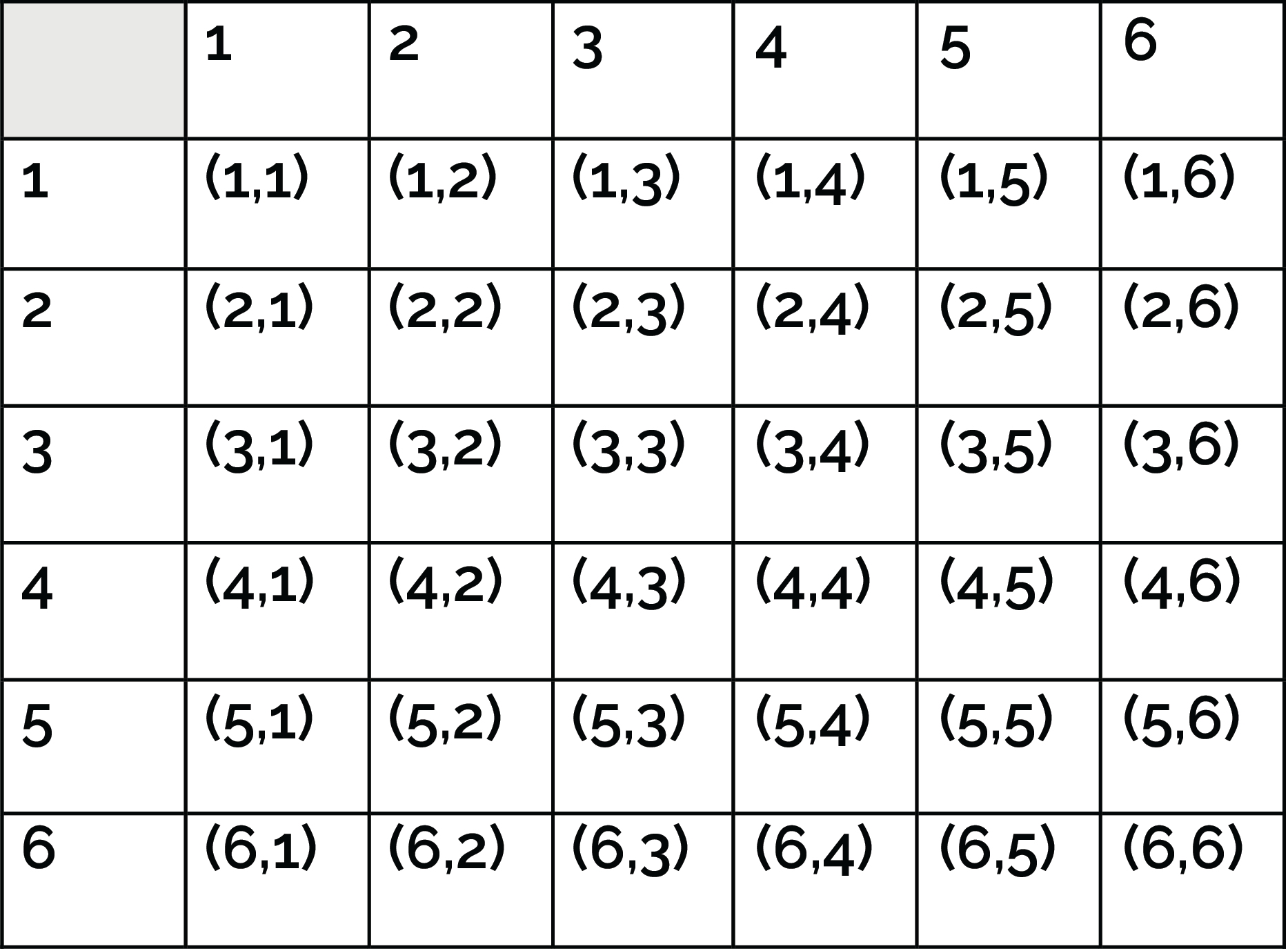
Sample space diagram for rolling two fair six-sided dice. Each cell represents one possible outcome, arranged in a clear grid that illustrates all 36 ordered pairs. This image focuses solely on outcomes, providing the foundational structure from which events are defined. Source.
Outcomes also establish a reference level for simulated processes. When conducting simulations, each run corresponds to a single outcome, and the accumulation of many such outcomes enables estimation of event probabilities.
Events as Meaningful Groupings of Outcomes
Events extend the concept of outcomes by grouping them into sets that correspond to conditions of interest. Because real-world questions often involve categories rather than individual results, events provide a practical way to express probability statements.
Types of Events
Events may take several forms:
Single-outcome events, which include only one outcome.
Multiple-outcome events, which combine several outcomes that share a meaningful attribute.
Complementary events, which contain all outcomes not in a specified event.
Compound events, which involve combinations or intersections of other events.
Although this section focuses on the general concept of events, these distinctions illustrate the flexibility of event-based descriptions in probability.
Events matter because probability is typically assigned not to individual outcomes alone, but to the set of outcomes that satisfy a particular condition. For example, asking whether a value falls within a certain category corresponds to determining whether the outcome belongs to the event of interest.
Linking Outcomes and Events to Simulation
Simulation is a powerful method for estimating probabilities when theoretical calculations are difficult or unnecessary. A clear understanding of outcomes and events is essential for designing and interpreting simulations effectively.
How Outcomes Function in Simulation
When simulating a random process:
Each simulated trial yields one recordable outcome.
The collection of outcomes across trials forms empirical data.
Tracking the frequency of each outcome helps approximate the relative likelihoods within the sample space.
Because simulations model real random processes, distinguishing outcomes ensures that the simulation reflects the true structure of the random phenomenon.
Between these individual outcomes, events emerge as meaningful patterns across many simulated trials.
How Events Are Used to Estimate Probabilities
Events play a central role in simulation-based estimation:
Students define an event by specifying which outcomes belong to it.
During the simulation, they count how many simulated outcomes fall within that event.
The relative frequency of the event—its proportion of total simulated trials—serves as an estimate of its probability.
This relationship reinforces why clear definitions matter: without distinguishing outcomes and events precisely, the resulting probability estimates may be inaccurate or misleading.
Importance of Distinguishing Outcomes and Events
The ability to differentiate outcomes and events supports a deeper understanding of randomness and ensures that probability models are both accurate and interpretable. Outcomes provide the fundamental units of chance behavior, while events allow analysts to structure questions and interpret results meaningfully. Together, they form the conceptual foundation for all subsequent work in simulation and probability estimation.
FAQ
Outcomes are grouped when they collectively represent a condition or question of interest. Statisticians consider what real-world feature the event is intended to capture.
Events are formed when grouping outcomes allows clearer interpretation, simplifies probability calculations, or aligns with a study’s investigative goal, such as identifying successes, errors, or threshold exceedances.
Yes, events can overlap if they share one or more outcomes. This means a single outcome can satisfy more than one condition at the same time.
Overlapping events occur frequently in applied settings, such as when outcomes meet multiple criteria. Recognising overlap helps avoid misinterpretation of combined probabilities and prevents double counting in later analyses.
The sample space determines what qualifies as a possible outcome, so an incorrectly defined sample space leads to flawed events. For example, excluding feasible outcomes makes probability assignments invalid.
A well-constructed sample space should be exhaustive and mutually exclusive to ensure events are defined accurately and simulation results reflect genuine randomness.
If outcomes are defined too broadly, events may become vague or uninformative. Conversely, if outcomes are excessively detailed, events may become unnecessarily complex.
A suitable level of detail balances clarity with practicality. Statisticians choose outcome granularity based on the purpose of the analysis, ensuring events remain meaningful without overwhelming the probability model.
Outcomes guide what should be recorded in each trial, while events guide how the resulting data will be interpreted.
When a simulation is revised, statisticians may:
• redefine outcomes to capture more relevant detail
• adjust events to align with updated research questions
• ensure outcomes and events remain consistent with the intended probability model
Clear definitions help avoid biased or misleading probability estimates as simulations evolve.
Practice Questions
Question 1 (1–3 marks)
A random process involves selecting a card at random from a box containing five cards labelled A, B, C, D, and E.
(a) Identify one possible outcome of this random process.
(b) Define an event in the context of this process and provide an example of a valid event.
Question 1
(a) 1 mark
• Correctly identifies any single outcome, such as A, B, C, D, or E.
(b) 2 marks
• 1 mark for correctly defining an event as a collection of outcomes.
• 1 mark for providing a valid example, such as {A, C} or {B, D, E}.
(Full 2 marks only if both definition and example are correct.)
Question 2 (4–6 marks)
A fair six-sided die is rolled once as part of a simulation study investigating the probability of rolling a value greater than 4.
(a) List the sample space for this random process.
(b) State the event corresponding to “rolling a value greater than 4” and identify the outcomes included in this event.
(c) Explain why distinguishing between outcomes and events is important when using simulations to estimate probabilities.
Question 2
(a) 1 mark
• States the sample space as {1, 2, 3, 4, 5, 6}.
(b) 2 marks
• 1 mark for correctly identifying the event as “rolling a value greater than 4”.
• 1 mark for listing the correct outcomes {5, 6}.
(c) 2–3 marks
Award up to 3 marks for an explanation that includes the following elements:
• 1 mark for stating that outcomes represent individual possible results of the process.
• 1 mark for stating that events are sets of outcomes defined by a condition of interest.
• 1 mark for explaining that simulations use counts of outcomes within events to estimate probabilities, requiring the two to be clearly distinguished.