The relationship between mass and weight is a fundamental aspect of physics, crucial in the field of mechanics. This concept is integral in understanding how gravity influences objects of varying masses.
Introduction to Mass and Weight
Mass and weight, though often used interchangeably, have distinct definitions and roles in physics.
- Mass refers to the quantity of matter in an object. It is a scalar quantity and is invariant, meaning it does not change regardless of the object's location in the universe.
- Weight is the force exerted on an object due to gravity. It is a vector quantity, varying depending on the gravitational field strength where the object is located.
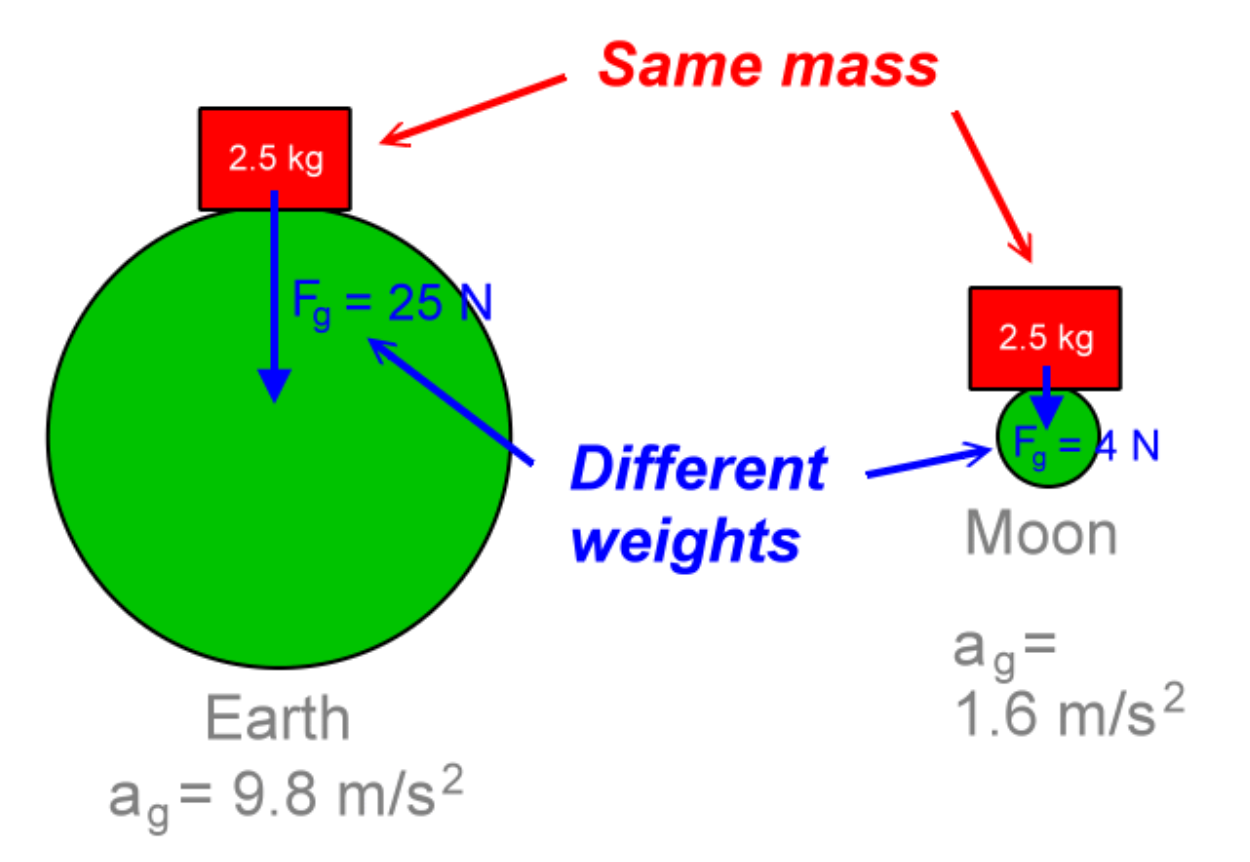
Image courtesy of Zonalandeducation
The Equation
The mass-weight relationship is encapsulated in the equation ( W = mg ), where:
- represents the weight of the object,
- denotes the mass of the object, and
- is the acceleration due to gravity.
This equation shows that weight is directly proportional to mass, with the acceleration due to gravity acting as the constant of proportionality.
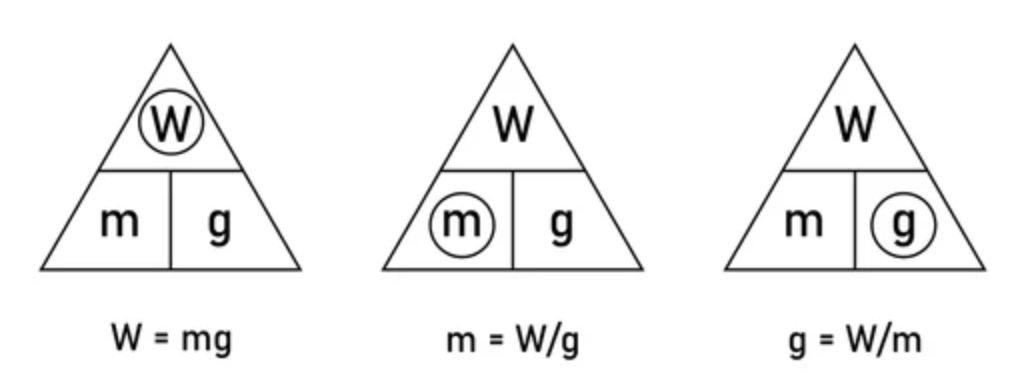
Acceleration Due to Gravity
In most educational contexts, is assumed to be for simplicity in calculations. This value is close to the actual average acceleration due to gravity on Earth's surface and is adequate for most academic purposes.
Application of Mass-Weight Relationship
This relationship is pivotal in various real-world scenarios, including engineering and space exploration.
Example 1: Calculating Weight on Earth
Problem: Find the weight of a 15 kg object on Earth.
Solution:
1. Formula: Weight (W) = mass (m) x gravity (g)
- Mass (m) = 15 kg
- Gravity on Earth (g) = 9.8 m/s² (sometimes rounded to 10 m/s² for simplicity)
2. Calculation:
- Exact: W = 15 kg x 9.8 m/s² = 147 Newtons (N)
- Rounded: W = 15 kg x 10 m/s² = 150 Newtons (N)
3. Result:
- The object's weight on Earth is about 147 N, or 150 N using the rounded gravity value.
Example 2: Weight Variations on Different Planets
Problem: Calculate the weight of a 15 kg object on Mars, where gravity is 3.7 m/s².
Solution:
1. Formula: Weight (W) = mass (m) x gravity (g)
- Mass (m) = 15 kg
- Gravity on Mars (g) = 3.7 m/s²
2. Calculation:
- W = 15 kg x 3.7 m/s² = 55.5 Newtons (N)
3. Result:
- The object would weigh 55.5 N on Mars.
Example 3: Determining Mass from Weight
Problem: Find the mass of a person who weighs 700 N on Earth.
Solution:
1. Formula Rearrangement: To find mass (m), rearrange the weight formula to:
- m = W/g
- Where W is weight and g is the acceleration due to gravity.
2. Known Values:
- Weight (W) = 700 N
- Gravity on Earth (g) = 9.8 m/s² (sometimes rounded to 10 m/s² for ease).
3. Calculation:
- Exact: m = ≈ 71.4 kg
- Rounded: m = = 70 kg
4. Result:
- The person's mass is about 71.4 kg, or 70 kg using the rounded gravity value.
Example 4: Weight Comparison on the Moon
Problem: Calculate the weight of an astronaut who has a mass of 80 kg, while they are on the Moon where gravity is 1.6 m/s².
Solution:
1. Formula: Use the weight formula:
- W = m x g
- Where W is weight, m is mass, and g is the acceleration due to gravity.
2. Known Values on the Moon:
- Mass of the astronaut (m) = 80 kg
- Gravity on the Moon (g) = 1.6 m/s²
3. Calculation:
- W = 80 kg x 1.6 m/s² = 128 Newtons (N)
4. Result:
- The astronaut's weight on the Moon is 128 N.