This topic focuses on the complexities of motion under the influence of various forces, primarily focusing on the effects of gravity and friction on objects situated on inclined surfaces. A clear understanding of these principles is fundamental for solving practical problems in physics and engineering applications.
Introduction to Motion on Planes
- Topic: Movement of particles on vertical and inclined planes.
- Focus: How forces affect motion under constant acceleration.
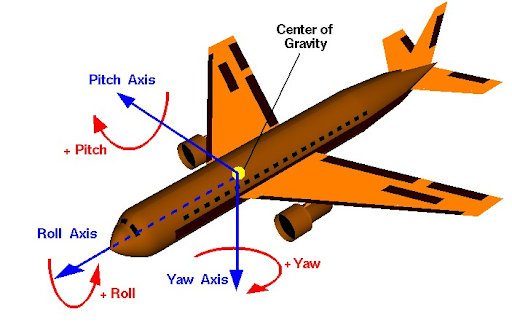
Image courtesy of Nasa Glenn Research Center
Key Concepts
1. Newton’s Second Law: Acceleration depends on net force and mass.
2. Gravity: Acts downwards.
3. Normal Force: Always perpendicular to the surface.
4. Friction: Opposes motion, parallel to the surface.
Inclined Planes
- Complex Forces: Includes gravity components, normal reaction, and friction.
- Force Components on Inclines:
- Gravity: Splits into two - one parallel and one perpendicular to the incline.
- Normal Reaction: Perpendicular to the incline.
- Friction: Parallel to the incline, opposes motion.
Resolving Forces
- Parallel to Plane: .
- Perpendicular to Plane: .
Example: Moving a Particle on an Incline
Situation: 5 kg particle on a 30° inclined plane, friction coefficient 0.3.
Goal: Find the force needed for constant upward velocity.
Steps:
1. Weight Components for 5 kg at 30°:
- Parallel: .
- Perpendicular: .
2. Frictional Force:
- .
3. Total Force Required:
- .
Conclusion: About is needed to move the particle up the plane at a constant speed.
Understanding Motion on Rough Planes
- Focus: How friction affects particle motion on rough inclines.
Friction on Inclines
- Frictional Force: Relies on friction coefficient and normal reaction .
- Direction: Friction opposes the particle's motion.
Example: Particle on a Rough Incline
- Scenario: kg particle on a incline, friction coefficient .
- Task: Find particle's acceleration when released.
Steps:
1. Calculating Forces for kg at with Friction:
- Parallel Gravity Force: .
- Perpendicular Gravity Force: .
2. Frictional Force:
- .
3. Net Force and Acceleration:
- Net Force: .
- Acceleration: .
Conclusion: The particle accelerates at approximately 3.45 m/s² on the rough incline.