IB Syllabus focus: 'Students should consider the structures of political systems and how they regulate interactions between political actors.'
Political systems are not just governments; they are organized arrangements of authority that shape who can make decisions, who can challenge them, and how conflicts between actors are managed.
What is meant by structure?
A political system is the formal arrangement of institutions through which public authority is organized. Structure matters because it determines where power is located, how decisions move through the system, and which actors can influence outcomes.
Political system: The organized set of institutions and decision-making processes through which authority is exercised and collective decisions are made.
When IB Global Politics refers to the structures of political systems, it is asking how institutions are designed and connected. A system may divide authority between branches, levels of government, and representative bodies. These arrangements create rules of interaction: who proposes laws, who approves them, who implements them, and who can review or block them.
Core institutions
Most political systems include several key institutions:
an executive that leads government and sets policy direction
a legislature that debates, amends, and passes laws
a judiciary that interprets law and resolves disputes
a bureaucracy or civil service that carries out decisions
subnational governments such as states, provinces, or municipalities in some systems
The relative strength of these institutions shapes political interaction. A strong legislature can scrutinize executives closely. A weak judiciary may struggle to limit abuses of power. Extensive local government can open additional channels for participation and bargaining.
How authority is distributed
Political systems vary in how they distribute authority horizontally and vertically. Horizontal distribution refers to relations among institutions at the same level of government, especially the executive, legislature, and judiciary.
A common structural principle is separation of powers.
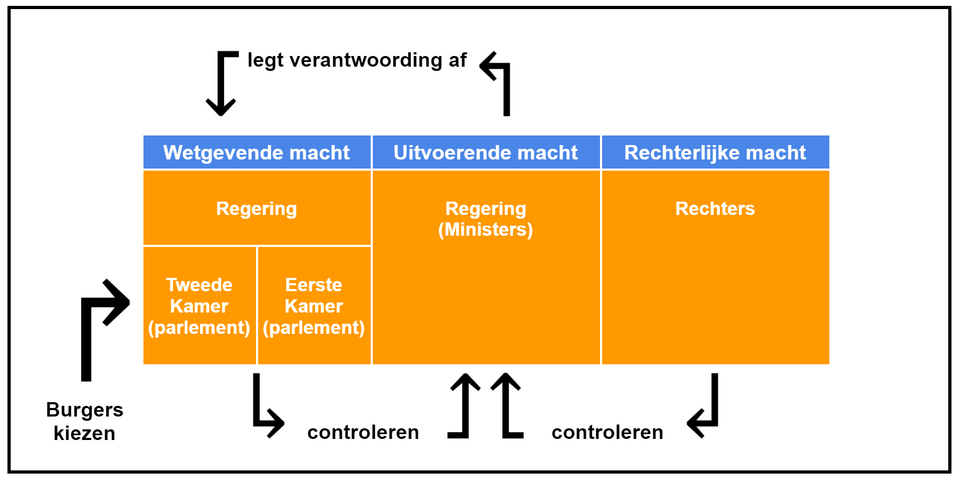
This diagram visualizes the trias politica (separation of powers) by distinguishing the legislative, executive, and judicial branches and mapping how they constrain one another. It helps show that “structure” is not just a list of institutions, but a pattern of relationships that regulates decision-making and limits concentrated authority. Source
Separation of powers: The division of state authority among different branches of government so that no single branch controls all major powers.
In presidential systems, executives are usually separately elected and institutionally distinct from the legislature. This can create clearer checks, but it can also produce deadlock when branches are controlled by rivals. In parliamentary systems, the executive usually emerges from the legislature, so interaction may be more coordinated, especially when one party has a majority. Semi-presidential systems combine features of both, often creating shared authority between a president and a prime minister.
Vertical distribution concerns the relationship between central and territorial levels of government. Some systems are unitary, meaning most authority is concentrated at the national level. Others are federal.
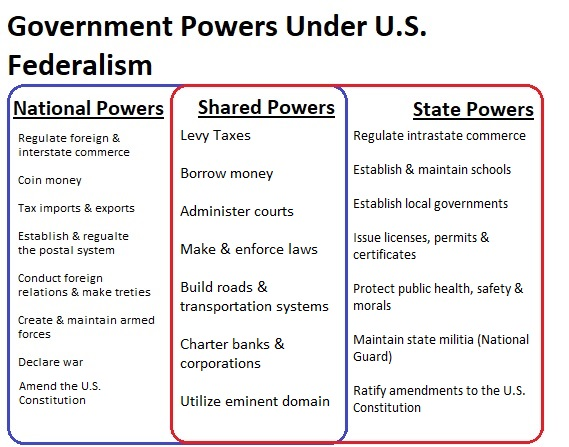
This Venn diagram illustrates federalism as a division of authority between central and regional governments, while also highlighting shared (concurrent) powers. It supports comparative analysis by making it easy to point to which policy competences are exclusive to one level and which require intergovernmental negotiation. Source
Federalism: A structure in which constitutional authority is divided between a central government and regional governments, each with protected powers.
Federal structures regulate interaction by requiring negotiation between levels of government over taxation, welfare, education, policing, or infrastructure. Unitary systems can act more uniformly, but local voices may have fewer constitutionally protected powers.
Representation within the structure
Political structures also determine how interests enter the system. Electoral systems shape which parties win representation and how leaders are selected. Majoritarian systems often favor larger parties and may produce single-party governments. Proportional systems usually allow a wider range of parties into legislatures, increasing coalition-building and bargaining.
The party system is closely connected to structure. In a two-party setting, competition may be concentrated and adversarial. In a multiparty system, negotiation across parties becomes more central to government formation and lawmaking. This affects how easily actors can build alliances, block legislation, or represent minority viewpoints.
Legislative design matters as well. A bicameral legislature can create an additional checking body, especially if the second chamber represents regions or has the power to delay legislation. A unicameral legislature may pass laws more efficiently but provides fewer internal veto points.
How structures regulate interaction
Structures of political systems regulate political interaction in several important ways:
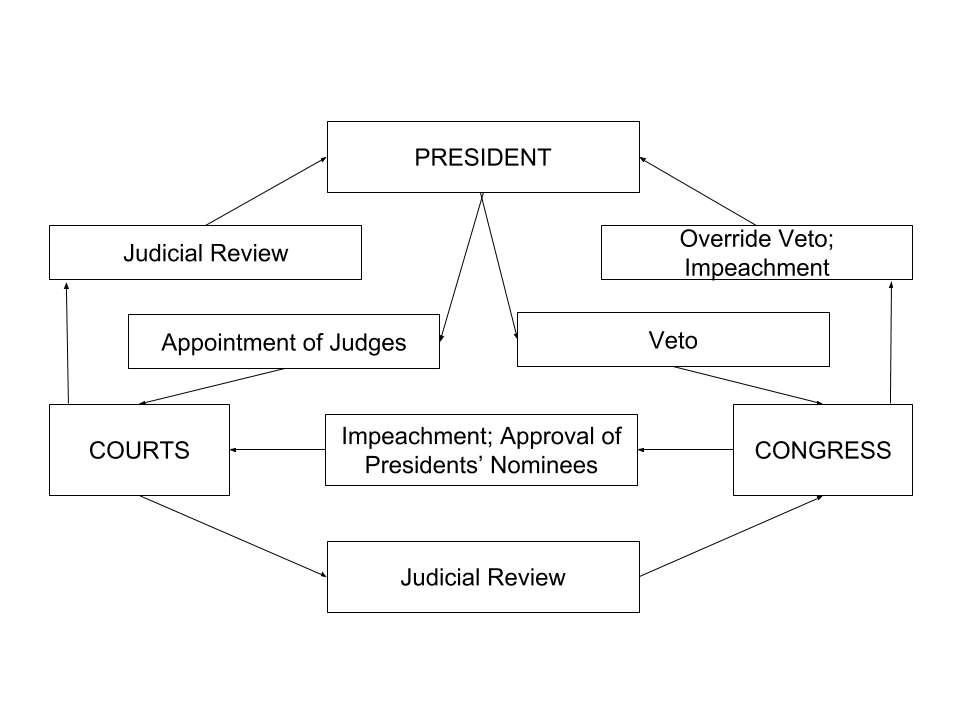
This flowchart depicts concrete “checks and balances” interactions among the executive, legislature, and courts (for example, vetoes, impeachment, judicial review, and judicial appointments). It is useful for explaining how institutional design creates predictable channels for oversight, constraint, and conflict management rather than relying on individual leaders’ preferences. Source
they allocate authority, deciding which actor has formal power in each policy area
they create access points, allowing some actors more routes into decision-making than others
they establish checks and balances, limiting concentration of power
they shape accountability, clarifying who can be blamed, removed, or challenged
they determine conflict-management mechanisms, such as judicial review, legislative oversight, or intergovernmental negotiation
For example, where courts can review legislation, executives and legislatures must anticipate legal constraints. Where local governments control major services, national leaders must bargain rather than simply command. Where legislatures are weak, executives may dominate agenda-setting and reduce scrutiny.
What to look for in case studies
When analyzing a political system, focus on the design of its institutions rather than only on individual leaders. A good comparison identifies the formal channels through which actors must cooperate, compete, or seek approval.
Key questions include:
Where is authority concentrated or dispersed?
Which institutions can veto, delay, or amend decisions?
How are national and subnational governments connected?
How does the electoral structure affect party competition?
Which actors have regular access to decision-making, and which are marginalized?
Practice Questions
[3 marks]
Identify one structural feature of a political system and explain one way it regulates interactions between political actors.
1 mark for identifying a valid structural feature, such as separation of powers, federalism, bicameralism, or an electoral system.
1 mark for accurately describing how that feature distributes authority or access.
1 mark for linking the feature to regulation of interaction, such as oversight, bargaining, vetoes, or coordination.
[6 marks]
Explain how the design of political institutions can shape the relationship between the executive and the legislature in different political systems.
1 mark for identifying one relevant institutional design feature, such as presidential, parliamentary, or semi-presidential structure.
1 mark for accurately describing how that feature organizes executive-legislative authority.
1 mark for explaining one effect on interaction, such as cooperation, scrutiny, or deadlock.
1 mark for introducing a second relevant structural feature or contrasting system.
1 mark for explaining a second effect on interaction, such as coalition-building, veto points, or legislative control.
1 mark for a developed comparative point or a clearly applied real-world example that supports the explanation.
FAQ
Devolution transfers powers from the center to regional or local bodies, but the national legislature usually remains legally sovereign and can redesign those powers.
Federalism divides powers constitutionally. Regional units have authority that the center cannot normally remove by ordinary legislation. This makes territorial power-sharing more durable and usually creates stronger intergovernmental bargaining.
A separate constitutional court specializes in disputes about the constitution, elections, federal divisions of power, and rights. Designers may prefer it when they want a clearly defined guardian of the constitutional order.
This can also separate ordinary appeals from highly political constitutional questions, which may reduce overload and clarify jurisdiction. In other systems, a supreme court performs both roles instead.
Asymmetric federalism means different regions have different constitutional powers. This often appears where some territories have strong nationalist movements, indigenous autonomy claims, or distinct historical agreements.
It can help manage diversity without granting the same level of autonomy everywhere. However, it may also trigger debates about fairness, fiscal balance, and whether unequal powers encourage or reduce separatist pressure.
Amendment rules determine how easily the system's structure can be changed. If amendment requires only a simple majority, central institutions can be redesigned quickly. If it requires supermajorities, referendums, or regional consent, structural change becomes harder.
Rigid amendment rules can protect minorities and federal bargains. Flexible rules can make institutions more adaptable. The trade-off is usually stability versus responsiveness.
Independent commissions are public bodies designed to operate at arm's length from day-to-day party competition. Examples include electoral commissions, boundary commissions, audit offices, and anti-corruption agencies.
Structurally, they matter because they remove some sensitive decisions from direct executive control. That can increase trust in elections, spending oversight, and rule enforcement, especially in polarized systems. Their impact depends on legal protection, appointment rules, and resources.