

IB Syllabus focus: 'Water and electrolyte balance can be measured using body weight, urine colour and osmolarity. Electrolyte balance is regulated by the hypothalamus, pituitary gland and kidneys.'
Hydration status affects physiological function, exercise safety, and performance. This topic focuses on practical ways to assess body water balance and on the hormonal control system that keeps fluid and electrolyte levels stable.
Measuring hydration status
Hydration can be assessed in several ways, but each method gives slightly different information. In IB SEHS, the key methods are body weight, urine color, and osmolarity. These methods vary in convenience, precision, and how easily they can be used in field or laboratory settings.
Body weight
Short-term changes in body weight are a practical indicator of fluid balance. Over a short period, especially around exercise, a decrease in body weight usually reflects loss of body water more than loss of fat or muscle tissue. For that reason, body weight is widely used to monitor hydration before and after training or competition.
Measurements should be taken under similar conditions to improve accuracy:
same scale
similar clothing
similar time of day
ideally after using the bathroom
Repeated measurements are more useful than a single isolated value.
Body weight is quick, inexpensive, and non-invasive.
Body weight does have limitations. Recent food intake, bowel contents, and differences in clothing can change the reading. This means body weight is helpful for monitoring trends, but it is less reliable if used alone without consistent testing conditions.
Urine color
Urine color provides a simple visual estimate of hydration. Pale yellow urine usually suggests a more dilute sample, while darker urine usually suggests a more concentrated sample and lower body water availability. Because it is easy to check, urine color is commonly used in schools, teams, and training environments.
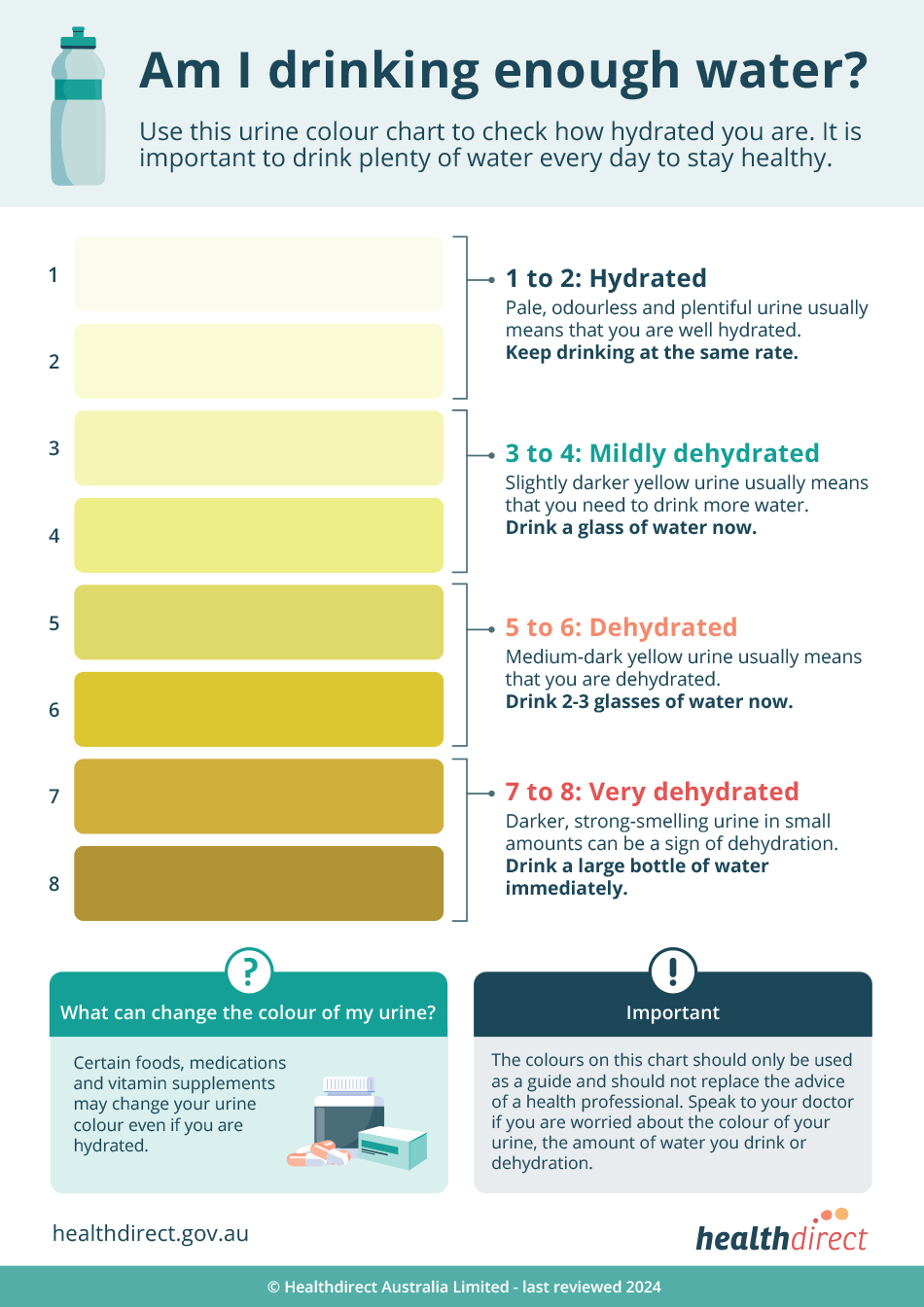
A simple urine-colour reference chart that categorizes shades into hydration bands (e.g., hydrated vs. dehydrated) for quick field screening. It supports your point that urine color is convenient but should be interpreted cautiously and ideally alongside other measures. Source
Urine color is most useful when checked regularly over time.
It should be judged in similar lighting conditions.
A standard urine color chart can improve consistency.
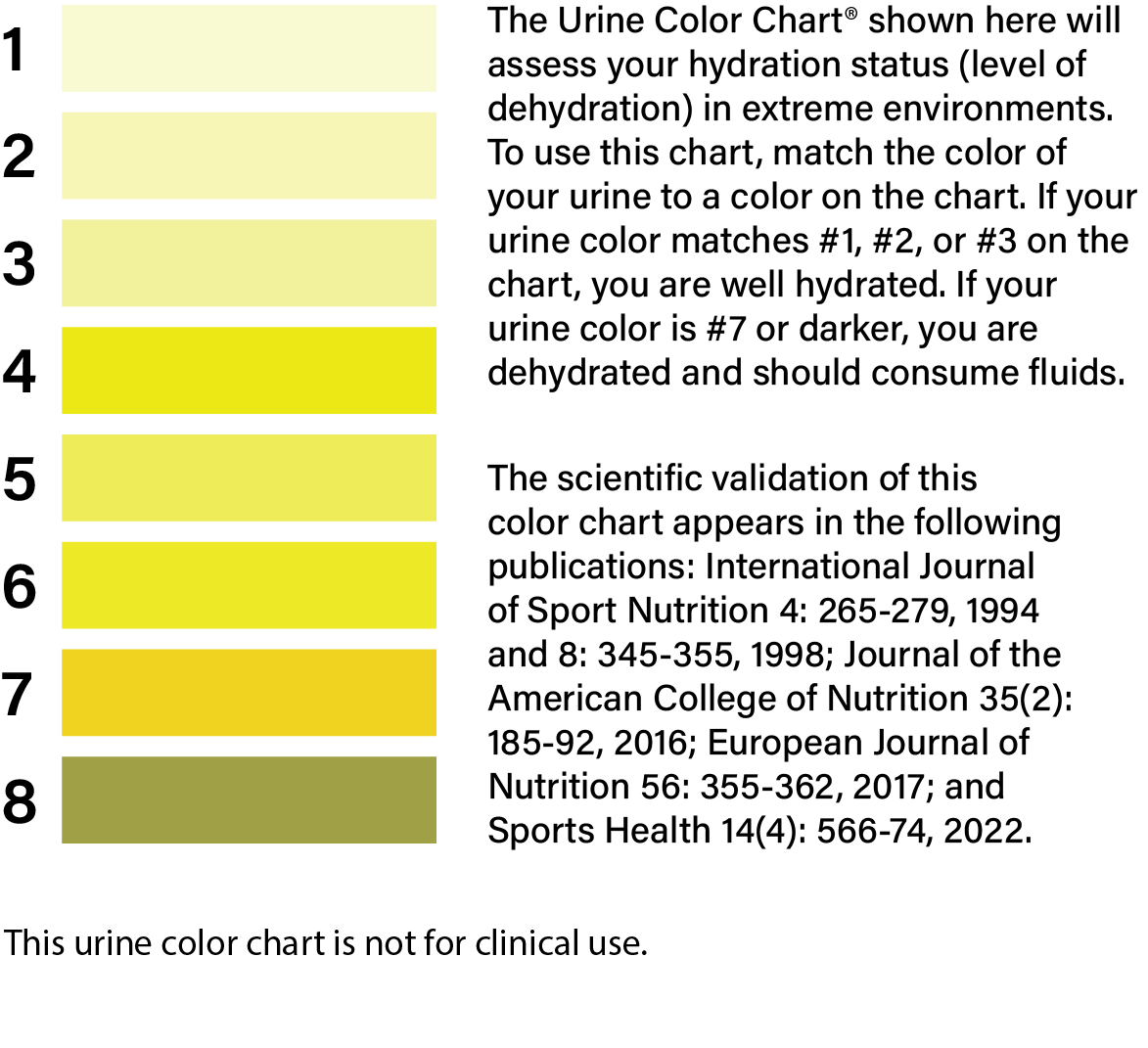
A validated urine color chart with standardized shades that can be matched to a urine sample to estimate hydration status. It reinforces the practical idea that paler urine generally reflects more dilute urine, while darker urine indicates greater concentration (often consistent with hypohydration). Source
It is best used as a practical screening method rather than a precise laboratory test.
This method is convenient, but it is not perfect. Vitamins, medications, and some foods can change urine color even when hydration status has not changed. As a result, urine color should be interpreted carefully and, when possible, alongside another measure.
Osmolarity
Osmolarity gives a more objective indication of fluid concentration. When body fluids contain less water relative to dissolved particles such as electrolytes, osmolarity rises. When there is more water relative to dissolved particles, osmolarity falls. This makes osmolarity useful for identifying how concentrated a fluid sample is.
Osmolarity: The concentration of dissolved particles in a solution, usually used to indicate how concentrated a body fluid is.
In hydration assessment, osmolarity can be measured from urine or blood samples. Compared with urine color, it is more precise. Compared with body weight, it is less affected by clothing or scale inconsistency. However, it usually requires specialized equipment, so it is less practical for everyday field use.
For IB SEHS, the key idea is straightforward: higher osmolarity means a more concentrated fluid, which usually indicates lower hydration status. Lower osmolarity means the fluid is more dilute.
Regulation of water and electrolyte balance
The body does not depend only on drinking behavior to stay hydrated. It also uses an internal control system to keep water and electrolyte levels within a narrow range. The syllabus focuses on the hypothalamus, pituitary gland, and kidneys. Together, these structures detect changes, send hormonal signals, and adjust urine production to restore balance.
Hypothalamus
The hypothalamus acts as the main monitoring center. It detects changes in the concentration of the blood, especially when the blood becomes more concentrated. If plasma osmolarity rises, this indicates that there is relatively less water compared with dissolved particles.
The hypothalamus then helps initiate two important responses:
it stimulates thirst, encouraging fluid intake
it signals that more water should be conserved by the body
This makes the hypothalamus the key structure for sensing fluid imbalance and coordinating the body’s response.
Pituitary gland
The pituitary gland, specifically the posterior pituitary, releases antidiuretic hormone (ADH) when the hypothalamus detects that body fluids are too concentrated.
Antidiuretic hormone (ADH): A hormone released from the pituitary gland that increases water reabsorption by the kidneys.
When osmolarity is high, ADH secretion increases.
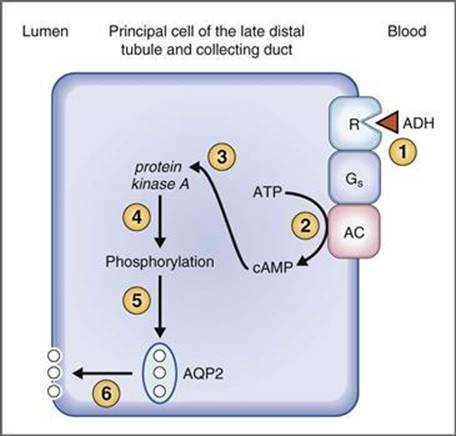
Cellular mechanism of antidiuretic hormone (ADH) action in a kidney collecting-duct principal cell. The figure traces the signaling pathway from ADH binding at the basolateral membrane to insertion of aquaporin-2 (AQP2) channels in the apical membrane, increasing water permeability and promoting water reabsorption. Source
When the body has excess water and the blood is more dilute, ADH secretion decreases. The pituitary gland therefore links detection in the brain to the response carried out by the kidneys.
Kidneys
The kidneys are the main organs that carry out the corrective response. They continuously filter the blood and adjust how much water is reabsorbed back into the body or lost in urine. Their activity changes according to the level of ADH in the blood.
When ADH levels are high, the kidneys reabsorb more water into the bloodstream. This leads to:
a smaller volume of urine
more concentrated urine
conservation of body water
When ADH levels are low, the kidneys reabsorb less water. This produces:
a larger volume of urine
more dilute urine
greater loss of excess water
Because electrolytes are dissolved in body fluids, regulating water reabsorption also helps regulate electrolyte concentration. If too much water is lost, electrolyte concentration rises. By conserving or excreting water appropriately, the kidneys help restore normal fluid and electrolyte balance under the control of the hypothalamus and pituitary gland.
Practice Questions
(3 marks) State three methods used to measure hydration status.
1 mark for body weight
1 mark for urine color
1 mark for osmolarity
(6 marks) Explain how the hypothalamus, pituitary gland, and kidneys regulate water and electrolyte balance when body fluids become too concentrated.
Mark scheme Award 1 mark for each valid point, up to 6 marks:
Hypothalamus detects increased concentration or increased osmolarity of body fluids
Hypothalamus stimulates thirst
Hypothalamus signals the pituitary gland
Pituitary gland releases ADH
ADH causes the kidneys to reabsorb more water
Urine volume decreases and urine becomes more concentrated
Water is conserved, helping return osmolarity toward normal
Restoring water balance also helps restore electrolyte concentration
FAQ
First-morning checks are often more consistent because they are less affected by recent meals, exercise, and fluid intake.
They are still not perfect:
late drinking can dilute urine
overnight sweating can lower body weight
bathroom use can change the result
This is why comparing several days is usually better than relying on one reading.
Both describe how concentrated a fluid is, but they are based on different reference measures.
Osmolarity is based on the volume of solution
Osmolality is based on the mass of the solvent
In many practical situations, the values are very similar. In physiology and clinical work, osmolality is often preferred because it is less affected by temperature, but IB SEHS uses osmolarity in this subsubtopic.
Yes. Glycogen stored in muscle and liver is held with water, so body weight can increase when carbohydrate stores increase.
This means:
a higher body weight is not always overhydration
a lower body weight is not always only fluid loss
recent diet can affect interpretation
That is why body weight works best when compared with a personal baseline and combined with other hydration measures.
ADH can change quite rapidly. The brain can detect shifts in fluid concentration within minutes, and hormone release can begin soon after.
The visible effect on urine takes a little longer because:
blood must circulate the hormone
kidneys must alter reabsorption
urine already in the bladder reflects earlier conditions
So regulation is fast, but the measurement you see may lag behind the initial signal.
Yes. Very clear urine can happen after drinking a large volume of fluid in a short time, even if the body did not need that much water.
In sport settings, this can be misleading because:
it may reflect recent drinking, not stable hydration
it can hide earlier fluid loss
repeated overdrinking may dilute sodium concentration
Clear urine is therefore not automatically a sign of ideal hydration. Context still matters.
