

Question 1
Graphing calculator required
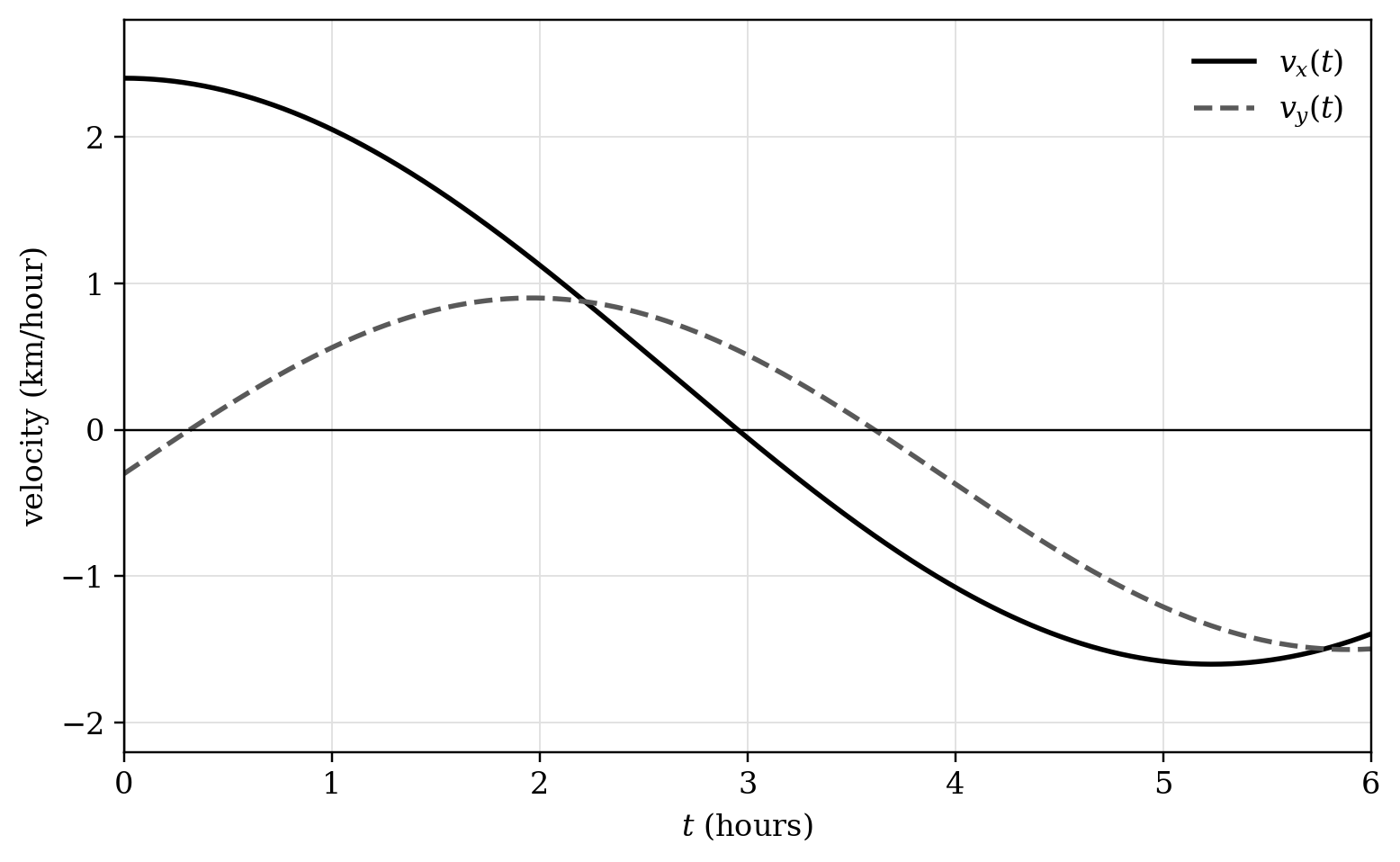
A survey drone moves in a horizontal plane. For , where is measured in hours, its velocity components are
and
.
Velocity is measured in . At time , the drone is at the position kilometres. The graph shows the two velocity components. Round calculator results to three decimal places.
Write an expression for the drone’s position vector at time .
Calculate the drone’s position at time .
Determine the first time in at which the drone’s horizontal direction changes from eastward to westward.
Calculate the total distance travelled by the drone from to .
Justify whether the drone’s speed is increasing or decreasing at .
Interpret the horizontal motion of the drone immediately after the time found in part (b).
Question 2
Graphing calculator not permitted
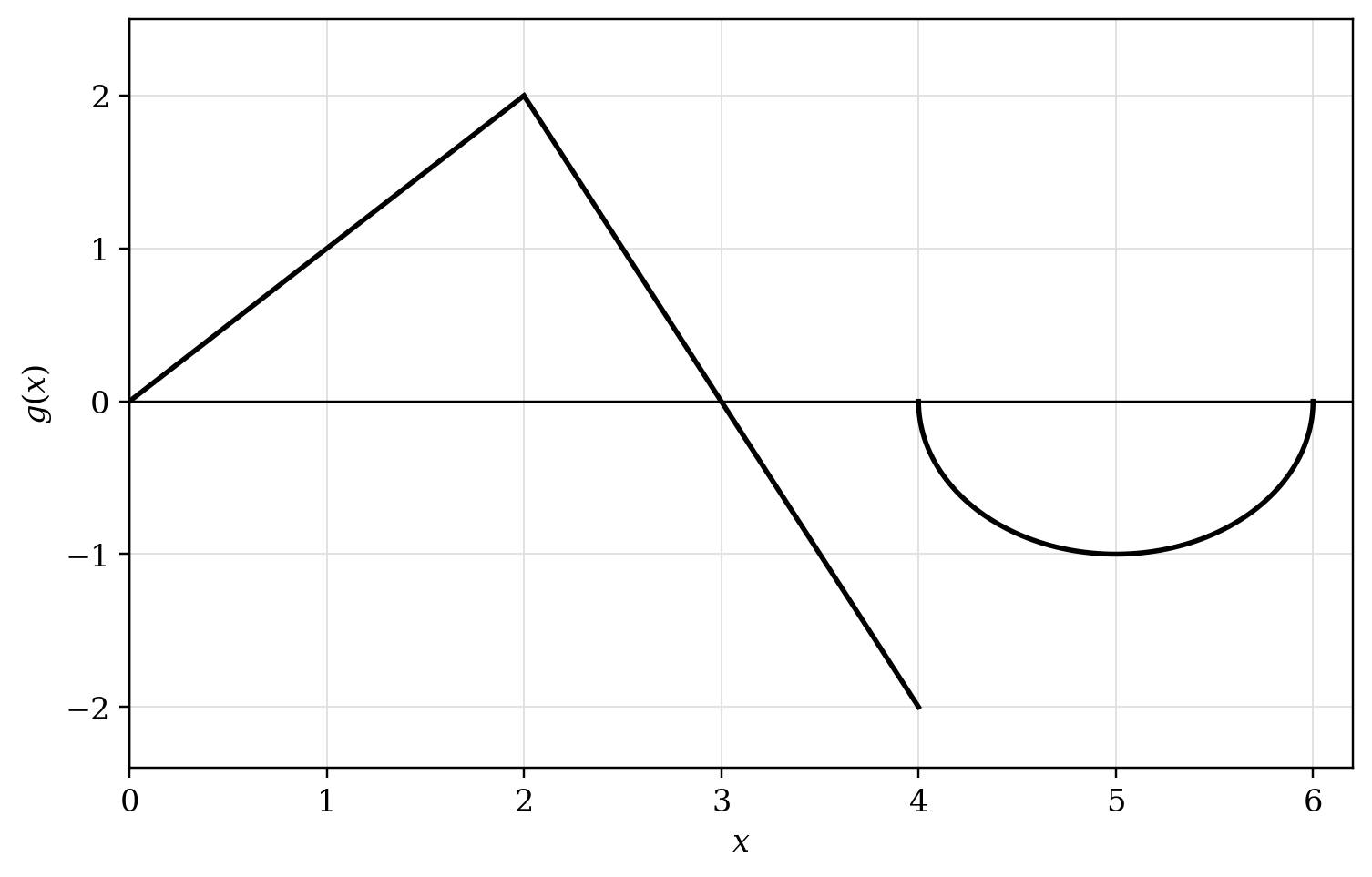
The graph shows a continuous function . The curved portion from to is a semicircle of radius lying below the -axis. Define
.
What is ?
A.
B.
C.
D.
Question 3
Graphing calculator required
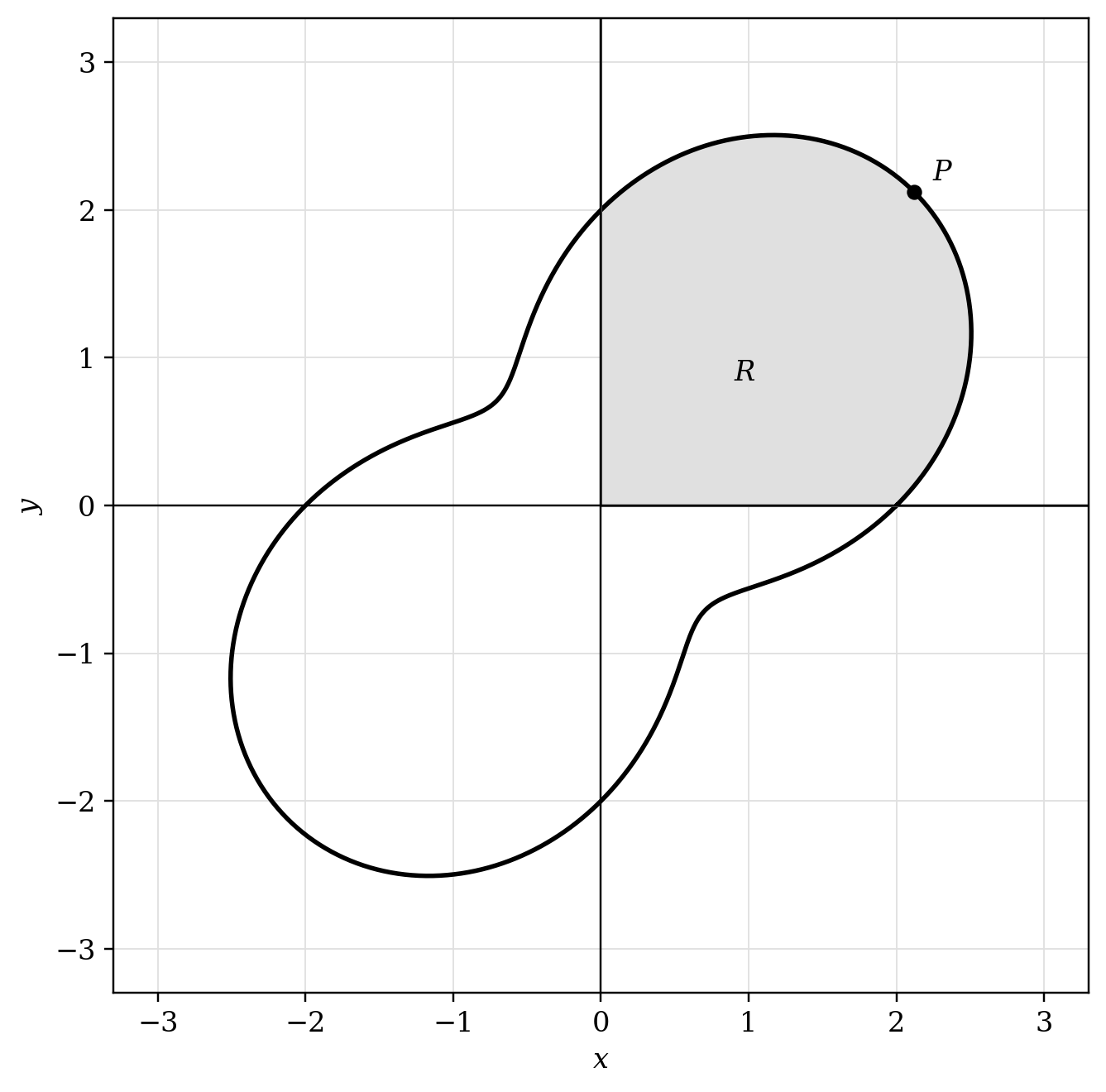
The polar curve is defined by
for . The region is bounded by the curve and the rays and . Point corresponds to . Round calculator results to three decimal places.
Calculate the rectangular coordinates of .
Calculate at .
Represent the line tangent to the polar curve at with an equation in and .
Write an expression for the area of region .
Evaluate the area of region exactly.
Write an expression for the length of the curve from to .
Approximate the length of this part of the curve.
Explain the direction in which the point on the curve is moving at as increases.
Question 4
GRAPHING CALCULATOR NOT PERMITTED
A curve is defined parametrically by and for . What is the value of at ?
A.
B.
C.
D.
Question 5
Graphing calculator not permitted
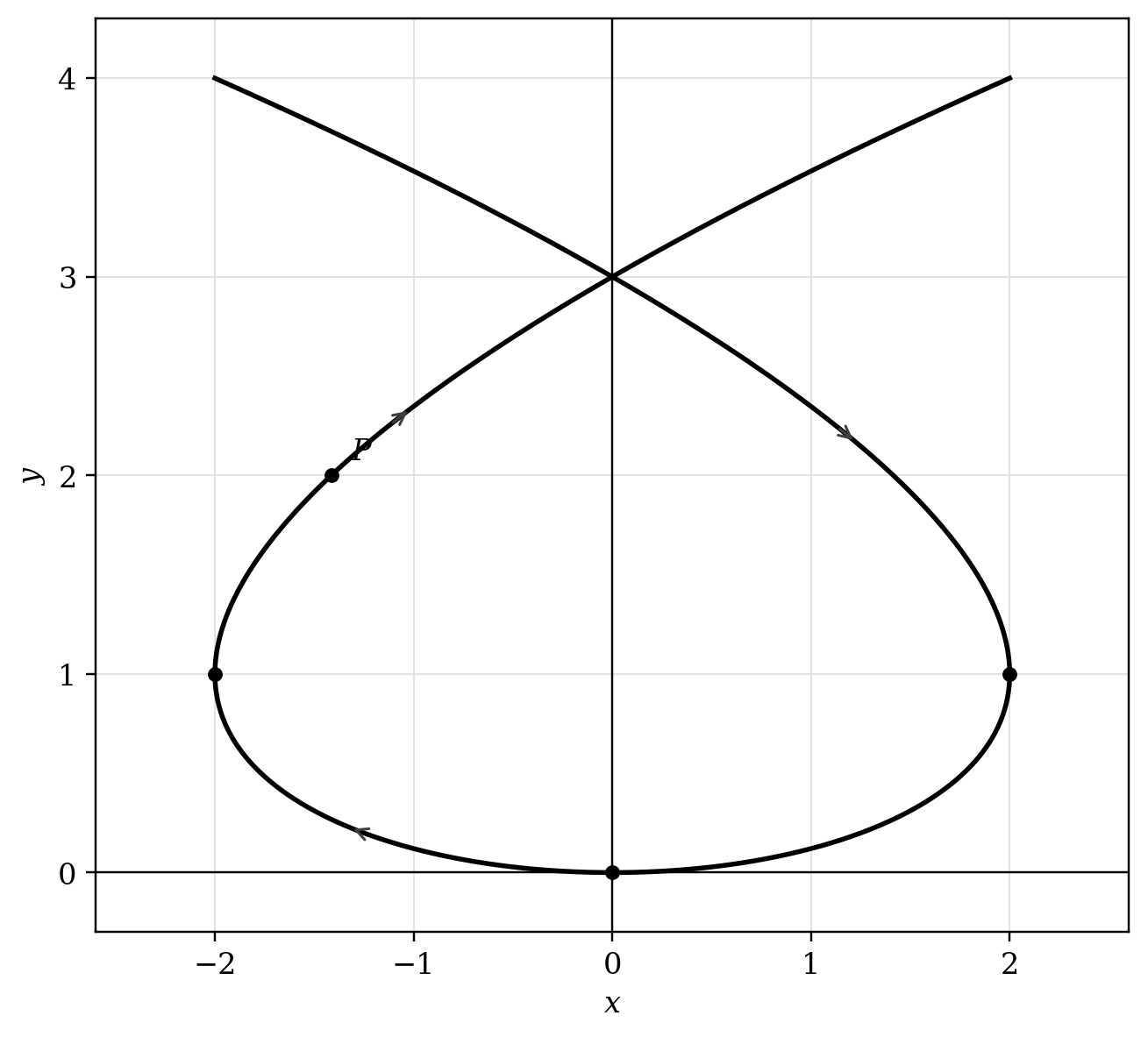
A curve is defined parametrically by
and
for . Point corresponds to .
Verify that the curve has a horizontal tangent at .
Verify that the curve has vertical tangents at and .
Calculate at .
Calculate at .
Determine whether the curve is concave up or concave down at .
Justify that on , can be treated as a differentiable function of and that this function is concave down.
Question 6
Graphing calculator not permitted
A ground robot moves along a path described by
and
for , where position is measured in metres and time is measured in seconds. Point corresponds to .
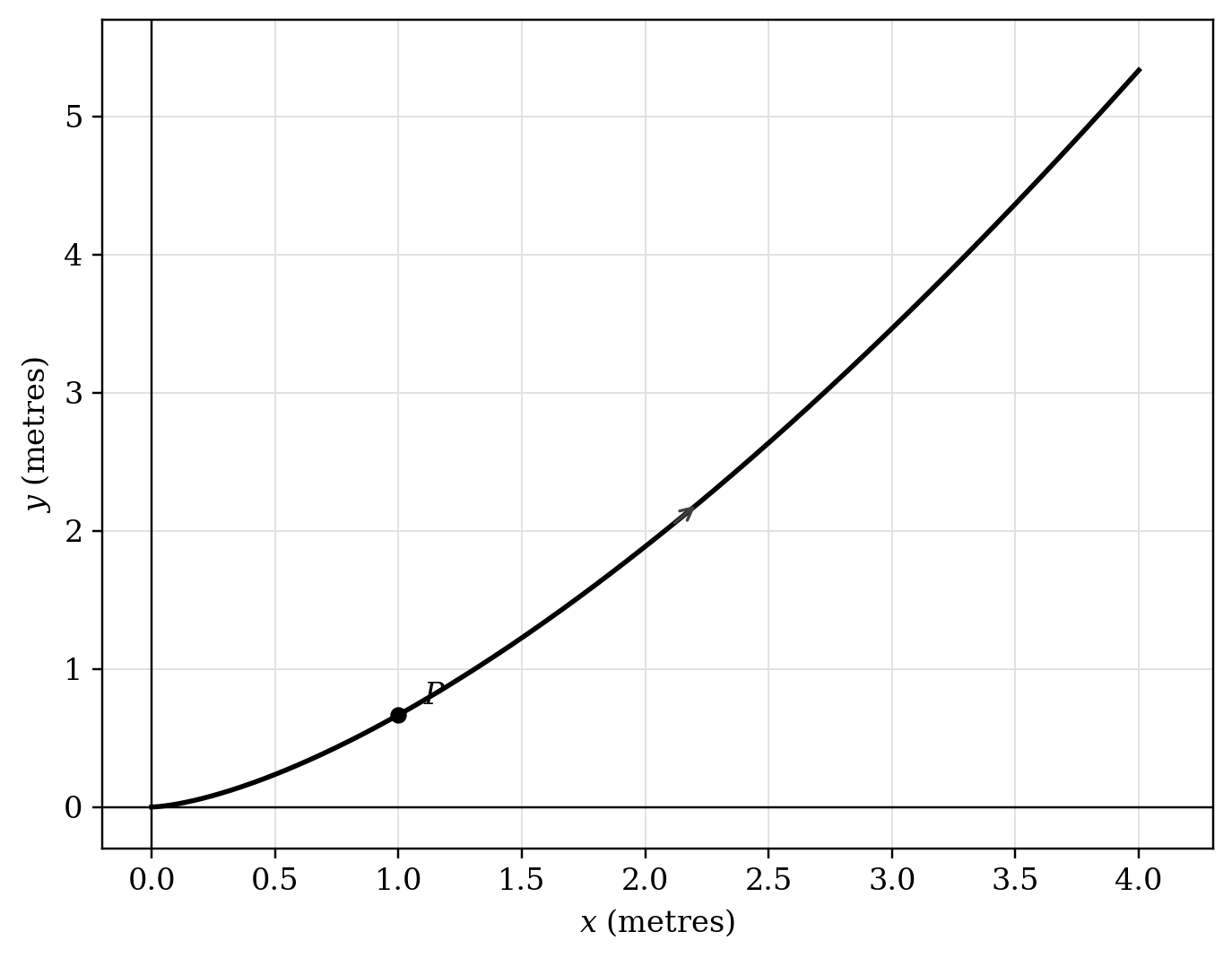
Calculate the velocity vector and acceleration vector at .
Represent the line tangent to the robot’s path at .
Calculate the total distance travelled from to .
Determine the robot’s displacement vector and the magnitude of its displacement from to .
Justify that the robot’s speed is increasing for .
Question 7
Graphing calculator not permitted
The graph shows the polar curves
and
.
Region lies inside and outside .
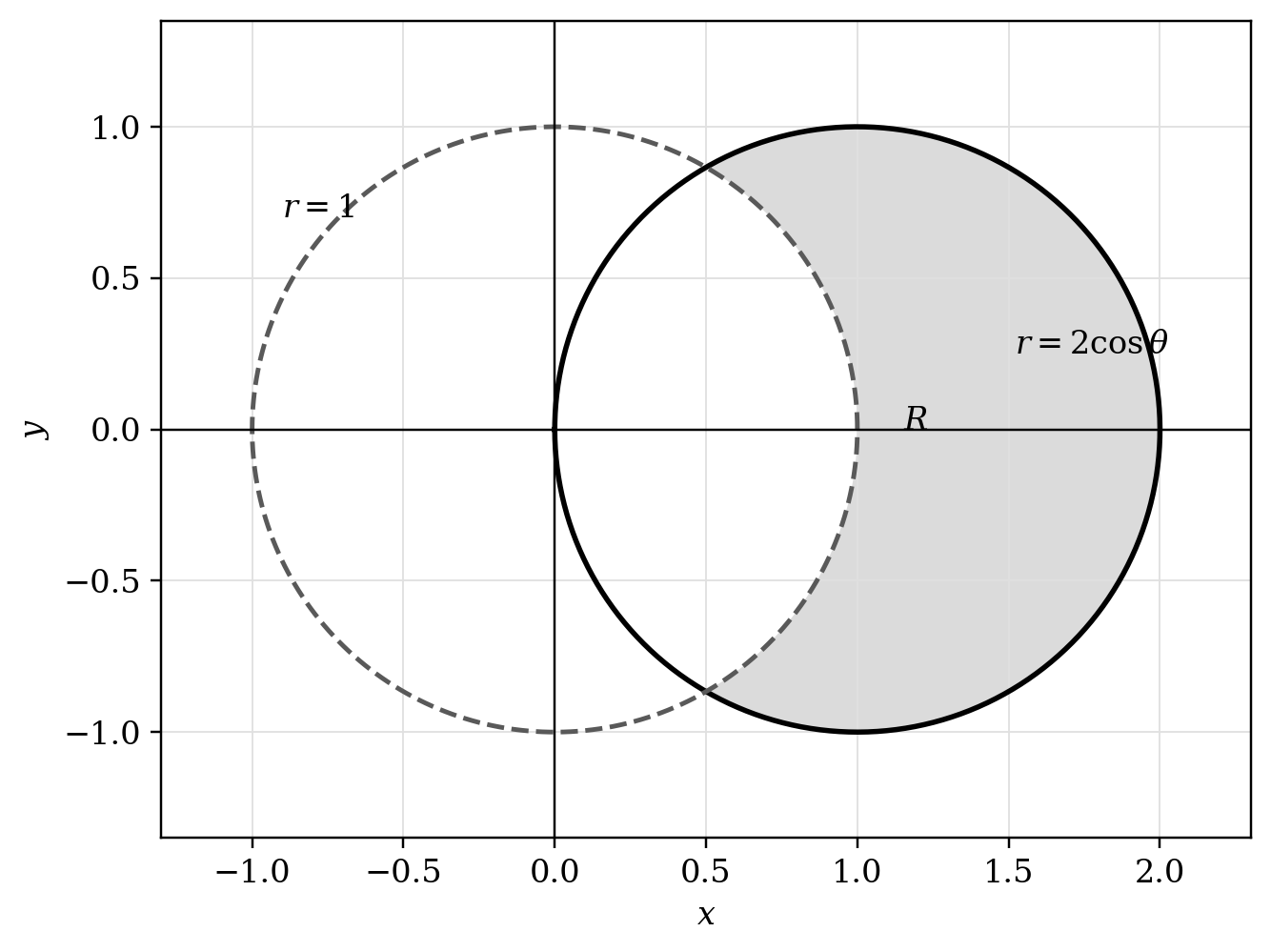
Determine the two angles at which the curves intersect and that bound region .
Write an expression for the area of region .
Evaluate the area of region .
Calculate the slope of the line tangent to at the upper intersection point.
Represent the tangent line at the upper intersection point with an equation in and .
Question 8
Graphing calculator not permitted
A particle has position for . The graph shows the velocity components and . At , the particle is at . Time is measured in seconds, position in metres, and velocity in .
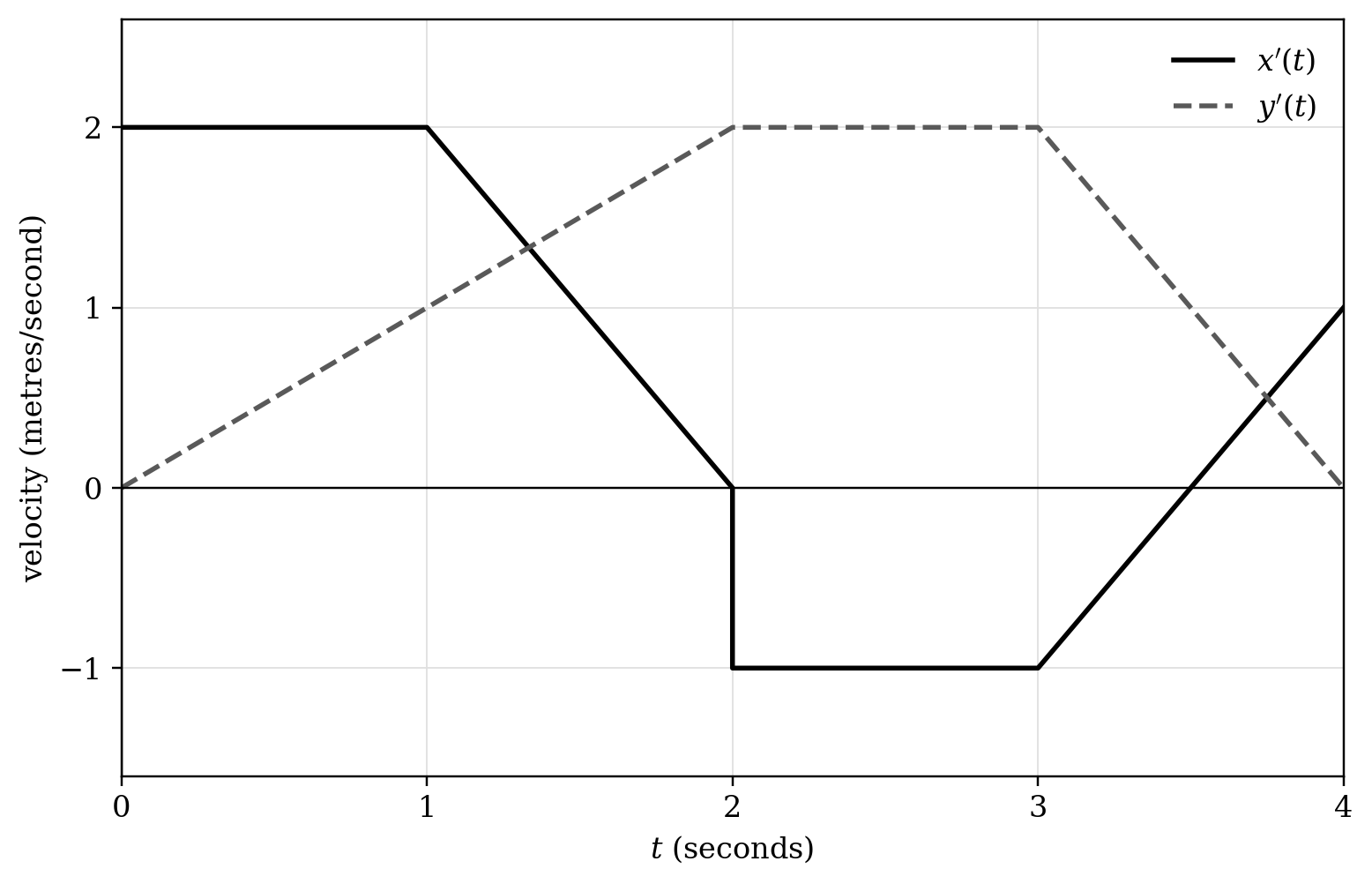
Calculate the particle’s position at .
Represent and algebraically for .
Represent the portion of the particle’s path for with a Cartesian equation relating and .
Calculate the particle’s average velocity vector on .
Interpret the particle’s motion at .
Question 9
Graphing calculator not permitted
A curve is defined parametrically by differentiable functions and for . The graph shows and . Both component graphs are linear on each displayed segment.
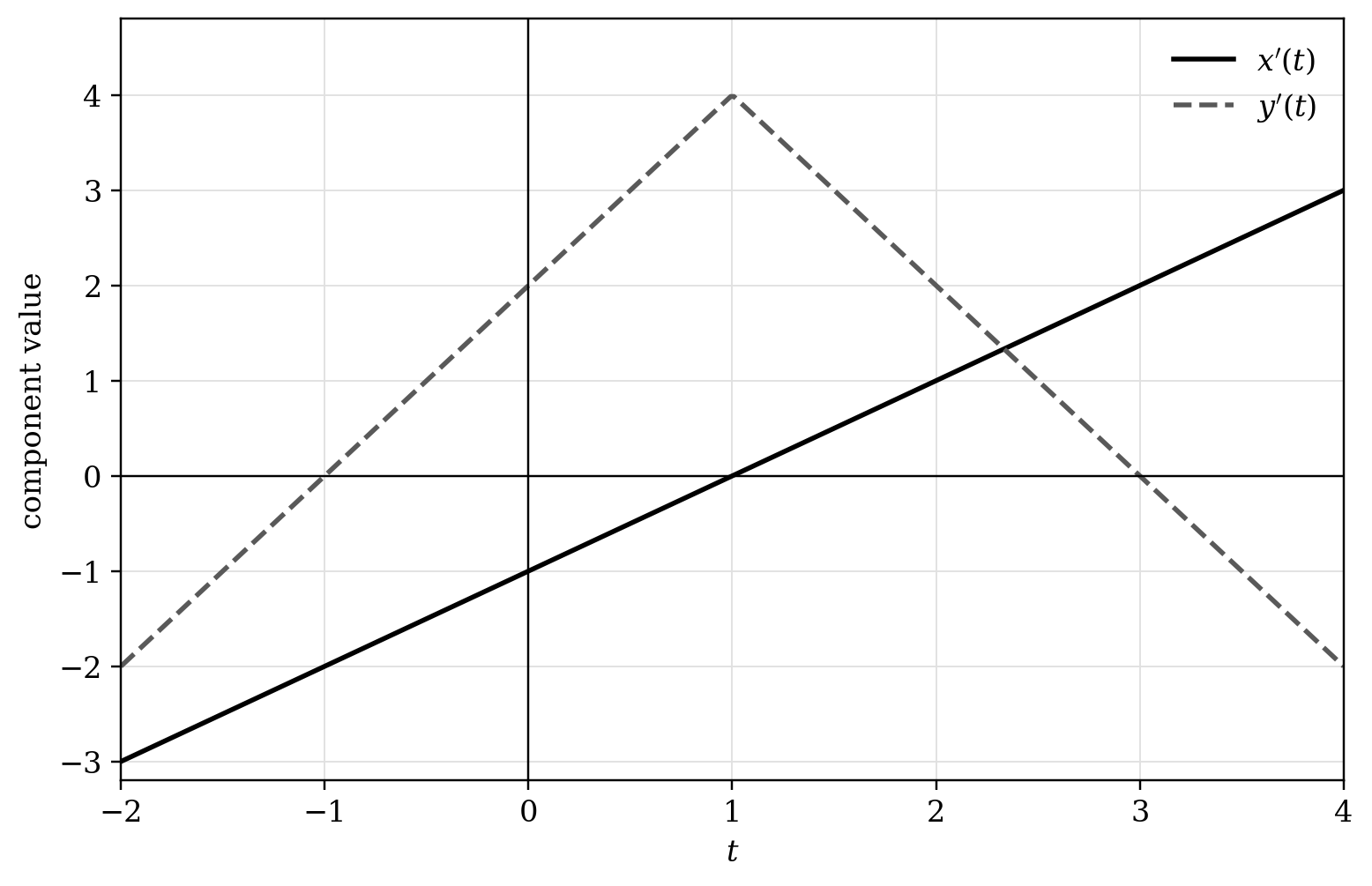
Determine all values of at which the curve has a horizontal tangent.
Verify that the horizontal-tangent condition is satisfied at those times.
Determine the value of at which the curve has a vertical tangent.
Verify that the vertical-tangent condition is satisfied at that time.
Justify whether the speed of the particle is increasing or decreasing at .
Calculate at .
Determine the concavity of the curve at .
Question 10
Graphing calculator not permitted
The polar curve is
.
The shaded region is the part of the curve lying above the -axis. What is the area of ?
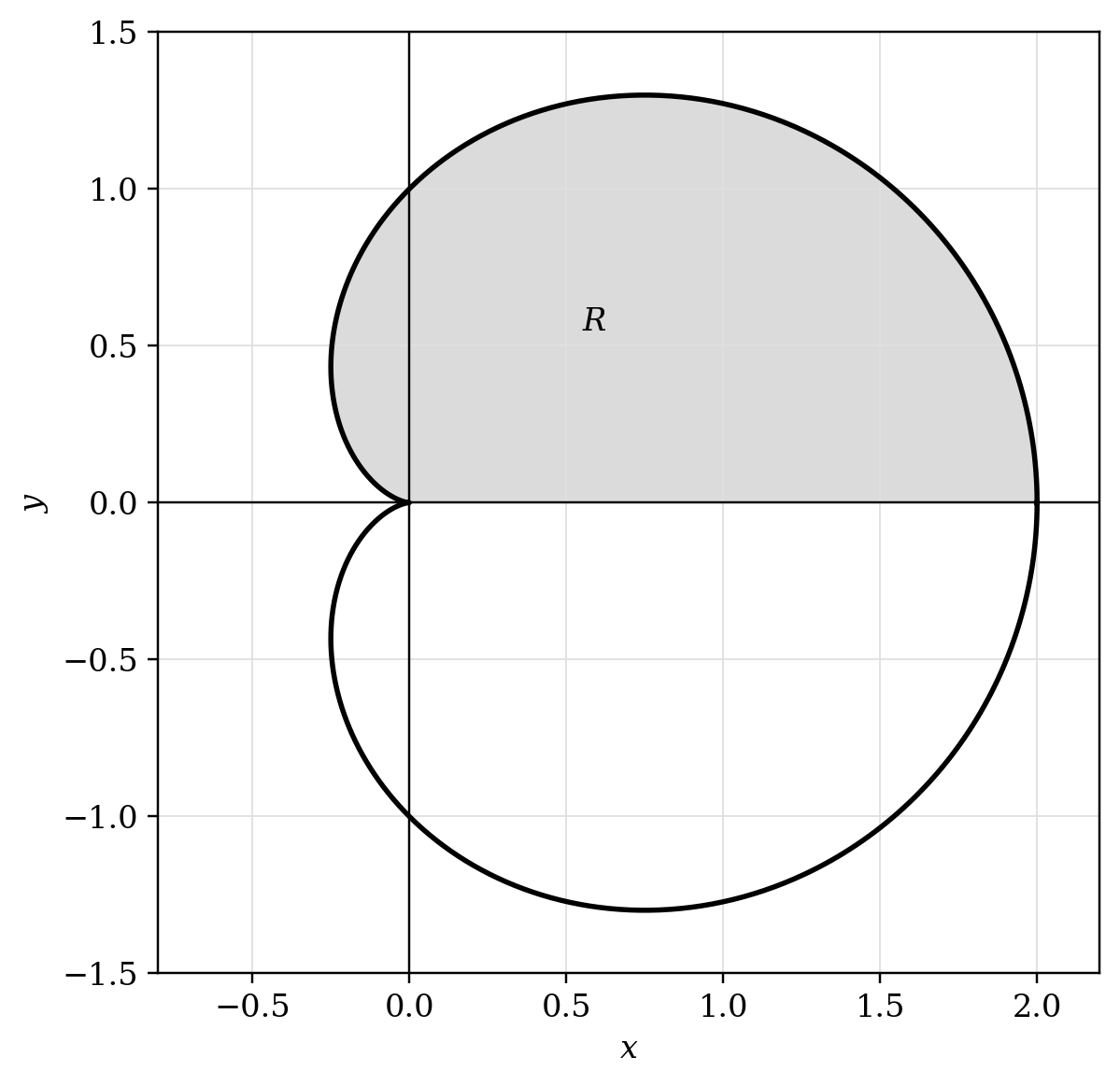
A.
B.
C.
D.