

Question 1
A low-friction wagon and rider are pushed horizontally. The image below shows the physical situation and a free-body representation of the same system. The wagon and rider may be treated as one system located at its center of mass.
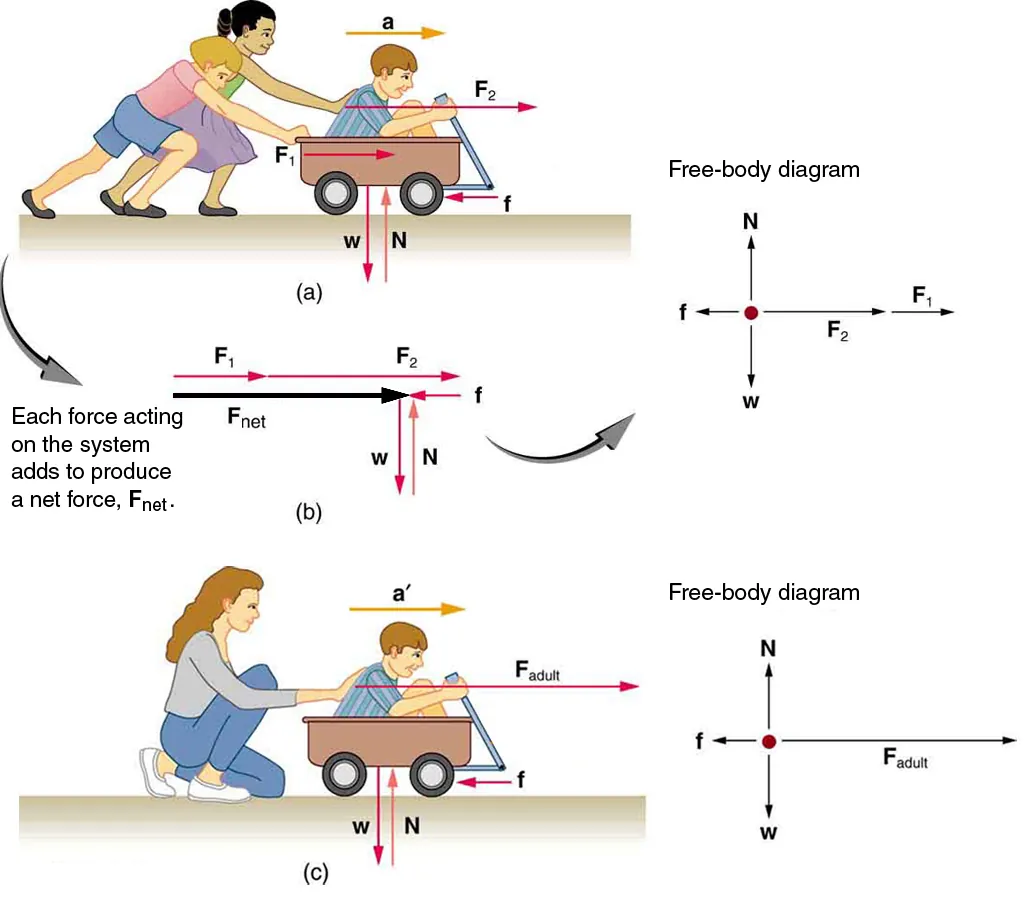
Describe which forces shown are external forces exerted on the wagon-and-rider system.
Compare the horizontal acceleration of the system when two children push it with the acceleration when the adult pushes it.
Justify why the vertical forces do not change the velocity of the system in the situation shown.
Question 2
A student pushes first on a basketball and then on a stalled car using the same horizontal force. The image below compares the effect of the same applied force on two systems with different masses.
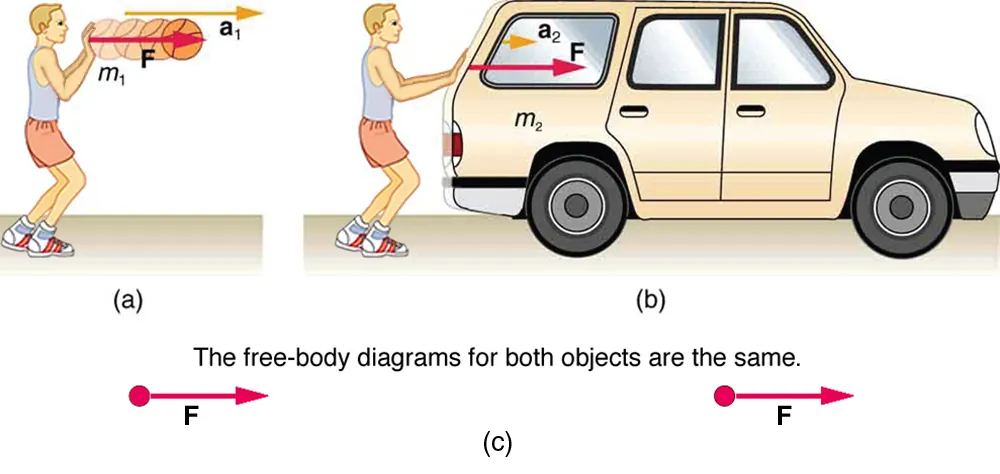
Compare the acceleration of the basketball with the acceleration of the car.
Derive the relationship between acceleration and mass for the two systems if the same net force is exerted on both.
Justify why the mass of the system affects the change in velocity produced by the same force.
Question 3
A group of four small carts is placed at fixed positions along a horizontal track. The masses of the carts and their positions are shown in the graph below. The carts are then connected so that they can be modeled as one system.
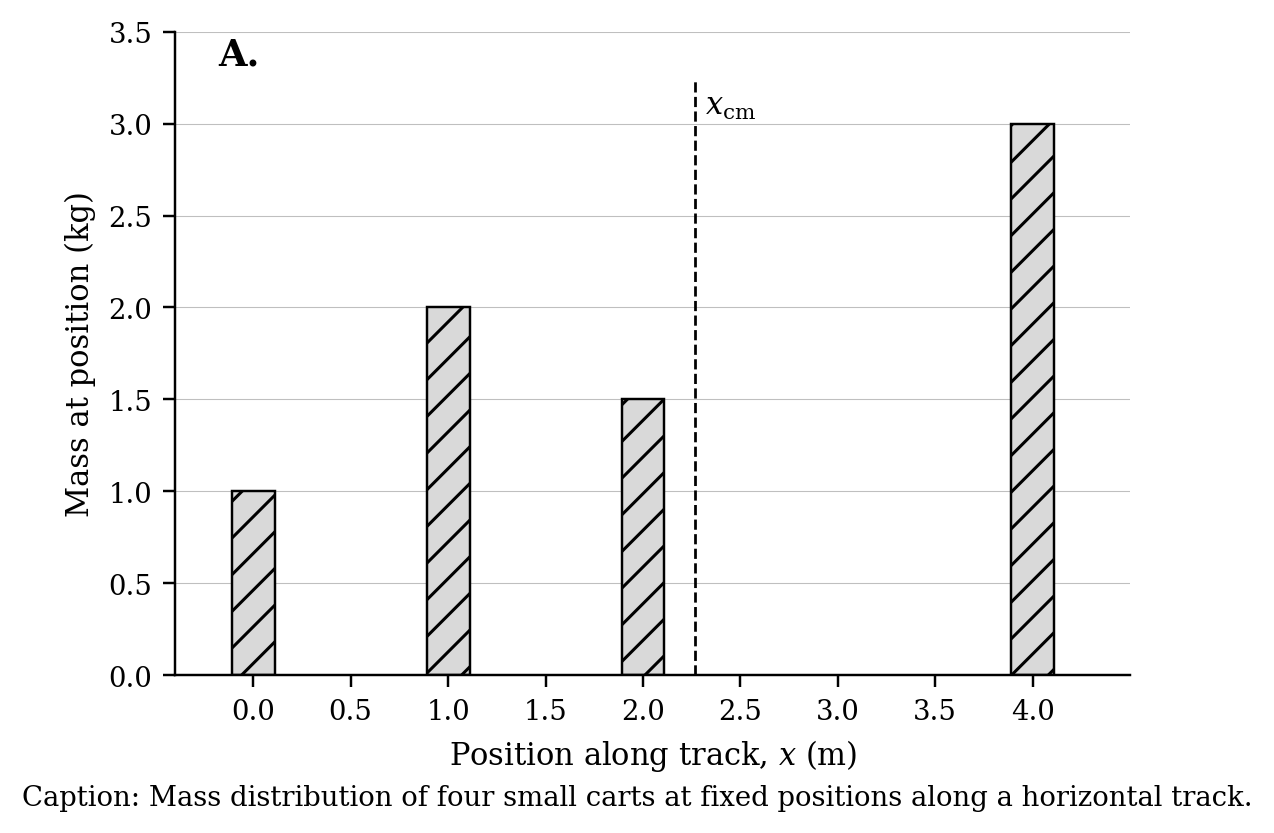
Calculate the position of the center of mass of the system.
Describe why the system can be modeled as a single object located at the center of mass.
Compare the effect on the center-of-mass location if the cart were moved from to .
Question 4
A cart system is pulled on a low-friction horizontal track. For each trial, students measure the acceleration of the system and the net external force exerted on it. The results are shown in the graph below.
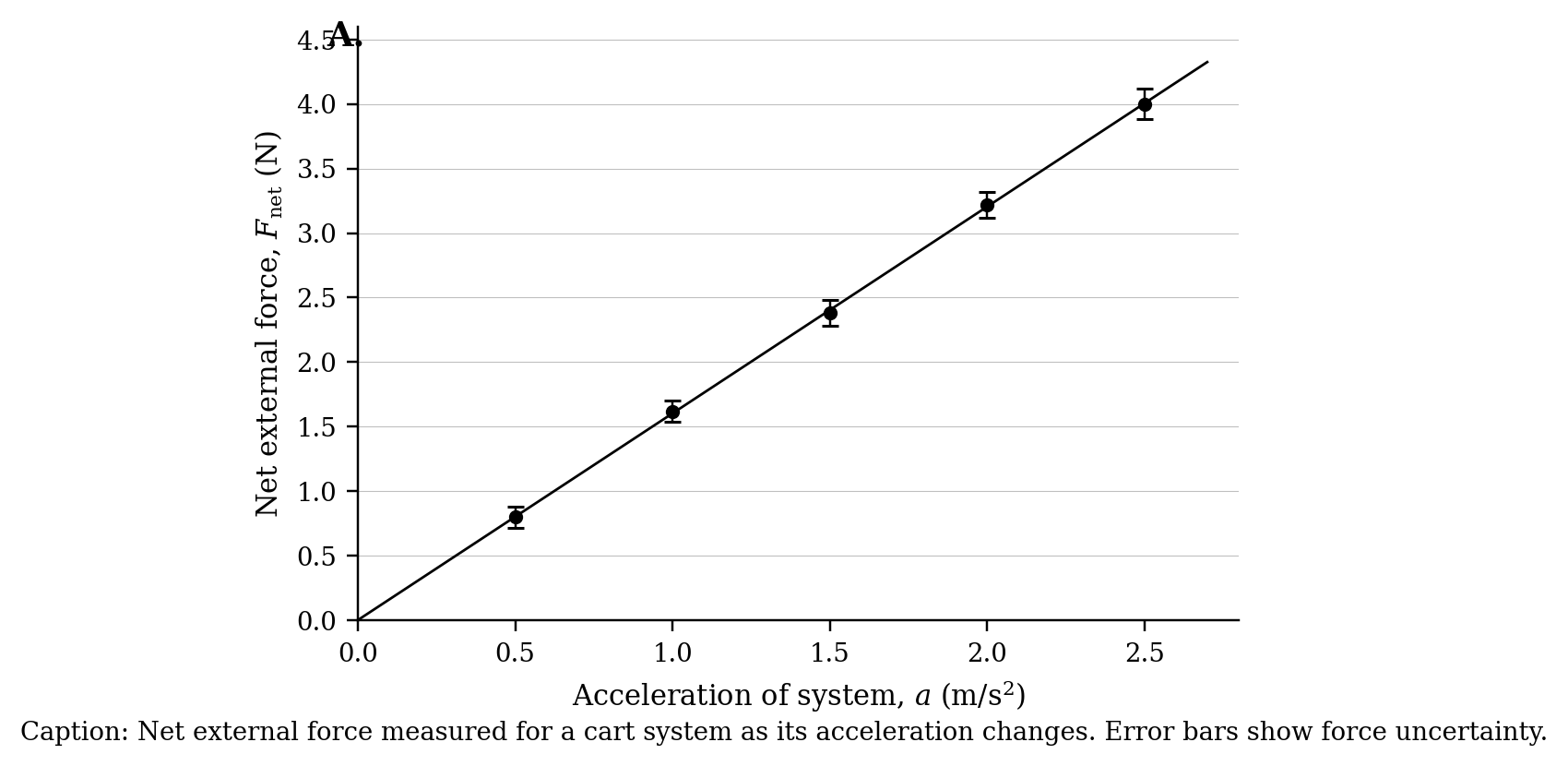
Determine the mass of the cart system from the graph.
Calculate the net external force required to produce an acceleration of .
Justify whether the graph supports Newton’s second law.
Describe the direction of the acceleration compared with the direction of the net external force.
Question 5
A person hangs motionless from a vine. The image below shows the person, the forces involved, and a free-body representation for the person as the system.
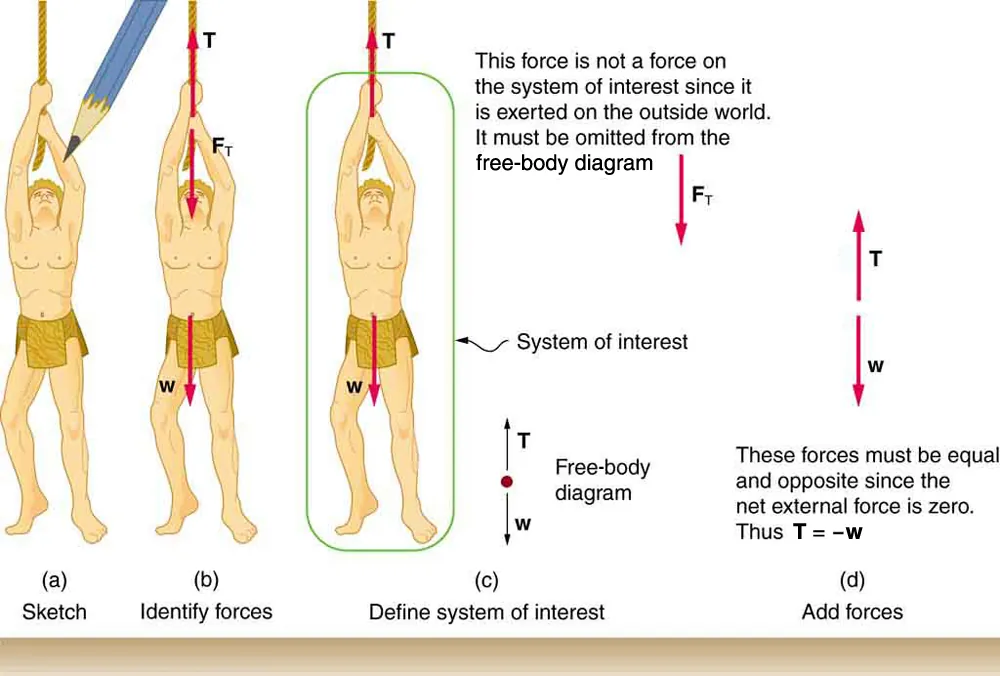
Draw a free-body diagram for the person while the person is stationary.
Determine the relationship between the tension force and the gravitational force on the person.
Justify why the force exerted by the person on the vine should not be included in the person’s free-body diagram.
Question 6
A skier slides down a straight snowy slope. The image below shows the skier and a force representation with axes chosen parallel and perpendicular to the slope.
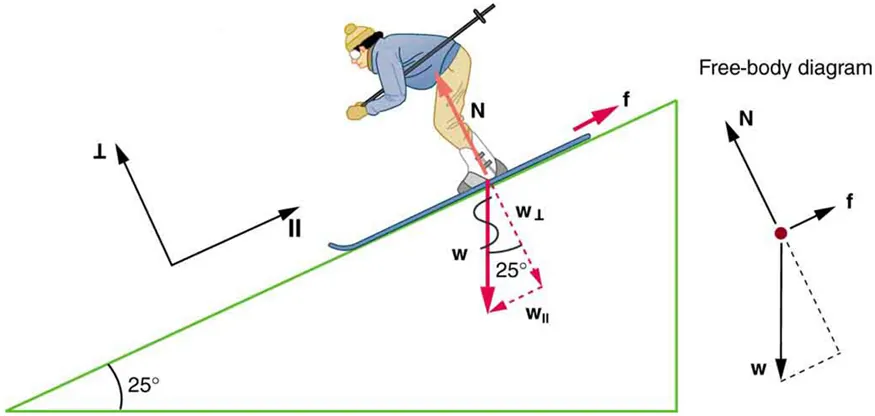
Describe why the coordinate axes shown are useful for analyzing the skier’s motion.
Determine the direction of the kinetic friction force exerted on the skier.
Justify why the normal force is not equal to the skier’s full weight on the incline.
Question 7
A block is pulled by a string over a pulley so that another object can exert a tension force on the block. The diagram below shows a simple pulley arrangement used to study forces and friction.
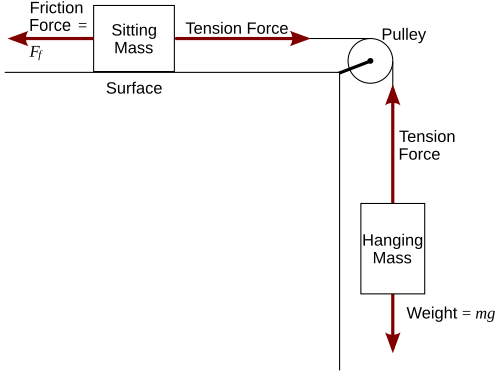
Describe the forces exerted on the block on the horizontal surface.
Determine whether the tension in an ideal string should be treated as the same at all points in the string.
Justify why the force the block exerts on the string is not shown as a force on the block.
Question 8
Two objects with different masses attract each other gravitationally. The diagram below shows the centers of mass of the objects and the line along which the interaction occurs.
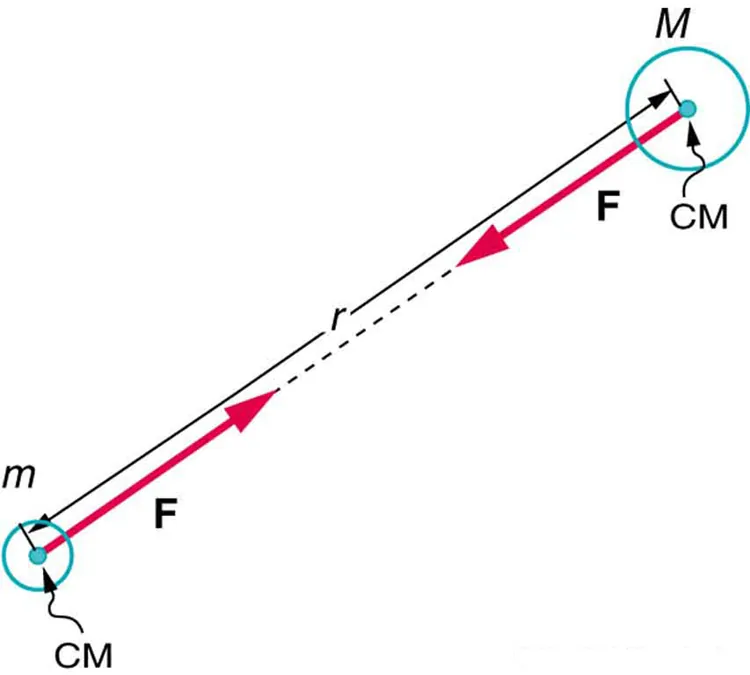
Describe the direction of the gravitational force exerted on each object.
Compare the magnitudes of the gravitational forces exerted on the two objects.
Justify how doubling the distance between the centers of mass affects the gravitational force magnitude.
Question 9
A spring is stretched and compressed from its relaxed length. The graph below relates the force exerted by an ideal spring to its displacement from equilibrium.
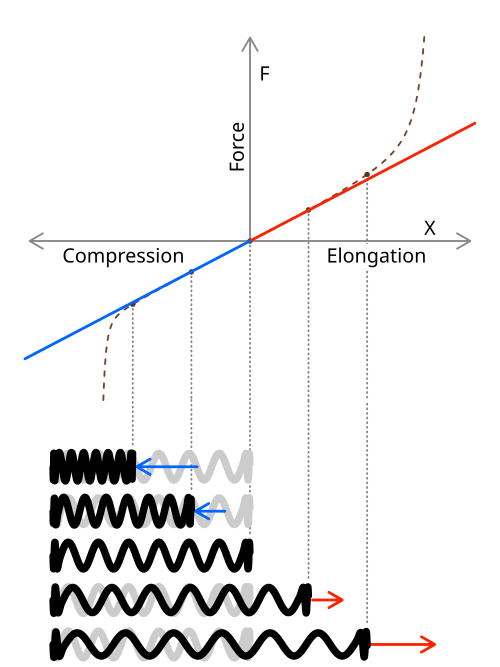
Describe the relationship shown between spring force and displacement from equilibrium.
Determine what physical quantity is represented by the slope of the force-displacement graph.
Justify why the spring force changes direction when the displacement changes sign.
Question 10
A spring is stretched by an applied force. The diagram below shows the applied force, the spring’s elongation, and the restoring force exerted by the spring.
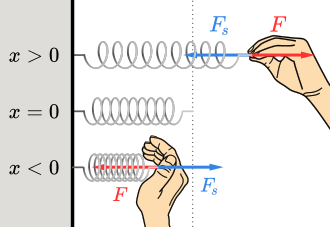
Describe the direction of the spring’s restoring force relative to the displacement of the spring.
Derive an expression for the magnitude of the spring force in terms of spring constant and displacement magnitude.
Compare the spring force for a displacement of with the spring force for a displacement of .