
Economic sectors
· Primary sector = businesses that extract or harvest natural resources, e.g. farming, fishing, mining, forestry.
· Secondary sector = businesses that manufacture or process raw materials into finished/semi-finished goods, e.g. car manufacturing, construction, food processing.
· Tertiary sector = businesses that provide services, e.g. retailing, banking, transport, education, healthcare.
· Quaternary sector = businesses based on knowledge, information, research, ICT, data, and innovation, e.g. software development, R&D, consultancy.
· In exams, classify a business by its main activity, not just its product.
· Example: a restaurant is mainly tertiary because it provides a service, even though it uses food ingredients.
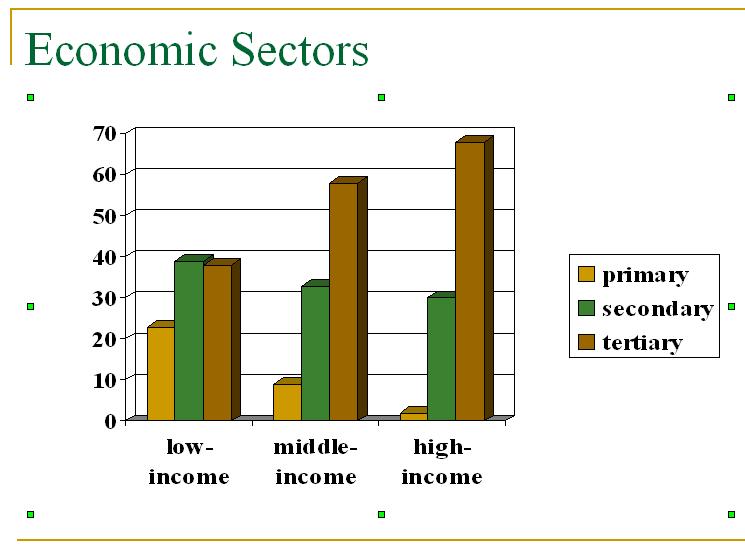
This image shows how the relative importance of economic sectors can change as economies develop. It is useful for understanding why the tertiary and quaternary sectors often become more important in developed economies. Source
Public and private sectors
· Private sector = businesses owned by private individuals or groups, often aiming to make profit.
· Examples: sole traders, partnerships, private limited companies, public limited companies.
· Public sector = organisations owned or controlled by the government, often providing goods/services for the public interest.
· Examples: public hospitals, state schools, public transport authorities, law enforcement, public infrastructure.
· Private sector objectives often include profit, growth, survival, market share, and shareholder return.
· Public sector objectives often include service provision, accessibility, social welfare, and efficient use of public funds.
· Exam skill: do not assume public sector organisations ignore costs; they still face budgets, efficiency targets, and stakeholder pressure.
Why the importance of sectors changes
· Economies often shift from primary → secondary → tertiary/quaternary as they develop.
· Reasons for changing sector importance:
· Economic development: rising incomes increase demand for services.
· Technology: automation reduces labour needed in agriculture and manufacturing.
· Globalisation: manufacturing may move to countries with lower production costs.
· Education and skills: more skilled workers support quaternary sector growth.
· Consumer demand: people spend more on services such as travel, finance, healthcare, and entertainment.
· Consequences for businesses:
· Need to adapt products and services to changing demand.
· Need for retraining and different workforce skills.
· Decline of old industries and growth of new industries.
· More competition from international businesses.
· Consequences for governments/economies:
· Changes in employment patterns.
· Need for investment in education, infrastructure, and technology.
· Possible regional unemployment if declining sectors are concentrated in one area.
Business ownership: key types
· Sole trader = owned and controlled by one person.
· Advantages: easy to set up, owner keeps profit, quick decisions, close customer contact.
· Disadvantages: unlimited liability, limited finance, long hours, business may lack continuity.
· Partnership = owned by two or more partners.
· Advantages: more capital than sole trader, shared workload, more skills/ideas.
· Disadvantages: unlimited liability for ordinary partnerships, profit shared, disagreements possible.
· Private limited company (Ltd) = incorporated business owned by shareholders, but shares cannot usually be sold to the general public.
· Advantages: limited liability, separate legal identity, easier to raise finance than sole traders/partnerships.
· Disadvantages: more legal requirements, accounts may need disclosure, less privacy than sole trader/partnership.
· Public limited company (PLC) = incorporated business that can sell shares to the general public, usually through a stock exchange.
· Advantages: can raise large amounts of capital, easier expansion, higher public profile.
· Disadvantages: expensive to set up, more regulation, risk of loss of control, pressure from shareholders.
· Franchise = one business (franchisor) allows another (franchisee) to use its brand, products, and business model in return for fees/royalties.
· Advantages for franchisee: established brand, training, lower start-up risk.
· Disadvantages for franchisee: less independence, fees, must follow franchisor rules.
· Co-operative = owned and controlled by members, such as workers, customers, or producers.
· Advantages: democratic control, shared benefits, can improve motivation/trust.
· Disadvantages: slower decisions, limited capital, possible conflict between members.
· Joint venture = two or more businesses work together on a specific project while remaining separate businesses.
· Advantages: shared costs, shared risk, access to local knowledge/technology.
· Disadvantages: profit shared, possible culture clashes, disputes over control.
· Social enterprise = business with social/environmental aims as well as financial objectives.
· Advantages: positive social impact, ethical reputation, may attract grants/support.
· Disadvantages: may face tension between mission and profit, limited finance, higher costs.
This image is useful for comparing common forms of business ownership. It helps students link ownership type to issues such as liability, registration, taxation, and control. Source
Limited liability and unlimited liability
· Unlimited liability = owners are personally responsible for business debts; personal assets may be at risk if the business fails.
· Common in: sole traders and ordinary partnerships.
· Limited liability = shareholders’ financial risk is limited to the amount invested in the business.
· Common in: private limited companies and public limited companies.
· Importance in exams:
· Limited liability reduces personal risk and can encourage investment.
· Unlimited liability may discourage risk-taking but gives owners strong motivation to manage carefully.
· Lenders may still ask small company owners for personal guarantees, reducing the practical benefit of limited liability.
· Strong exam phrase: “Limited liability makes expansion less personally risky for owners because they cannot normally lose more than they invested.”
Choosing the most appropriate ownership type
· The best ownership type depends on the business context, especially:
· Size of business: small local businesses may suit sole trader or partnership; large businesses may need Ltd or PLC status.
· Need for finance: companies can usually raise more capital than sole traders.
· Risk level: high-risk businesses benefit from limited liability.
· Control: sole traders keep full control; PLC owners may lose control to shareholders.
· Legal requirements and cost: companies face more regulation and administration.
· Objectives: a social mission may suit a social enterprise or co-operative.
· Exam rule: always judge “appropriate” by linking to the case.
· Example: “Because the business wants rapid national expansion, becoming a PLC may help raise share capital, but the founders risk losing control.”
Changing ownership type
· Businesses may change ownership type as they grow or as their objectives change.
· Sole trader → partnership: allows more capital and skills, but profit/control is shared.
· Partnership → Ltd: gives limited liability and separate legal identity, but increases legal requirements.
· Ltd → PLC: raises much larger finance for expansion, but increases regulation and shareholder pressure.
· Independent business → franchise: may reduce start-up risk using an established brand, but reduces independence.
· Advantages of changing ownership:
· access to more finance
· reduced personal risk through limited liability
· increased skills and resources
· easier expansion
· Disadvantages of changing ownership:
· loss of control
· higher legal/admin costs
· profit shared with more owners/shareholders
· more public scrutiny

This open educational resource is useful for reviewing common ownership structures and their advantages/disadvantages. It supports exam answers about choosing the most appropriate ownership type for a business context. Source
Exam application tips
· For define questions: give a precise definition and one example.
· For explain questions: use cause-and-effect language, e.g. “This reduces risk because…”
· For analyse questions: link ownership to the business context: finance, control, risk, growth, and objectives.
· For evaluate questions: make a final judgement using criteria such as risk, control, capital needs, and long-term growth.
· Avoid generic answers such as “Ltd is better”; write “Ltd is more suitable for this business because…”
Checklist: can you do this?
· Classify a business into primary, secondary, tertiary, or quaternary sector using its main activity.
· Distinguish between public sector and private sector businesses.
· Compare sole traders, partnerships, Ltds, PLCs, franchises, co-operatives, joint ventures, and social enterprises.
· Explain the importance of limited liability and unlimited liability.
· Recommend an appropriate ownership type for a given business scenario and justify your answer.