
Positive economics
Positive economics examines economic claims using logic and evidence.
Positive statements are intended to be testable rather than determined by personal values.
Positive analysis helps economists construct and assess explanations of economic behaviour and outcomes.
Ceteris paribus, evidence and refutation
Ceteris paribus means holding other relevant factors constant while examining an economic relationship.
Empirical evidence is observed evidence used to assess economic claims.
Economists compare evidence with predictions from hypotheses, models and theories.
Refutation occurs when evidence leads economists to reject or revise an economic explanation.
Testing against evidence allows economic ideas to be challenged rather than simply accepted.
18th–19th century economic thought
In the 18th century, Adam Smith was associated with laissez-faire economic thinking.
In the 19th century, classical microeconomics developed ideas concerning utility.
Classical microeconomics also developed the concept of the margin.
Classical macroeconomics included Say’s law.
A Marxist critique challenged classical economic thought.
These developments show that economic ideas originate and change within a historical context.
21st century behavioural economics
The 21st century has brought increasing dialogue between economics and other disciplines.
Psychology has become particularly important in this interdisciplinary dialogue.
The role of behavioural economics has grown.
Behavioural economics reflects the increasing use of insights beyond traditional economic approaches when studying economic decisions.
Checklist: can you do this?
Can you distinguish positive economics from normative economics?
Can you explain the roles of logic, hypotheses, models and theories?
Can you explain the ceteris paribus assumption?
Can you explain how empirical evidence and refutation are used?
Can you distinguish equity from equality and relate both to value judgments?
Can you outline the major developments in 18th- and 19th-century economic thought?
Can you outline the Keynesian, monetarist and new classical developments of the 20th century?
Can you explain the growth of behavioural economics, interdisciplinary thinking and the circular economy in the 21st century?
Logic, hypotheses, models and theories
Logic connects economic assumptions and reasoning to conclusions.
A hypothesis is a proposed economic explanation or relationship that can be tested.
A model represents economic reality in a simplified form.
An economic theory organizes explanations about how economic relationships operate.
Economists use hypotheses, models and theories to make complex economic reality easier to analyse.
Normative economics, equity and equality
Normative economics concerns judgments about what ought to happen.
Normative statements depend on value judgments, particularly when making economic policy.
Equality concerns sameness in treatment, opportunities or outcomes.
Equity concerns judgments about what is fair.
Different value judgments can therefore produce different views about desirable economic policies.
20th century economic thought
The Keynesian revolution was a major development in 20th-century economic thought.
It was associated with the growing importance of macroeconomic policy.
A later monetarist counter-revolution challenged Keynesian approaches.
The new classical counter-revolution also represented a significant shift in macroeconomic thinking.
Economic thought therefore changed considerably during the 20th century.
Economy, society, environment and the circular economy
Economists increasingly recognize interdependencies between the economy, society and environment.
Economic activity therefore cannot be considered completely separately from wider social and environmental systems.
The 21st century has brought greater awareness of compelling reasons to move toward a circular economy.
This development represents another change in how economists approach the economic world.
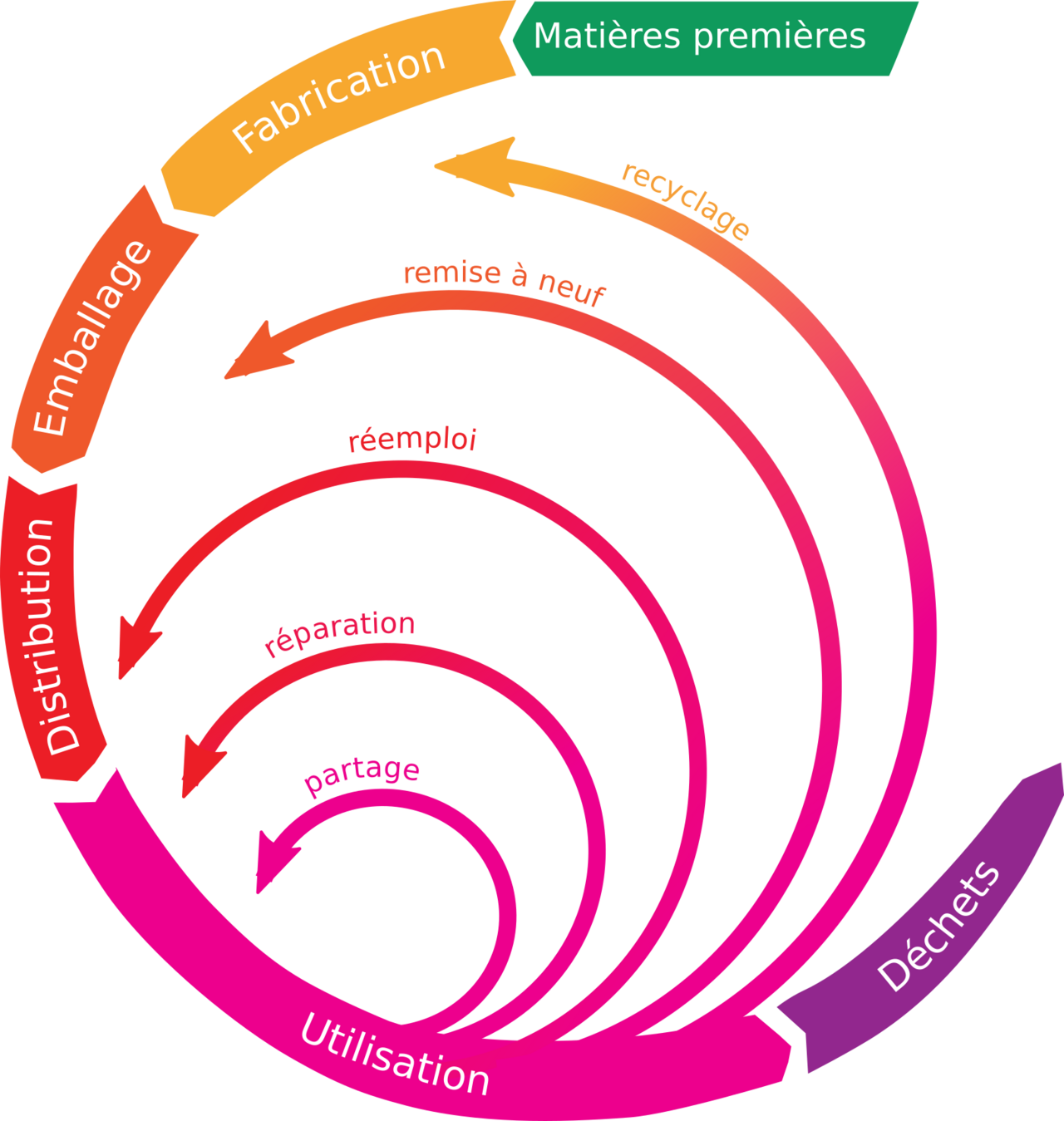
The diagram shows how resources can loop back into economic activity through repair, reuse and recycling instead of moving directly to waste. Connect these loops to the syllabus emphasis on interdependence between the economy, society and environment. Source