
Homeostasis and negative feedback
Homeostasis is any self-regulating biological process that maintains a relatively stable internal environment for optimal body function.
Relatively stable means that internal conditions fluctuate within controlled limits rather than remaining perfectly constant.
Homeostatic mechanisms respond continuously to changing internal conditions and external conditions.
Negative feedback reverses a detected change and moves the regulated condition back towards its controlled state.
In an explanation, link the initial change, detection, corrective response and reversal of the change.
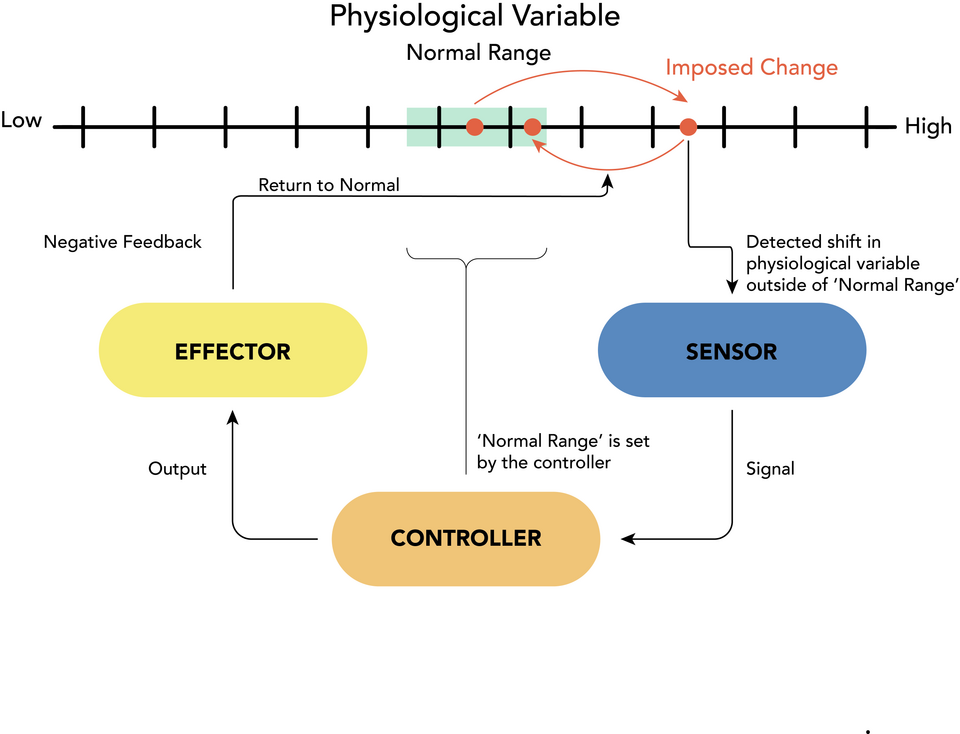
The sensor detects movement away from the normal range, and the controller activates an effector. The effector opposes the original disturbance, illustrating how negative feedback restores a relatively stable internal condition.
Intrinsic and extrinsic heart regulation
Heart regulation depends on both intrinsic excitation and extrinsic excitation.
Intrinsic excitation originates within the heart, while extrinsic excitation modifies its regulation from outside the heart.
Treat the two forms of excitation as interacting controls rather than competing explanations.
Use the SEHS data-booklet heart diagram when examination questions require reference to heart structure.
Thermoregulatory responses
Response | Physiological action | Homeostatic effect |
|---|---|---|
Sweat response | Sweat is produced at the skin and evaporates. | Increases heat loss when body temperature rises. |
Vasodilation | Blood vessels supplying the skin widen. | Increases heat transfer from the body to the environment. |
Vasoconstriction | Blood vessels supplying the skin narrow. | Reduces heat loss when body temperature falls. |
Shivering | Rapid, involuntary muscular activity occurs. | Increases heat production. |
Non-shivering thermogenesis | Metabolic heat production increases without shivering. | Raises heat production without muscular contractions. |
Blood glucose regulation during exercise
Blood glucose regulation relies on the hormones insulin and glucagon.
Together, these hormones provide control that helps maintain regulated blood sugar levels.
During exercise, the release of insulin is limited.
Exercise also facilitates glucose uptake, helping regulate blood sugar while activity continues.
In an examination answer, identify exercise, state both effects and link them directly to blood glucose regulation.
HL Only: Environment, activity and acclimatization
The environmental impact on performance depends on the nature of the activity being performed.
The same temperature, humidity or altitude may therefore affect different activities to different extents.
Performance-support strategies are used to manage demands in the immediate environment.
Acclimatization strategies help the body adjust to variations in environmental conditions.
Strategies should be matched to both the environmental condition and the demands of the activity.
An evaluation should connect environment, activity demands, physiological response, strategy and performance.
Blood and regulation
Blood is influenced by hydrogen ion concentration, represented by .
The concentration of influences concentration and therefore affects blood .
The brain’s respiratory control centre participates in monitoring blood .
Chemoreceptors throughout the body also monitor the relevant chemical conditions and contribute to feedback.
A complete explanation should connect changing , changing and regulation of blood .
Coordinated thermoregulation
Thermoregulation maintains a core body temperature of approximately .
The cardiovascular, muscular, nervous and integumentary systems work together to maintain this range.
The nervous system coordinates responses to changes in internal and external temperature conditions.
The cardiovascular and integumentary systems regulate heat exchange, while the muscular system can contribute to heat production.
A homeostatic response must oppose the temperature change and move core temperature towards the controlled range.
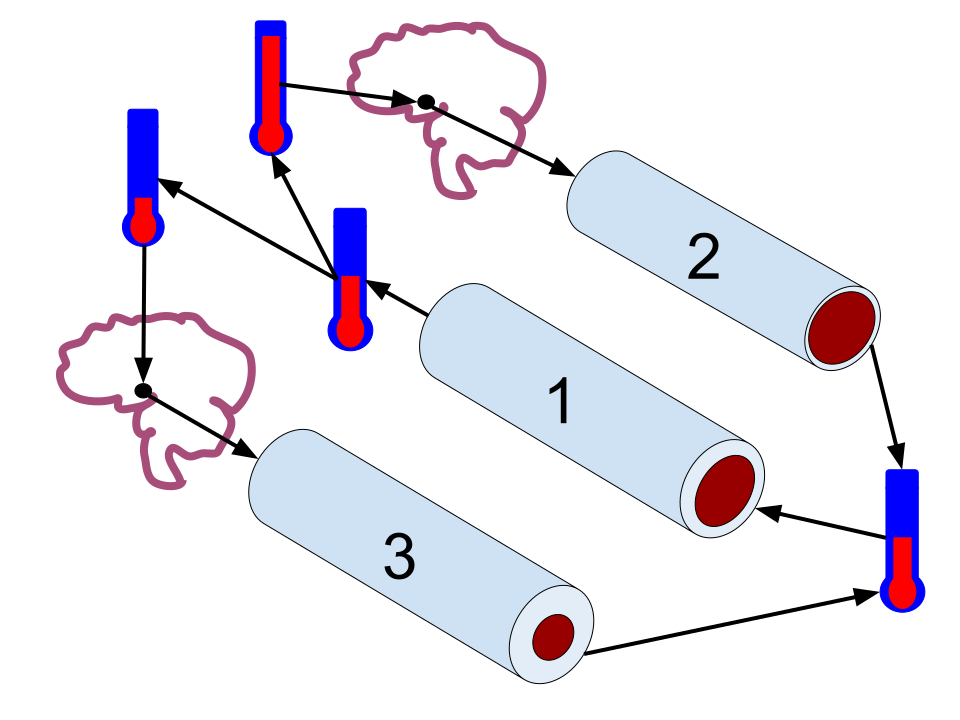
When body temperature changes, the hypothalamus coordinates adjustments in blood-vessel diameter. Vasodilation promotes heat loss, whereas vasoconstriction limits heat loss, helping restore core temperature towards .
Factors affecting thermoregulation
Training status can alter the thermoregulatory response and should be considered when comparing performers.
Body composition can influence how heat is produced, stored and lost.
The environment changes the demands placed on the body’s temperature-regulation mechanisms.
Sex differences, including differences between hormonal phases, can influence thermoregulatory responses.
Evaluation should consider how these factors interact rather than assuming that one factor acts independently.
HL Only: Acute and long-term environmental responses
The body produces acute responses and possible long-term adaptations to its external environment.
Relevant environmental conditions are temperature, humidity and altitude.
An acute response occurs during or shortly after exposure to an environmental condition.
Long-term adaptation may develop through continued or repeated exposure, but the syllabus describes this as a possibility rather than a certainty.
Distinguish responses from adaptations by their timescale when analysing environmental effects.
Checklist: can you do this?
Can you define homeostasis and explain how negative feedback reverses a change?
Can you connect , and regulation of blood ?
Can you distinguish intrinsic excitation from extrinsic excitation in heart regulation?
Can you explain how four physiological systems maintain ?
Can you compare the five required thermoregulatory responses?
Can you evaluate the factors affecting thermoregulation?
Can you explain how exercise changes insulin release and glucose uptake?
Can you distinguish acute responses, long-term adaptations and acclimatization strategies in varied environments?