
Cardiovascular Transport
The cardiovascular system transports nutrients, hormones, gases, heat and waste between body tissues.
Pulmonary circulation carries deoxygenated blood from the heart to the lungs and returns oxygenated blood.
Systemic circulation delivers oxygenated blood from the heart to body tissues and returns deoxygenated blood.
Arteries carry blood away from the heart, veins return blood and capillaries permit exchange with tissues.
Effective transport supports cellular respiration, temperature regulation, nutrient delivery and waste removal.
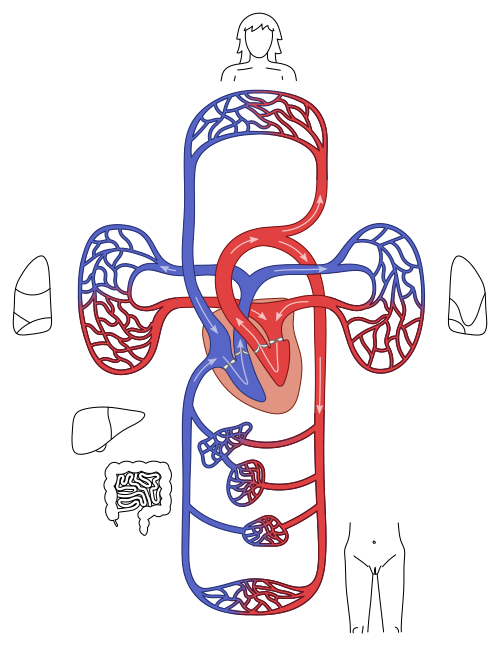
The diagram distinguishes pulmonary circulation from systemic circulation. Follow the arrows to trace how blood moves between the heart, lungs and body tissues.
Cardiovascular Response to Activity
Heart rate rises as activity intensity increases, producing more frequent ventricular contractions.
Stroke volume usually increases from rest towards moderate exercise and may level off at higher intensities.
Because both variables contribute, cardiac output increases substantially as exercise intensity rises.
Systolic blood pressure generally rises during dynamic exercise, while diastolic blood pressure usually changes less.
The precise response depends on the participant and the type, duration and intensity of activity.
During recovery, these measures progressively return towards their resting values.
Factors Affecting Cardiovascular Measures
Factor | Likely influence on cardiovascular measurements |
|---|---|
Age | Heart-rate ranges, maximal responses and recovery rates change across the lifespan. |
Sex differences | Average anatomical and physiological differences can affect absolute values, although individual ranges overlap. |
Body size | Larger individuals often require greater absolute blood flow and may have a larger stroke volume. |
Fitness | At the same submaximal workload, trained performers often have a lower heart rate and higher stroke volume. |
Type of activity | Dynamic, static, upper-body and whole-body activities produce different circulatory demands. |
Intensity | Increasing intensity generally increases heart rate, cardiac output and the redistribution of blood. |
Mechanics of Breathing
During inspiration, the diaphragm contracts and flattens while the external intercostal muscles raise the ribs.
Thoracic volume increases, pressure inside the lungs falls and air moves into the lungs down a pressure gradient.
During quiet expiration, the breathing muscles relax and elastic recoil reduces thoracic and lung volume.
Pressure inside the lungs rises above atmospheric pressure, causing air to move out.
During vigorous activity, accessory muscles deepen inspiration and can assist forced expiration.
These mechanical changes increase airflow and help meet the greater gas-exchange demands of exercise.
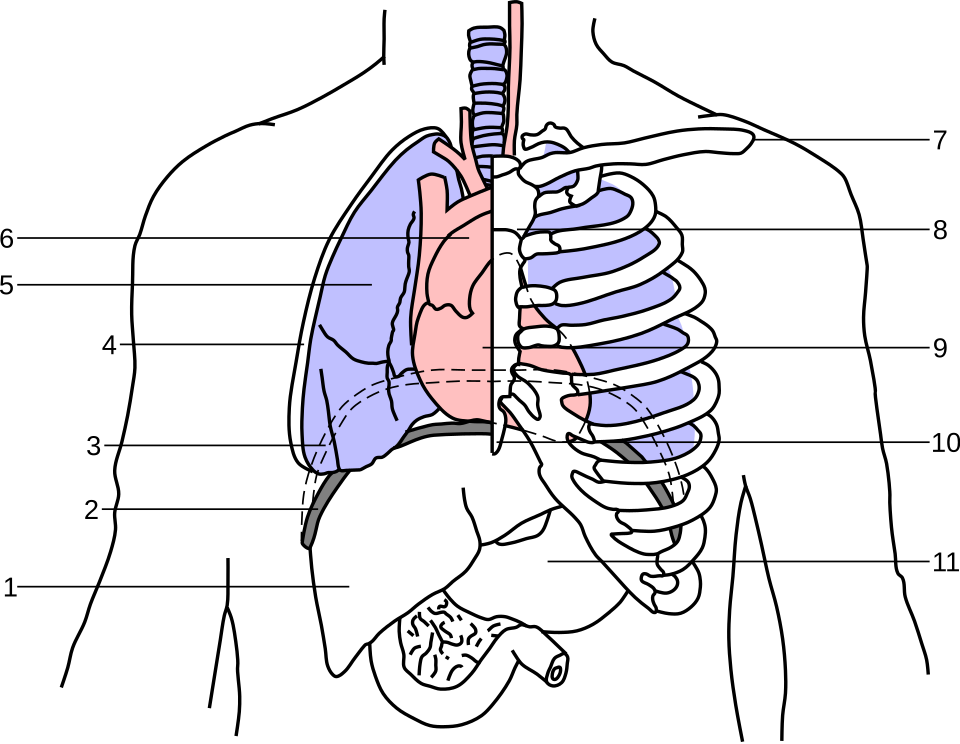
During inspiration, the diaphragm contracts and moves downwards, increasing thoracic volume. During expiration, it relaxes and rises as thoracic volume decreases.
Checklist: can you do this?
Can you state the five major categories of material transported by the cardiovascular system?
Can you define heart rate, stroke volume, cardiac output and blood pressure?
Can you calculate cardiac output using ?
Can you explain how cardiovascular measures change as activity intensity increases?
Can you explain why blood is redistributed during exercise?
Can you explain gas exchange between the alveoli and pulmonary capillary blood?
Can you explain the mechanics of inspiration and expiration?
Can you calculate minute ventilation using and apply the six influencing factors?
Cardiovascular Measures
Measure | Meaning | Unit or relationship |
|---|---|---|
Heart rate, | Number of heart beats each minute | |
Stroke volume, | Blood ejected by one ventricle per beat | |
Cardiac output, | Blood pumped by one ventricle each minute | ; |
Blood pressure, | Pressure exerted by blood against arterial walls | Systolic over diastolic; |
Blood Redistribution
Blood redistribution changes the proportion of cardiac output supplied to different tissues.
During exercise, blood flow increases towards active skeletal muscles and the heart muscle.
Flow towards the skin can increase when heat must be transferred from the body.
Vasodilation increases flow through active tissues, while vasoconstriction reduces flow through less-active regions.
Redistribution improves oxygen and nutrient delivery while accelerating the removal of carbon dioxide, heat and metabolic waste.
Exam answers should distinguish redistribution from an increase in total cardiac output.
Respiratory Gas Exchange
The respiratory system conducts air through the airways towards the lungs and alveoli.
At the alveoli, oxygen diffuses from alveolar air into pulmonary capillary blood.
Carbon dioxide diffuses from pulmonary capillary blood into the alveoli for exhalation.
Oxygen transported by the cardiovascular system supports cellular respiration in body tissues.
Gas exchange requires both effective ventilation and sufficient blood flow through pulmonary capillaries.
The respiratory and cardiovascular systems therefore work together to support health and performance.
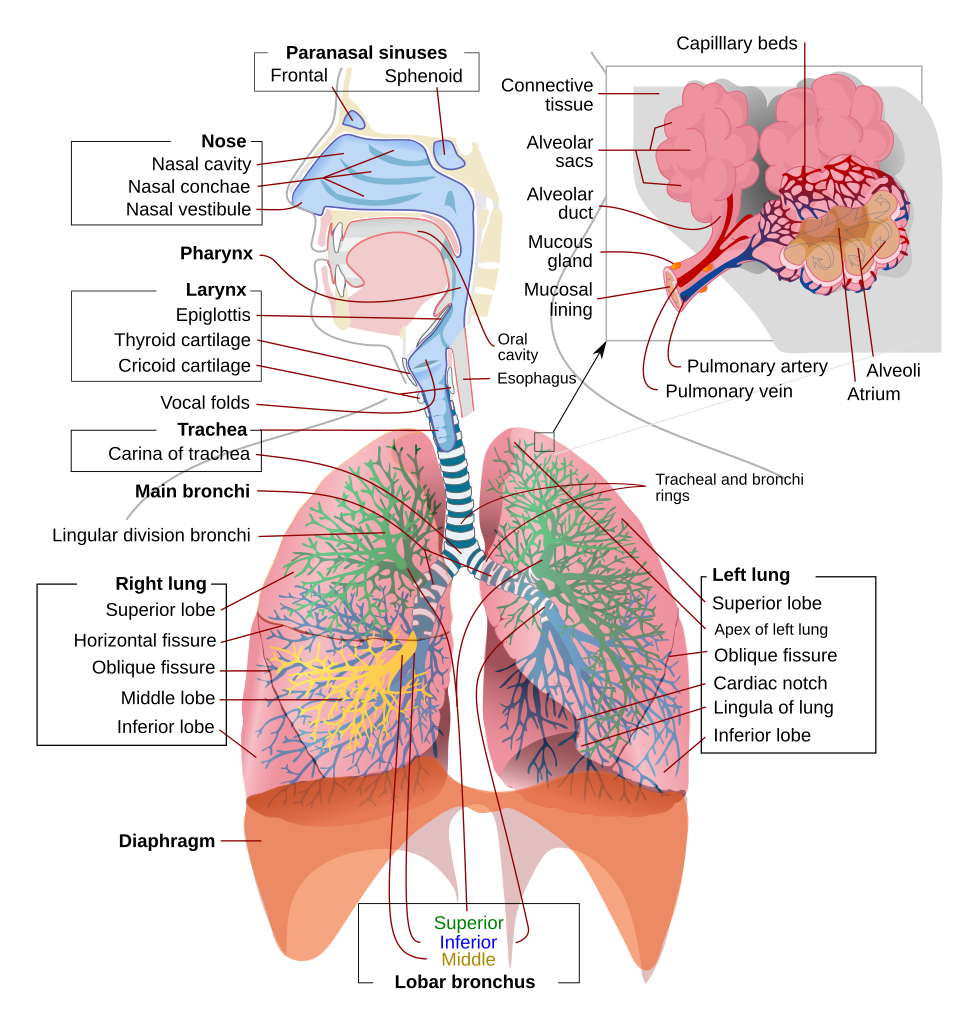
Trace the movement of air from the upper airway towards the alveoli. The enlarged region identifies where gases are exchanged between air and blood.
Respiratory Measures
Measure | Meaning | Unit or relationship |
|---|---|---|
Tidal volume, | Volume of air moved during one breath | |
Respiration rate, | Number of complete breathing cycles each minute | |
Minute ventilation, | Total volume of air moved each minute | ; |
Respiratory Responses and Influencing Factors
As exercise intensity rises, tidal volume and respiration rate normally increase, raising minute ventilation.
At higher intensities, further increases in ventilation depend increasingly on respiration rate as tidal volume begins to level off.
Greater ventilation supplies more oxygen and removes additional carbon dioxide produced during cellular respiration.
Age, sex differences and body size affect lung dimensions, breathing rates and absolute ventilatory values.
Fitness level influences ventilatory efficiency and the maximum workload that can be sustained.
Activity type and intensity determine how rapidly and deeply breathing must increase.
Comparisons are valid only when workload and participant characteristics are considered.