

AP Syllabus focus:
‘Understand instantaneous rate of change as the limit of average rates of change over intervals shrinking to an instant, using limits to model dynamic change in many contexts.’
Instantaneous rate of change captures how a quantity evolves at a single moment, extending the idea of average rate of change through the powerful concept of limits central to calculus.
Understanding Change at an Instant
When studying changing quantities, students first encounter average rate of change, which measures how one variable varies with respect to another over a finite interval. However, many real-world situations—such as velocity at a specific time or chemical concentration at a precise moment—require understanding change at an instant, not over a span. This leads naturally to the idea of the instantaneous rate of change, a foundational concept in calculus.
Instantaneous Rate of Change: The value approached by average rates of change as the interval over which the change is measured shrinks to zero.
As the time interval becomes smaller, the average rate describes increasingly localized behavior. The progression from a coarse measurement to an extremely precise one relies on the mathematical machinery of limits.
Connecting Average and Instantaneous Rates Using Limits
To understand instantaneous behavior, begin with the average rate of change of a function f between two points. As the horizontal distance between those points shrinks, the average rate reveals the dynamic change occurring at a single input value.
= Input value
= Small change in the input
This expression becomes a bridge to instantaneous change when students examine what happens as becomes very small. The limit captures this idea rigorously by examining how the expression behaves as approaches zero. In doing so, the limit describes the rate of change at an exact moment, not over an interval.
Between definition and application, it is essential to see limits not as a computational tool but as a conceptual framework: they describe the behavior of a function as one variable approaches another value, even if the function never actually reaches that value.
Why Limits Are Essential for Instantaneous Change
The instantaneous rate of change cannot be computed directly by substituting into the average rate formula, because this would lead to a denominator of zero. Instead, the limit evaluates the behavior near zero, allowing us to extract meaningful information about the function's behavior at a specific input.
Key reasons limits are necessary include:
Avoiding undefined expressions by examining behavior rather than direct substitution.
Capturing dynamic behavior, such as velocity at a single moment during motion.
Generalizing change across many contexts, such as population growth or temperature variation.
Limit: The value a function approaches as its input gets arbitrarily close to a specified point.
Discussing limits in this context reinforces their role in transforming average measurements into precise, instantaneous ones. A limit formalizes the idea of “approaching” without requiring exact equality, allowing calculus to describe scenarios that algebra alone cannot express.
The Limit as Intervals Shrink
The central process in finding instantaneous rate of change is shrinking the interval between two points on a graph. As the second point moves closer to the first, the slope of the secant line between them approaches the slope of the tangent line at the point of interest.
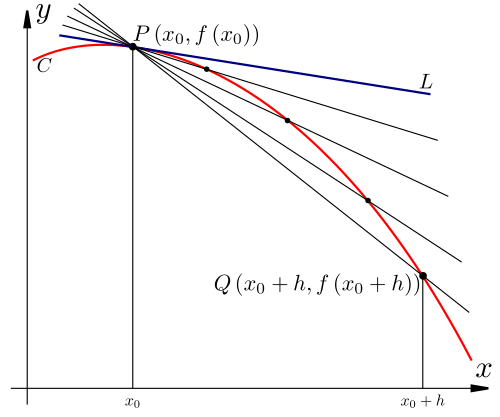
This diagram shows a curve with secant lines approaching the tangent line as the interval shrinks, illustrating how instantaneous rate of change arises from the limit of average rates. Source.
Although graphical interpretations are not computed here, this conceptual picture supports the analytic definition.
Important relationships in this shrinking-interval perspective include:
The distance between the two -values becomes extremely small.
The numerator measures increasingly subtle change in output.
The ratio of these quantities trends toward a stable value if the function behaves smoothly.
Because of this, limits model real-world dynamic processes such as instantaneous velocity in physics, marginal cost in economics, or concentration change in chemistry.
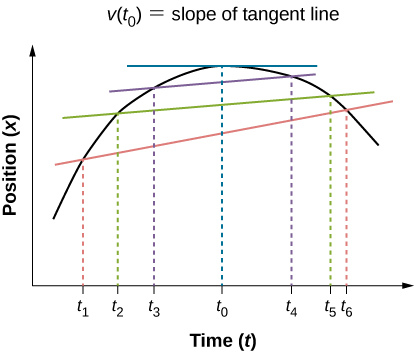
This graph shows average velocities as slopes of secant lines and instantaneous velocity as the slope of the tangent line, demonstrating how limits describe motion at a precise moment. Source.
Limits as a Unifying Framework for Dynamic Contexts
In many applied situations, change is continuous rather than abrupt. The limit-based definition of instantaneous rate of change allows students to describe:
How quickly an object is moving at a specific moment.
How a biological population is changing at a particular time.
The rate at which a chemical reaction proceeds at a precise concentration.
These contexts highlight why calculus is essential for modeling natural and human-made systems.
Instantaneous Velocity: The rate of change of position with respect to time at a single moment, obtained as the limit of average velocities over shrinking intervals.
Students should recognize that the same limit concept underpins all such interpretations, regardless of the specific phenomenon being analyzed.
The Importance of Approaching, Not Equaling
A crucial conceptual shift is realizing that the input does not need to equal the target value. The limit describes behavior near the value of interest, enabling analysis even when the function is undefined at that exact point. This framing helps students appreciate the flexibility and power of limits in capturing instantaneous behavior where algebraic tools fail.
Bullet points reinforcing this idea include:
The function need not be defined at the point where the instantaneous rate is evaluated.
What matters is predictable, stable behavior as inputs get arbitrarily close.
Limits allow functions with holes, jumps, or other discontinuities to still exhibit meaningful trends nearby.
This viewpoint aligns with the AP requirement to use limits to model dynamic change and supports later work with derivatives, which formalize instantaneous rate of change.
Limits as the Foundation for Further Calculus Concepts
Instinctively, students may imagine instantaneous change as an intuitive notion; however, its mathematical definition depends entirely on limits. By grounding the concept in limit processes, they build a robust foundation for derivative rules, motion models, optimization, and differential equations. Understanding instantaneous rate of change through limits establishes a coherent pathway into the core ideas of calculus, linking numerical, graphical, and conceptual reasoning around dynamic change.
Practice Questions
Question 1 (1–3 marks)
A function f represents the height of a ball above the ground at time t. The average rate of change of the height between t = 2 and t = 2.1 seconds is 4.8 metres per second. Explain what is meant by the instantaneous rate of change of the height at t = 2 seconds, and describe how it relates to the given average rate of change.
Question 1
• 1 mark: States that the instantaneous rate of change is the value approached by average rates of change as the time interval becomes very small.
• 1 mark: Explains that it represents the ball’s rate of change of height at exactly t = 2 seconds.
• 1 mark: Connects it to the given average rate by noting that the average rate over small intervals (such as between 2 and 2.1) approximates the instantaneous rate.
Question 2 (4–6 marks)
A function g models the temperature (in degrees Celsius) of a liquid at time t (in minutes). The average rate of change of the temperature between t = 5 and t = 5 + h is given by
[g(5 + h) − g(5)] / h.
(a) State the mathematical expression that represents the instantaneous rate of change of the temperature at t = 5.
(b) Explain why the expression in part (a) involves a limit.
(c) The table below gives values of the average rate of change for several small values of h:
h: 0.5, 0.2, 0.1, 0.05
[g(5 + h) − g(5)] / h: 1.8, 1.5, 1.4, 1.35
Use the table to estimate the instantaneous rate of change of the temperature at t = 5, giving a reason for your answer.
Question 2
(a)
• 1 mark: States the expression for the instantaneous rate of change as the limit of [g(5 + h) − g(5)] / h as h approaches 0.
(b)
• 1 mark: Explains that the limit is needed because substituting h = 0 directly is impossible (division by zero).
• 1 mark: States that taking h approaching 0 allows the calculation of the rate of change at exactly t = 5.
(c)
• 1 mark: Uses the table to identify values approaching roughly 1.3–1.4 as h becomes very small.
• 1 mark: Gives a sensible estimate, such as 1.35 degrees Celsius per minute, with justification that values stabilise toward this number as h decreases.
FAQ
This refers to considering a sequence of smaller and smaller intervals around a chosen point, each producing an average rate of change, and analysing how these values behave.
As the interval length approaches zero, the average rates stabilise (if the function behaves smoothly), revealing the instantaneous rate of change. This process does not require the interval ever to reach length zero; only that it approaches it.
The limit process examines values arbitrarily close to the target input, not the value at that input itself. Thus, the function may have a hole at the point yet still possess a well-defined instantaneous rate nearby.
This distinction allows meaningful analysis of functions with isolated gaps or missing values.
A tangent line is a geometric interpretation of instantaneous change, but the concept itself is formally defined using limits of average rates.
Drawing a tangent line relies on visual accuracy, whereas the limit process provides a precise numerical value even when a graph is not available or is drawn imprecisely.
Instantaneous rates are essential when behaviour varies rapidly, such as:
• the speed of a car at a specific moment
• the rate of chemical concentration change at a precise time
• biological growth rates in short-lived processes
In all cases, average rates may obscure critical moment-to-moment variation
By computing average rates across progressively smaller intervals and observing their behaviour, one can identify whether they approach a stable value.
If the values converge, an instantaneous rate exists. If they diverge, oscillate, or behave erratically, no well-defined instantaneous rate is present at that point.
