AP Syllabus focus:
‘Develop an intuitive understanding of continuity as having no breaks or jumps in a graph at a point, connecting this idea to the formal definition using limits.’
Continuity at a point describes when a function’s graph flows smoothly without breaks or sudden jumps. Understanding this intuitive idea builds the foundation for later formal limit-based definitions.
The Intuitive Meaning of Continuity at a Point
Continuity begins with the visual idea that a function behaves smoothly at a specific value of x, without interruptions or abrupt changes. When students first encounter continuity, the image of drawing a graph without lifting the pencil offers a powerful way to understand how functions behave near a point.
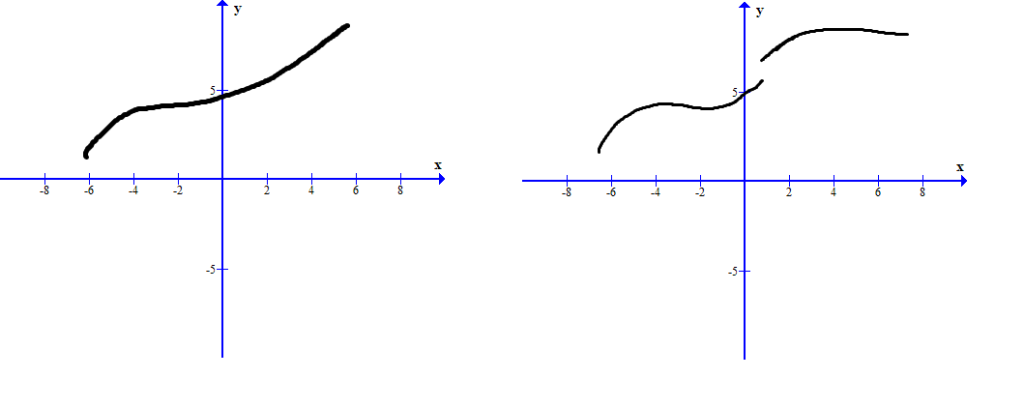
Two graphs compare a continuous function with one that has a jump discontinuity. The continuous graph can be traced without lifting a pencil, illustrating the intuitive meaning of continuity. The image highlights how a break or jump disrupts the expected local behavior of a function. Source.
This intuitive perspective emphasizes what the function looks like and how it behaves locally, rather than relying immediately on formal limit notation. The AP syllabus stresses viewing continuity as the absence of breaks or jumps, then connecting that understanding to deeper limit-based reasoning.
Smooth, Predictable Local Behavior
A function is continuous at a point when its nearby values align naturally with the function’s value at that point. In other words, as x approaches a specific value, the function’s output moves in a predictable manner rather than shifting suddenly. This idea forms the bridge between graphical intuition and calculus concepts that depend on smoothness, such as differentiation.
When a graph shows no holes or jumps at a point, we typically say it is “continuous there” because the local behavior of the function matches what is expected from the surrounding parts of the graph. This connection between visual smoothness and local predictability is fundamental to understanding continuity across all contexts.
Connecting Intuition to the Behavior of Limits
Although this subsubtopic focuses on intuition, the idea of limits naturally arises when describing how a function behaves as x gets close to a certain value. The notion that the function’s values approach a single, stable number reinforces the concept of graphical smoothness. This prepares students for the three-part formal definition that appears later in the course, where limits become the core analytical tool for determining continuity.
Continuity at a Point (Informal): A function is continuous at a point if its graph has no breaks, jumps, or holes at that location, and the function’s value aligns with its nearby behavior.
Between the intuitive picture and its limit-based explanation lies the recognition that continuity reflects the agreement between what happens at the point and what happens close to that point.
Understanding Breaks, Jumps, and Holes through Intuition
Students should be able to identify discontinuities visually before working with algebraic tools. The intuitive notion of continuity highlights three types of disrupted behavior:
Breaks: The graph ends or pauses before resuming elsewhere, signaling that the function does not provide a value that fits smoothly with surrounding values.
Jumps: The graph shifts suddenly from one height to another, creating a visible vertical gap reflecting inconsistent behavior near the point.
Holes: The function approaches a value but is missing the actual point, creating a removable discontinuity that is intuitively clear from the graph.
Each of these disruptions represents a failure of the graph to follow a single, predictable path through the point of interest.
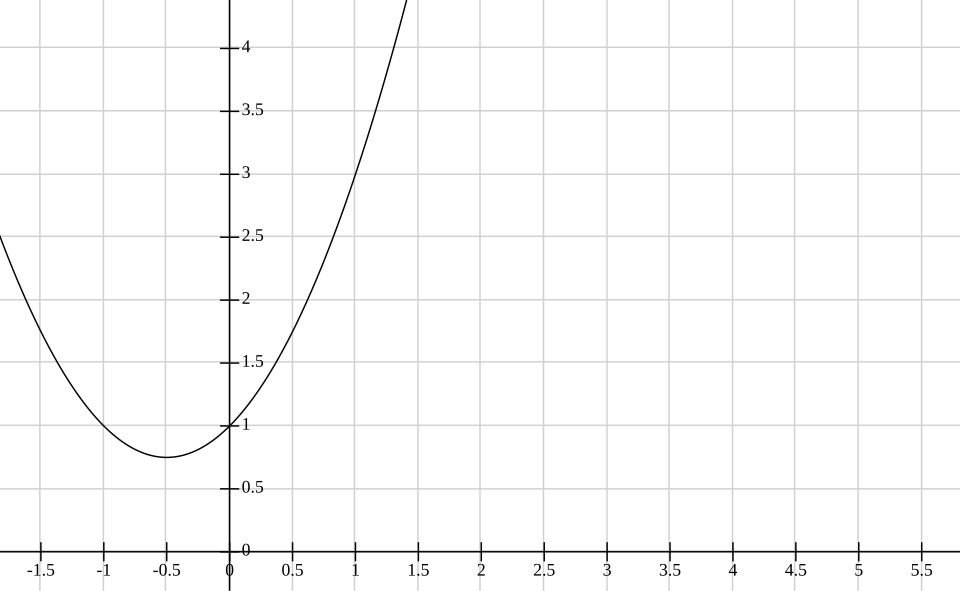
This graph depicts a smooth curve with a single hole, where the function is not defined at one point despite approaching a clear value nearby. It visually illustrates a removable discontinuity. The formula shown in the image exceeds syllabus needs but does not detract from its usefulness in representing a hole at a specific point. Source.
Students should recognize that continuity is lost whenever the function’s behavior cannot be drawn smoothly at that location.
Why Intuition Matters Before Formalism
Before introducing formal continuity conditions, students benefit from building strong visual and conceptual intuition. This conceptual readiness helps prevent confusion later when limits and symbolic definitions become central. When learners already associate continuity with smooth, unbroken behavior, they can more easily interpret what the limit is doing and how a function value must match it.
This intuitive grounding also helps students evaluate real-world models, where continuity captures the idea that physical quantities change gradually rather than instantaneously leaping between values.
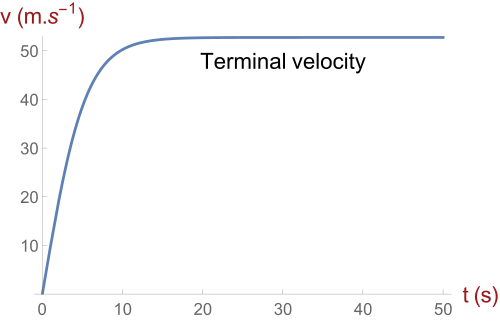
This real-world graph shows a skydiver’s velocity increasing smoothly over time with no jumps, demonstrating continuity in physical motion. The curve approaches terminal velocity gradually. Although the image includes a specific analytic model, students need only focus on its continuous shape. Source.
When students recognize why engineers, scientists, and economists depend on continuous models, they gain a deeper appreciation for the concept’s significance.
Developing a Mental Checklist for Intuitive Continuity
Even before the formal definition is introduced, students can use a simple mental process to judge intuitive continuity at a point:
Look for unbroken behavior in the graph near the point.
Check whether the graph can be drawn smoothly through the point.
Notice whether any value is missing even though the rest of the graph approaches a particular height.
Observe whether the graph jumps to a different height without passing through the intermediate region.
Decide whether the surrounding behavior matches the function’s value at the point.
This checklist aligns closely with the later formal requirements, but focuses first on visual and conceptual clarity. By establishing these habits early, students develop more robust reasoning that will support later analytical work with limits.
Building Toward the Formal Definition
Although this page does not present the formal three-part definition in full, students must understand that intuitive continuity prepares them for it. The idea that the function’s value matches what the function “wants to be” based on nearby inputs directly leads into evaluating limits at a point. This intuition reinforces the future emphasis on checking whether a limit exists and whether it corresponds to the function’s stated value.
Practice Questions
(1–3 marks)
A function g is represented by a graph near x = 2. The graph shows a smooth, unbroken curve passing through the point (2, 5).
Based on the intuitive idea of continuity at a point, state whether g is continuous at x = 2 and give a brief reason.
(1–3 marks)
• 1 mark: States that g is continuous at x = 2.
• 1 mark: Recognises that the graph is smooth or unbroken at that point.
• 1 mark: Explains that the function does not exhibit a break, jump, or hole at x = 2.
(4–6 marks)
A function h is shown in a graph near x = 4. The graph approaches the height 3 from both sides of x = 4, but there is an open circle at (4, 3). The point (4, 6) is plotted as a solid point.
(a) Using only the intuitive idea of continuity at a point, describe the behaviour of h near x = 4.
(b) Explain whether h is continuous at x = 4 and justify your answer using the graphical features described.
(c) Briefly describe how the graph illustrates the difference between the function’s value at a point and its nearby behaviour.
(4–6 marks)
(a)
• 1 mark: States that the graph approaches the same height, 3, from both sides.
• 1 mark: Recognises that the behaviour near x = 4 is smooth despite the open circle.
(b)
• 1 mark: States that h is not continuous at x = 4.
• 1 mark: Correctly identifies that the function value at x = 4 is 6, not 3.
• 1 mark: Explains that there is a hole at the point where the graph would otherwise be continuous.
(c)
• 1 mark: States that the point plotted at x = 4 does not match the value suggested by nearby points.
• 1 mark: Explains that the nearby behaviour indicates what the function would be if the hole were filled, but the defined point differs.
FAQ
Intuitive continuity focuses on how a graph appears: smooth, connected, and free from breaks or jumps. It relies on visual and conceptual reasoning rather than algebra.
The formal definition requires checking specific conditions involving limits and function values. Intuition guides recognition, whereas formalism provides a method for proof.
Yes. Graphs drawn by hand or software may hide small gaps or undefined points that are not visible at the scale shown.
A function that appears smooth may still have a hole or restricted domain. Always consider that diagrams are approximations and might not display fine detail.
Intuition allows quicker insights into behaviour before applying formal tools. It develops understanding of how functions behave physically or conceptually near a point.
This intuition also helps students recognise common patterns of continuity and discontinuity without immediately performing limit calculations.
Yes. Mathematical models often simplify situations and may include idealised jumps or transitions that do not occur smoothly in reality.
For example, switching laws, thresholds, or step-based measurements can create artificial discontinuities even when the underlying phenomenon changes gradually.
Key features include:
• Whether the curve can be traced through the point without lifting your pencil.
• The presence of holes, breaks, or vertical gaps.
• Whether the left-hand and right-hand behaviour aligns at the point.
Identifying these features helps distinguish natural smoothness from structural irregularities.