AP Syllabus focus:
‘Explain what it means for a function to be continuous on an interval by requiring continuity at every point in the interval, with appropriate attention to endpoints.’
Continuity on intervals extends pointwise continuity to ranges of x-values, clarifying how limits, function values, and endpoints interact across open, closed, and half-open intervals clearly.
Understanding Continuity Beyond a Single Point
In earlier discussions of continuity, attention is placed on whether a function is continuous at a specific point. However, many important results in calculus rely on understanding continuity over an entire interval. Continuity on an interval means that the function behaves smoothly throughout that range, without breaks, jumps, or holes, while also respecting how endpoints are handled. This concept is essential for applying major theorems and for reasoning about real-world situations modeled by functions.
Continuity at Every Point in an Interval
The central idea of continuity on an interval is that the function must be continuous at each point contained in that interval. This requirement builds directly on the formal definition of continuity at a point and extends it across a set of x-values.
Formal Meaning of Continuity on an Interval
Continuity on an interval: A function is continuous on an interval if it is continuous at every point in that interval, with endpoint conditions applied when endpoints are included.
This definition emphasizes two ideas:
Continuity must hold everywhere, not just at selected points.
The type of interval determines whether endpoints must be checked.
A function that fails to be continuous at even one point in the interval is not continuous on that interval.
Open Intervals
An open interval, written using parentheses such as (a, b), includes all x-values strictly between a and b but excludes the endpoints themselves. Continuity on an open interval requires checking only interior points.
Continuity Requirements on Open Intervals
For a function to be continuous on an open interval (a, b), it must be continuous at every point c where a < c < b.
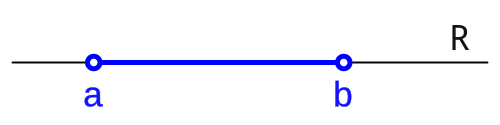
This number-line diagram represents the open interval (a,b)(a,b)(a,b). The open circles at aaa and bbb indicate that the endpoints are not included, emphasizing that continuity is required only at interior points. Source.
No conditions are imposed at x = a or x = b, because those values are not part of the interval.
This situation is common in calculus, especially when dealing with functions whose domains naturally exclude certain values. Open intervals allow the function to approach the endpoints without requiring defined behavior there.
Closed Intervals
A closed interval, written with brackets such as [a, b], includes both endpoints as well as all points between them. Continuity on a closed interval imposes stricter requirements because the function must behave appropriately at the endpoints.
Endpoint Behavior on Closed Intervals
To be continuous on a closed interval [a, b], a function must satisfy:

This figure illustrates the closed interval [a,b][a,b][a,b] on a number line. The filled endpoints show that both boundary points are included, which is why one-sided continuity must be verified at each endpoint. Source.
Continuity at every interior point a < c < b
Right-hand continuity at x = a, meaning the limit as x approaches a from the right equals f(a)
Left-hand continuity at x = b, meaning the limit as x approaches b from the left equals f(b)
These one-sided conditions reflect the fact that values outside the interval are not considered. The function only needs to match its limit from within the interval.
Continuity on closed intervals is especially important because many foundational calculus theorems apply only under this condition.
Half-Open and Half-Closed Intervals
A half-open interval includes one endpoint but excludes the other, such as [a, b) or (a, b]. These intervals combine features of open and closed intervals.
Checking Continuity on Half-Open Intervals
For continuity on a half-open interval such as [a, b), you require continuity at every interior point and a one-sided continuity condition at the included endpoint.
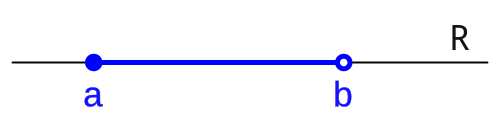
This diagram shows the half-open interval [a,b)[a,b)[a,b). The filled dot indicates the included endpoint, while the open circle marks the excluded endpoint, highlighting how continuity conditions depend on endpoint inclusion. Source.
At interior points, the function must be continuous in the usual two-sided sense.
At an included endpoint, the function must be continuous using the appropriate one-sided limit.
At an excluded endpoint, no continuity condition is required.
For example:
On [a, b), right-hand continuity is required at x = a, but nothing is required at x = b.
On (a, b], left-hand continuity is required at x = b, but nothing is required at x = a.
This flexibility allows half-open intervals to model situations where a process begins or ends at a specific value without extending beyond it.
Why Endpoint Attention Matters
Endpoints often represent boundaries in real-world contexts, such as starting times, physical limits, or defined ranges of validity. Ignoring endpoint behavior can lead to incorrect conclusions about a function’s overall continuity.
Key ideas to remember include:
Continuity on an interval depends on which points are included.
Interior points always require two-sided continuity.
Included endpoints require one-sided continuity from within the interval.
Excluded endpoints require no continuity checks.
This careful attention to endpoints ensures that continuity on intervals is defined precisely and applied correctly.
Connection to Broader Calculus Concepts
Understanding continuity on different types of intervals prepares students to apply the Intermediate Value Theorem and other results that rely on continuous behavior across an entire range. It also reinforces the idea that continuity is not just local, but a global property tied to both function behavior and domain structure.
Practice Questions
Question 1 (2 marks)
A function f is defined on the interval (−2, 5). The function is continuous at every point in this interval.
(a) State whether f must be continuous at x = −2 and x = 5.
(b) Give a brief justification for your answer.
Question 1 (2 marks)
(a) f is not required to be continuous at x = −2 or x = 5. (1 mark)
(b) The interval is open, so the endpoints −2 and 5 are not included and continuity is only required for values strictly between them. (1 mark)
Question 2 (5 marks)
A function g is defined on the interval [1, 4) and satisfies the following conditions:
g is continuous at every interior point of the interval.
The right-hand limit of g(x) as x approaches 1 exists and equals g(1).
The left-hand limit of g(x) as x approaches 4 exists.
(a) Explain why g is continuous at x = 1.
(b) Explain why continuity at x = 4 is not required for g to be continuous on the interval [1, 4).
(c) State whether g is continuous on the entire interval [1, 4), with justification.
Question 2 (5 marks)
(a) g is continuous at x = 1 because the function value exists and equals the right-hand limit at that point. (2 marks)
• Identifies that x = 1 is included in the interval. (1 mark)
• Correct use of right-hand continuity. (1 mark)
(b) Continuity at x = 4 is not required because 4 is not included in the interval [1, 4). (1 mark)
(c) g is continuous on [1, 4) because it is continuous at all interior points and satisfies the required one-sided continuity condition at the included endpoint. (2 marks)
FAQ
At an endpoint, values of the function only exist on one side of the point within the interval. Requiring a two-sided limit would involve x-values that are outside the interval, which are not relevant.
One-sided continuity ensures the function’s value matches its behaviour from within the interval, which is sufficient to guarantee smooth behaviour over the defined range.
Yes. Continuity on an interval depends only on the behaviour of the function at points within that interval.
The function does not need to exist or behave well outside the interval, as long as all required continuity conditions are satisfied for the points that are included.
A graph that appears unbroken does not automatically guarantee continuity on a specified interval.
Continuity on an interval is a precise condition that depends on which points are included and whether the function satisfies the correct limit conditions at those points, especially at endpoints.
Closed intervals include their endpoints, so continuity must be verified there using one-sided limits.
Open intervals exclude endpoints, removing the need to check function values or limits at those boundary points.
This distinction is essential when applying theorems that require continuity over an entire closed interval.
If a function fails to be continuous at even one included point, it is not continuous on the entire interval.
This is true regardless of how well-behaved the function is elsewhere, since continuity on an interval requires continuity at every required point in that interval.