AP Syllabus focus:
‘Determine whether a discontinuity at a point can be removed by checking if the limit exists there, even though the original function value is missing or different.’
A removable discontinuity occurs when a function’s graph has a hole at a point but still approaches a well-defined value there, allowing continuity to be restored.
Understanding Removable Discontinuities
A removable discontinuity arises when the limit of a function exists at a point where the function is not defined or is defined differently from the limit. This situation reflects a mismatch between the function’s local behavior and its assigned value.
Removable Discontinuity: A point where a function is discontinuous because its value is missing or inconsistent, even though the limit at that point exists.
A removable discontinuity is characterized not by wild behavior but by an avoidable gap, which makes it unique among discontinuity types encountered in calculus.
The Role of Limits in Determining Removability
To decide whether a discontinuity can be removed, the central question is whether the two-sided limit exists. If the left-hand and right-hand limits approach the same finite number, the function’s behavior is predictable near the point and suggests the discontinuity is not essential.
Required Limit Behavior
A removable discontinuity can only occur when the function approaches a single value from both sides of the point in question. If the limit does not exist or grows without bound, the discontinuity cannot be removed.
Limit Notation and Conceptual Framing
Because removable discontinuities rely on the behavior of the function near a point, rather than at the point itself, the concept depends heavily on limit notation and interpretation.
= Input value being approached
= Limit value approached by
This expression describes the essential requirement: the function must settle toward a single number as moves arbitrarily close to .
A discontinuity is removable only when the limit exists and is finite, regardless of whether the function is undefined at that point or incorrectly defined.
Identifying When a Discontinuity Can Be Removed
To determine whether a discontinuity is removable, a student must check the relationship between the function value, the existence of the limit, and the agreement of the two.
Essential Conditions
A discontinuity at is removable when:
The limit exists.
The function value is either missing or not equal to the limit.
The mismatch can be resolved by redefining to equal the limit.
These conditions ensure that the issue lies with the function’s definition, rather than its inherent behavior.
Why Limits Determine Removability
The limit governs removability because it captures how the function behaves arbitrarily close to the point. If the behavior stabilizes at a single value, then defining the function to match this value eliminates the discontinuity.
Two-Sided Limit: A limit that exists only when the left-hand and right-hand limits agree and approach a single real number.
A sentence continues after this block to maintain required structure. When the two-sided limit exists, the discontinuity is considered superficial rather than inherent to the function.
Graphical and Algebraic Indicators of Removable Discontinuities
A removable discontinuity typically appears as a hole in a graph, indicating that the function is not defined or incorrectly defined at a single input value.
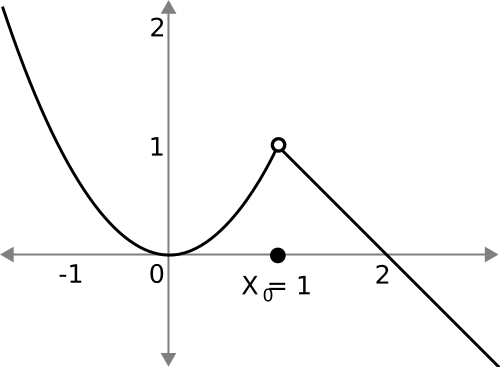
A graph of a function with a removable discontinuity marked by a hole. The curve approaches the same value from both sides, illustrating that the limit exists even though the function is undefined at that point. Source.
Algebraically, it often corresponds to a factor that cancels, creating a simplified form that reveals the limiting behavior.
Graphical Clues
When analyzing a graph:
A single isolated hole often indicates a removable discontinuity.
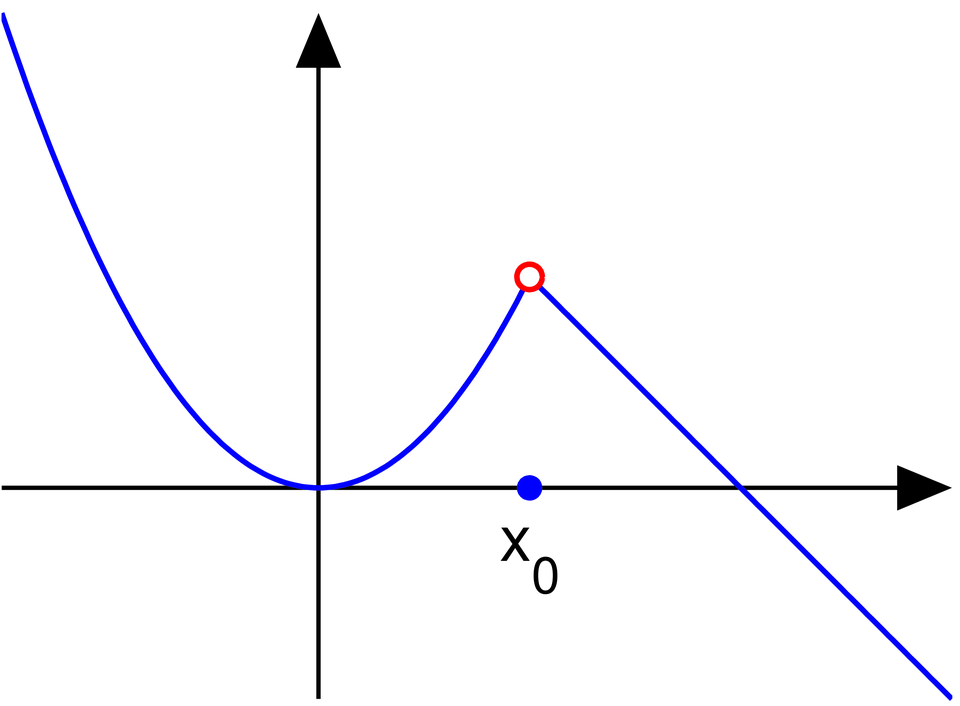
A graph showing a removable discontinuity as a small open circle at , where the function is undefined but the limit exists. Extra subplots on the page depict other discontinuity types not required by the syllabus. Source.
The curve behaves smoothly on both sides of the hole.
The function approaches a finite, consistent value as approaches the discontinuity.
These features signal that the function’s definition, not its structure, creates the discontinuity.
Algebraic Clues
When working with expressions:
A common factor may cancel, suggesting the function behaves like a continuous expression everywhere except the point where the original denominator is zero.
The simplified version of the function demonstrates what value the function is approaching, revealing the limit.
These algebraic signs help determine the value needed to redefine the function at the discontinuity.
Using Limits to Determine Removability
Determining whether a discontinuity is removable follows a structured limit-based approach.
Procedure
Check whether the limit exists by evaluating the left-hand and right-hand behavior near the point.
Determine the limit value, ensuring it is finite and consistent.
Compare the limit to the function value at the point (if one exists).
Decide whether redefining the function to match the limit would produce continuity.
Interpretation
If redefining the function at a point makes the graph smooth with no breaks, the discontinuity is removable. If the underlying limit does not exist, continuity cannot be repaired by altering a single value.
Practice Questions
Question 1 (1–3 marks)
A function g is defined for all real numbers except x = 2. The limit of g as x approaches 2 is 5.
(a) State the value that g(2) must be defined to equal in order to remove the discontinuity at x = 2.
Question 1
(a) 1 mark:
• g(2) must be defined to equal 5.
(Any statement conveying that the function value must equal the limit earns the mark.)
Question 2 (4–6 marks)
A function h is given by
h(x) = (x² − 9) / (x − 3) for x ≠ 3.
The function is undefined at x = 3.
(a) Determine whether the discontinuity at x = 3 is removable.
(b) If the discontinuity is removable, define a new function H that removes it.
(c) Explain why the new function H is continuous at x = 3.
Question 2
(a) 2 marks:
• 1 mark for stating that the discontinuity is removable.
• 1 mark for correctly explaining that the limit as x approaches 3 exists and equals 6 (or that the expression simplifies to x + 3).
(b) 2 marks:
• 1 mark for defining H(3) = 6.
• 1 mark for defining H(x) = x + 3 for x ≠ 3.
(c) 1–2 marks:
• 1 mark for stating that H(3) equals the limit of h(x) as x approaches 3.
• 1 mark for concluding that this satisfies the condition for continuity at a point.
FAQ
A removable discontinuity occurs only when the limit exists. If the limit does not exist or the function approaches different values from each side, the point is not removable.
Check the nearby behaviour:
• If the graph approaches a single value, it is removable.
• If it approaches several values or diverges, the undefined point is non-removable.
A factor that creates a zero in the denominator causes the function to be undefined, but if that factor cancels, the simplified version describes how the function behaves near the point.
The cancellation exposes the underlying continuous behaviour, helping identify whether redefining the function restores continuity.
Yes. Each instance where the function is undefined or incorrectly defined but has a well-defined limit represents a removable discontinuity.
These points are independent; removing one does not affect the removability of another.
A piecewise or algebraically complex function may contain several such locations.
Even after redefining the function to be continuous, the derivative may still fail to exist because differentiability requires stronger conditions than continuity.
If the limiting slopes from each side disagree, the function becomes continuous but not differentiable at the formerly discontinuous point.
Removable discontinuities indicate situations where the function can be repaired, making it suitable for further analysis involving continuity-based theorems.
In contrast, jump or infinite discontinuities cannot be fixed by redefining a single value, which limits the applicability of tools such as the Intermediate Value Theorem and certain limit techniques.