

AP Syllabus focus:
‘Solve for parameters in piecewise-defined functions so that expressions on each side of a boundary agree with each other and with the function value at the boundary.’
Making a piecewise function continuous at a boundary requires ensuring its pieces meet smoothly, motivating a careful analysis of function behavior and parameter choices at shared endpoints.
Understanding Continuity Requirements at a Boundary
When dealing with piecewise-defined functions, each rule governs the function on a specified interval. A boundary is a point where two pieces meet, such as at . Since continuity models real-world change without abrupt jumps, AP Calculus AB emphasizes constructing conditions that make these functions behave seamlessly at such points. The goal is to force the left-hand expression and the right-hand expression to produce the same output at the shared boundary, ensuring no breaks in the graph.
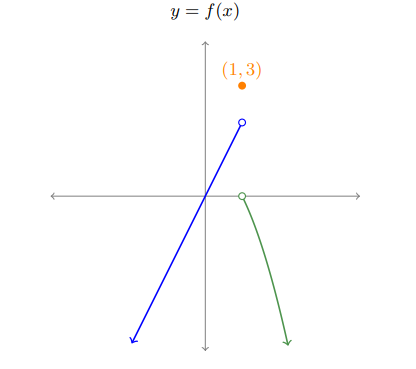
Graph of a piecewise function with a jump discontinuity at x=1x=1x=1. The left-hand and right-hand pieces meet at different heights, illustrating failure of continuity at a boundary. This demonstrates why parameter choices must force agreement of the expressions on both sides of the boundary. Source.
Continuity at a Point: A function is continuous at if exists, exists, and these two values are equal.
A piecewise function may include parameters (like , , or ) that must be solved so all continuity requirements are satisfied. Solving for those parameters ensures the formulas agree with each other at the boundary and, when defined, with the function value explicitly assigned there.
The Role of Limits When Matching Function Pieces
Although piecewise definitions can appear disconnected, continuity depends entirely on the limit at the boundary. To enforce continuity at , the limit from the left must equal the limit from the right. If the function also defines a value at , that value must match the limit to prevent a removable discontinuity.
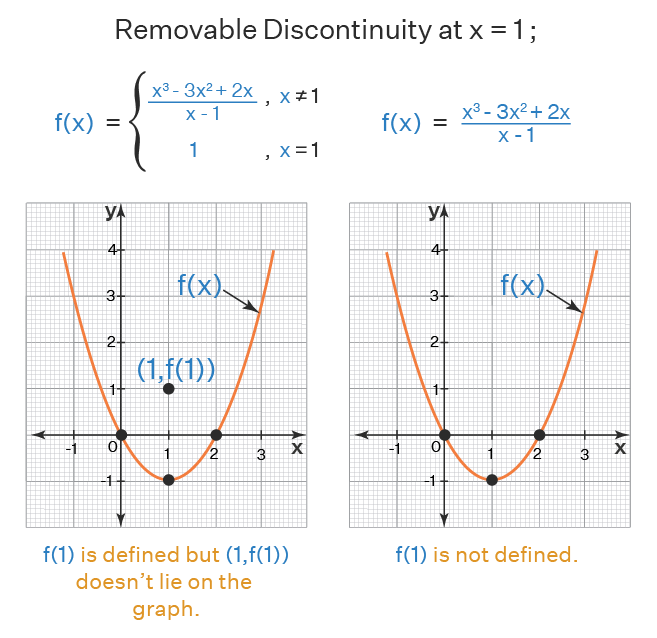
Illustration of a removable discontinuity at x=1x=1x=1, where the curve approaches a single value from both sides but contains a hole. The diagrams show cases where f(1)f(1)f(1) is either misdefined or undefined, producing discontinuity. Some additional context on other types of discontinuities appears on the source page but is not required by this syllabus subsubtopic. Source.
= Value approached from the left
= Value approached from the right
When a parameter appears within either expression, determining its value typically means setting and solving. Afterward, the common limit must also equal the defined function value (if present), ensuring the boundary satisfies the three-part definition of continuity.
A piecewise function without a defined value at the boundary relies solely on matching left- and right-hand limit expressions. A function that does define a value at the boundary requires that same match plus equality with the listed value.
Making Expressions Agree at a Boundary
To ensure continuity, students must relate the algebraic structure of each piece to the required limit behavior. The following steps summarize the conceptual framework emphasized in the AP specification:
Identifying the Boundary and Relevant Expressions
Start by locating the relevant endpoint where two rules meet. Extract the expressions that apply immediately to the left and right of the boundary. The forms may be polynomial, rational, exponential, or any other function type allowed within AP Calculus AB. Because these forms behave predictably near most finite points, direct substitution often gives the one-sided limits.
Enforcing Equality Using Algebraic Conditions
To make a piecewise function continuous at , impose algebraic conditions that require the output of the two sides to coincide at that point. This often produces equations involving parameters. Solving them guarantees that the expressions “agree with each other,” fulfilling the syllabus requirement.
Key ideas underlying the algebraic process:
Match the left-hand and right-hand limits.
If substitution is permitted (i.e., expressions are continuous on their respective intervals), simply plug in the boundary value.Verify any explicitly defined boundary value.
If the function lists separately, ensure that equals the shared limit. Otherwise, the function would contain a removable discontinuity.Solve for unknown parameters.
Setting expressions equal may yield one or more equations. The set of solutions gives all possible values that make the function continuous at the boundary.
Conditions Involving Parameters and Functional Form
Piecewise functions often include coefficients that modify slopes, vertical shifts, or nonlinear characteristics across intervals. Because the AP Calculus AB curriculum focuses on conceptual reasoning, understanding why these parameters must match is as important as calculating them.
Reasons parameters determine continuity:
They influence output magnitude directly, altering the height of the graph near the boundary.
They affect local behavior, especially when the pieces differ in type (e.g., polynomial vs. rational).
They ensure the function models a single, coherent rule despite using multiple algebraic expressions.
When solving for parameters, continuity can sometimes restrict them to a single value, or sometimes yield infinitely many values depending on the structure of the function. In either case, the student must base the reasoning on limit equality.
Practical Framework for Students
A structured approach to making piecewise functions continuous strengthens skills for later differentiation topics, where continuity often becomes a prerequisite.
A reliable process includes:
Identify the boundary point.
Determine which piece applies on each side.
Compute one-sided limits using direct substitution when allowed.
Set the two expressions equal to form an algebraic condition.
Include any defined function value at the boundary and equate it to the limit if necessary.
Solve for parameters and interpret whether the resulting value(s) produce a continuous function.
Understanding how to make piecewise functions continuous ensures that students can modify and analyze functions to behave smoothly across domains, satisfying both algebraic and graphical criteria essential to AP Calculus AB.
Practice Questions
Question 1 (1–3 marks)
A function f is defined as
f(x) = 3x + 1 for x < 2
f(x) = kx − 2 for x ≥ 2
Find the value of k that makes f continuous at x = 2.
Question 1
• 1 mark: Substitutes x = 2 into 3x + 1 to obtain 7.
• 1 mark: Substitutes x = 2 into kx − 2 to obtain 2k − 2.
• 1 mark: Equates 7 = 2k − 2 and solves to get k = 4.5 (or 9/2).
Question 2 (Total 6 marks)
A piecewise function g is defined as
g(x) = ax² − 1 for x ≤ 1
g(x) = 4x + b for x > 1
(a) State the condition required for g to be continuous at x = 1.
(b) Use this condition to find a relationship between a and b.
(c) Given that a = 2, find the value of b and determine whether the resulting function is continuous at x = 1. Justify your answer.
Question 2
(a) (1 mark)
• States the condition for continuity: the left-hand expression at x = 1 must equal the right-hand expression at x = 1.
(b) (2 marks)
• 1 mark: Correctly evaluates ax² − 1 at x = 1 to obtain a − 1.
• 1 mark: Correctly evaluates 4x + b at x = 1 to obtain 4 + b, and sets a − 1 = 4 + b.
(c) (3 marks)
• 1 mark: Substitutes a = 2 into a − 1 = 4 + b.
• 1 mark: Solves b = −3.
• 1 mark: States that with a = 2 and b = −3, both expressions give the same value at x = 1, hence the function is continuous at that point.
FAQ
If a formula used in one interval is undefined at the boundary, you cannot use direct substitution to enforce continuity. Instead, you rely on the limit of that expression as it approaches the boundary from within its valid domain.
If the limit exists and matches the neighbouring expression’s value or limit, continuity is still achievable. If the limit does not exist, no choice of parameters will make the function continuous at that boundary.
Yes. When a function has more than one boundary, each boundary yields its own continuity condition.
• Each condition produces an equation involving the parameters.
• Multiple boundaries may produce a system of equations.
• In some cases, the system is overdetermined, meaning no parameter choice satisfies all boundaries.
Parameter flexibility determines whether simultaneous continuity across all boundaries is possible.
Absolute value functions are continuous everywhere, so substitution is normally permitted. However, ensuring continuity requires checking that the algebraic form on the other side of the boundary matches the absolute value expression’s value at the point.
Break the absolute value into its piecewise form only if needed. This is helpful when solving for parameters, because expressing the absolute value explicitly may reveal constraints not obvious in its compact form.
Yes. Continuity only requires matching function values or limits, but differentiability demands matching slopes from both sides.
Even if the pieces meet cleanly at the boundary, a sharp corner or cusp results when the derivatives differ. This situation is common when linear and nonlinear expressions meet. Ensuring differentiability requires an additional equation equating the derivatives, separate from the continuity condition.
A graph may appear continuous at a boundary even when a small gap or jump is actually present. Limited resolution can hide open circles or slight mismatches between the pieces.
To reduce misinterpretation:
• Examine graphs with appropriately chosen scales.
• Check numeric values or algebraic forms whenever precision matters.
• Avoid relying solely on a sketch when determining whether the pieces genuinely meet at a single point.
