

AP Syllabus focus:
‘Use infinite limits to describe and identify vertical asymptotes, explaining how unbounded function values near certain x-values correspond to vertical asymptotic behavior.’
Vertical asymptotes reveal how functions behave when values grow without bound. Understanding infinite limits provides a precise mathematical framework for identifying where this unbounded behavior occurs on a graph.
Identifying Vertical Asymptotes Using Infinite Limits
Understanding Infinite Limits and Unbounded Behavior
When studying function behavior near specific x-values, it is essential to distinguish between finite and infinite limits. A limit describes how a function behaves as x approaches a given value, and an infinite limit describes situations where the function values increase or decrease without bound. This unbounded behavior is closely tied to the presence of vertical asymptotes, which appear in graphs as vertical lines the function approaches but never intersects.
Infinite Limit: A limit in which increases or decreases without bound as approaches a specific value.
A function can behave differently when approached from the left or the right, and AP Calculus AB requires careful attention to these one-sided infinite limits.
Relating Infinite Limits to Vertical Asymptotes
A vertical asymptote occurs at if the function's values grow without bound as approaches . In other words, vertical asymptotes represent locations where the graph climbs upward toward positive infinity or drops downward toward negative infinity as the input gets arbitrarily close to a specific point.
Vertical Asymptote: A vertical line where approaches or as approaches from at least one side.
This relationship allows infinite limits to become a powerful analytic tool for identifying vertical asymptotes even when a graph is not provided.
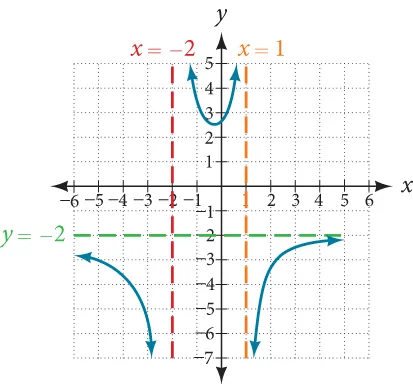
Graph of a rational function with vertical asymptotes at and , where the function values grow without bound as approaches these values. A horizontal asymptote at is also shown, which extends beyond this subsubtopic but helps distinguish vertical from horizontal asymptotic behavior. The dashed vertical lines represent locations defined by infinite limits rather than actual points on the graph. Source.
Limit Notation for Vertical Asymptotes
Infinite limits are expressed symbolically to capture the direction and nature of unbounded function behavior. These limit expressions clarify whether the function grows positively or negatively without bound, and whether the behavior is the same on both sides of the point being approached.
= approaches from the left
= function value growing without bound
A similar symbolic structure communicates behavior from the right-hand side or toward negative infinity.
When a function satisfies any such statement, the presence of a vertical asymptote at is confirmed.
Processes for Identifying Vertical Asymptotes
The connection between infinite limits and asymptotic behavior enables a structured approach to determining where vertical asymptotes occur. AP Calculus AB emphasizes using algebra, graphs, and the function’s structure to identify unbounded behavior.
Key steps include:
Examine the function’s domain
Points excluded from the domain due to division by zero or undefined expressions often indicate candidates for vertical asymptotes.
Evaluate one-sided limits
Determine whether approaches or as approaches the excluded value from the left and right.
Check for factors that cancel
If simplification removes a zero denominator, the point may represent a removable discontinuity instead of an asymptote.
Confirm unbounded behavior
A vertical asymptote exists only when the limit demonstrates unbounded growth or decay.
These steps ensure accuracy when interpreting function behavior near potential asymptotic locations.
Connecting Algebraic Structure to Infinite Limits
Many functions exhibit asymptotic behavior because of algebraic features such as denominators approaching zero, logarithmic restrictions, or tangent function singularities. Recognizing these structural cues strengthens students’ ability to predict where infinite limits will occur even before calculating them.
Important structural indicators include:
Rational functions with denominators that equal zero at certain x-values.
Logarithmic functions undefined for nonpositive arguments, often producing vertical asymptotes at boundary points.
Trigonometric functions such as , which has vertical asymptotes where .
Expressions involving radicals in denominators or exponents that introduce restricted domains.
Although these cues cannot replace formal limit evaluation, they provide preliminary guidance for further analysis.
Differences Between Limit Behavior and Function Values
A crucial conceptual point emphasized in the syllabus is that vertical asymptotes are determined by the behavior of the function near a point, not at the point itself. The function does not need to be defined at the x-value associated with a vertical asymptote. Even if a function assigns a finite value at that location, the nearby behavior can still exhibit unbounded growth.
This distinction ensures students focus on the limit, not the function value, as the defining feature of asymptotic behavior.
Graphical Interpretation of Vertical Asymptotes
When reading or analyzing graphs, vertical asymptotes appear as steep curves approaching a vertical reference line. However, AP Calculus AB emphasizes that the graph provides evidence for infinite limits, rather than defining the asymptote on its own. Students should confirm visually suggested asymptotes by relating them to formal limit behavior.
Key graphical patterns include:
Sharp upward or downward spikes near specific x-values
Curves hugging a vertical line without crossing it
Consistent one-sided divergence from both sides or from a single side
These patterns reinforce the analytical definition of vertical asymptotes.
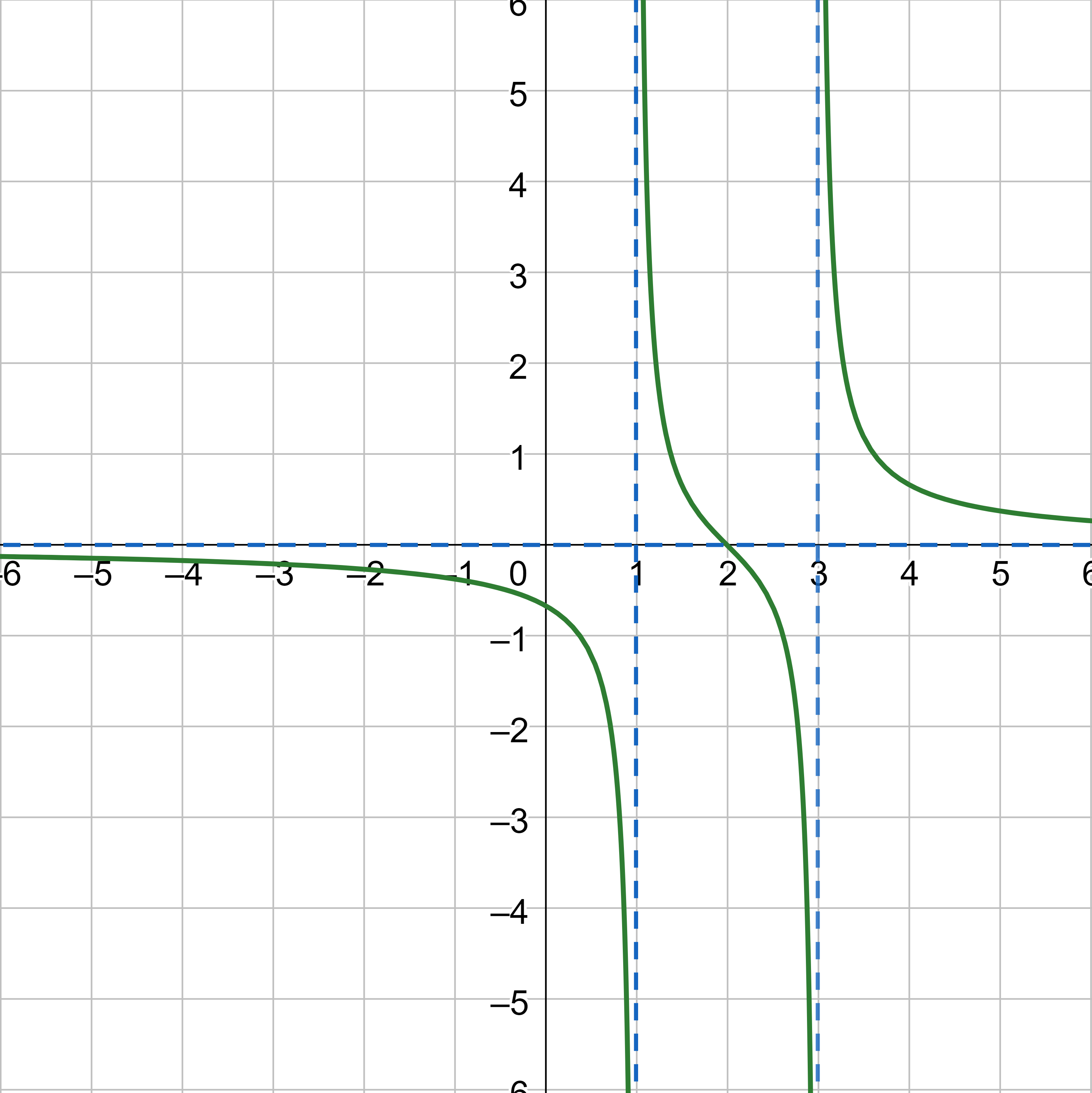
Graph of a rational function with vertical asymptotes at , , and , each defined by infinite limits from one or both sides. A horizontal asymptote at is also shown, which extends beyond the strict syllabus content but clarifies how vertical and horizontal asymptotes differ. The curve approaches each asymptote toward or , illustrating unbounded behavior. Source.
Contextual Importance in Calculus
Vertical asymptotes represent more than graphing artifacts; they describe real-world behaviors such as physical blow-ups, near-singular conditions, or boundary constraints. Infinite limits offer a rigorous language to describe these situations and link them to the broader study of continuity, differentiability, and curve behavior in AP Calculus AB.
Practice Questions
Question 1 (1–3 marks)
The function g is defined by g(x) = 5 / (x + 2).
(a) Determine the behaviour of g(x) as x approaches −2 from the right.
(b) Hence state the equation of the vertical asymptote of g.
Question 1
(a)
• 1 mark: Correct statement that g(x) approaches positive infinity as x approaches −2 from the right.
(Allow equivalent wording describing unbounded growth.)
(b)
• 1 mark: Correct identification of the vertical asymptote x = −2.
Question 2 (4–6 marks)
Consider the function h defined by h(x) = (3x − 1) / (x² − 4).
(a) Identify all x-values at which h may have a vertical asymptote.
(b) For each value found in part (a), determine whether the limit of h(x) approaches positive infinity or negative infinity from both sides.
(c) Hence state the equation(s) of the vertical asymptote(s) and justify your answer using infinite limits.
Question 2
(a)
• 1 mark: Correctly identifies x = −2 and x = 2 as the values where h may have vertical asymptotes (denominator zero).
(b)
• 1–2 marks: Correct determination of the sign of the limit as x approaches −2 from the left and right.
• 1–2 marks: Correct determination of the sign of the limit as x approaches 2 from the left and right.
(Full credit requires correct reasoning about sign changes or interval behaviour, not simply listing results.)
(c)
• 1 mark: Correct statement that vertical asymptotes occur at x = −2 and x = 2.
• 1 mark: Justification using infinite limits, for example by stating that h(x) tends to positive or negative infinity as x approaches these values from at least one side.
FAQ
A removable discontinuity occurs when a factor causing the denominator to be zero also appears in the numerator and can be cancelled, leading to a finite limit. A vertical asymptote occurs when the denominator becomes zero but the numerator does not, causing values to grow without bound.
To distinguish them, factor both numerator and denominator fully:
• If a shared factor cancels, the issue is removable.
• If not, the function diverges, indicating a vertical asymptote.
Infinite limits depend on how the sign of the expression changes as x approaches the asymptote. Even a simple rational function may have opposite signs on either side of the critical point.
Differences occur when:
• The numerator and denominator change sign at different rates.
• The denominator crosses zero from positive to negative.
• The function’s structure forces asymmetric divergence.
Each of these leads to distinct left- and right-hand behaviours.
Yes. A function may assign a value at the x-location where a vertical asymptote occurs, but the definition does not affect the asymptote.
A vertical asymptote depends solely on nearby behaviour, not the function’s value at the point.
• If the limits diverge to infinity from either side, the asymptote exists even if the function is artificially defined or redefined at that x-value.
Piecewise functions may approach the same vertical asymptote from both sides or may only diverge on one side. Infinite limits are assessed separately for each piece.
To analyse:
• Examine each piece’s formula near the critical x-value.
• Determine whether each side approaches positive infinity, negative infinity, or a finite limit.
• A vertical asymptote exists if any one-sided limit diverges.
Yes. Certain functions, especially periodic or repeating algebraic forms, can exhibit infinitely many vertical asymptotes.
Common examples include:
• Trigonometric functions such as tangent and secant.
• Functions whose denominators repeat zeroes in regular patterns.
Infinitely many vertical asymptotes typically indicate periodic domain restrictions or recurrent singularities in the function’s algebraic or geometric structure.
