AP Syllabus focus:
‘Determine horizontal asymptotes by evaluating limits of functions as x approaches positive or negative infinity and relating constant limit values to asymptotic behavior.’
Horizontal asymptotes describe a function’s long-term behavior as the input grows without bound. Understanding limits at infinity reveals how functions settle toward constant values that govern end behavior.
Understanding Horizontal Asymptotes
Horizontal asymptotes arise when the output of a function approaches a constant value as x → ∞ or x → −∞.
This perspective focuses on end behavior, the long-run trend of a graph rather than its behavior near specific points. Students must recognize that horizontal asymptotes describe approach, not permanent confinement; a function may cross or move away from an asymptote yet still exhibit asymptotic behavior at infinity.
When studying end behavior, the guiding principle is that limits at infinity translate directly into statements about horizontal asymptotes. If a function settles toward a single numerical value as x becomes arbitrarily large in the positive or negative direction, that value defines a horizontal asymptote. These ideas align with the AP emphasis on connecting limit notation with graphical interpretation, enabling students to understand asymptotes as descriptors of long-term stability.
Limits at Infinity and Asymptotic Behavior
A limit at infinity describes the value a function approaches as x increases or decreases without bound. This concept underlies every determination of a horizontal asymptote. When the limit equals a real number, the corresponding horizontal line indicates the end behavior of the curve. A graph interpreted through this lens becomes a tool for predicting how a model behaves far into the future or at extreme input values.
Limit at Infinity: A limit describing the value a function approaches as the input increases or decreases without bound.
Between positive and negative infinity, a function may approach different constant values. Therefore, it is essential to consider each direction separately, consistent with the syllabus requirement to determine horizontal asymptotes using limits as x approaches positive or negative infinity.
A single sentence must appear here before any other definition or equation to maintain proper formatting.
Horizontal Asymptote: A horizontal line that a function approaches as becomes arbitrarily large in the positive or negative direction.
A function may have no horizontal asymptotes, one horizontal asymptote, or two distinct horizontal asymptotes depending on the values of the relevant limits.
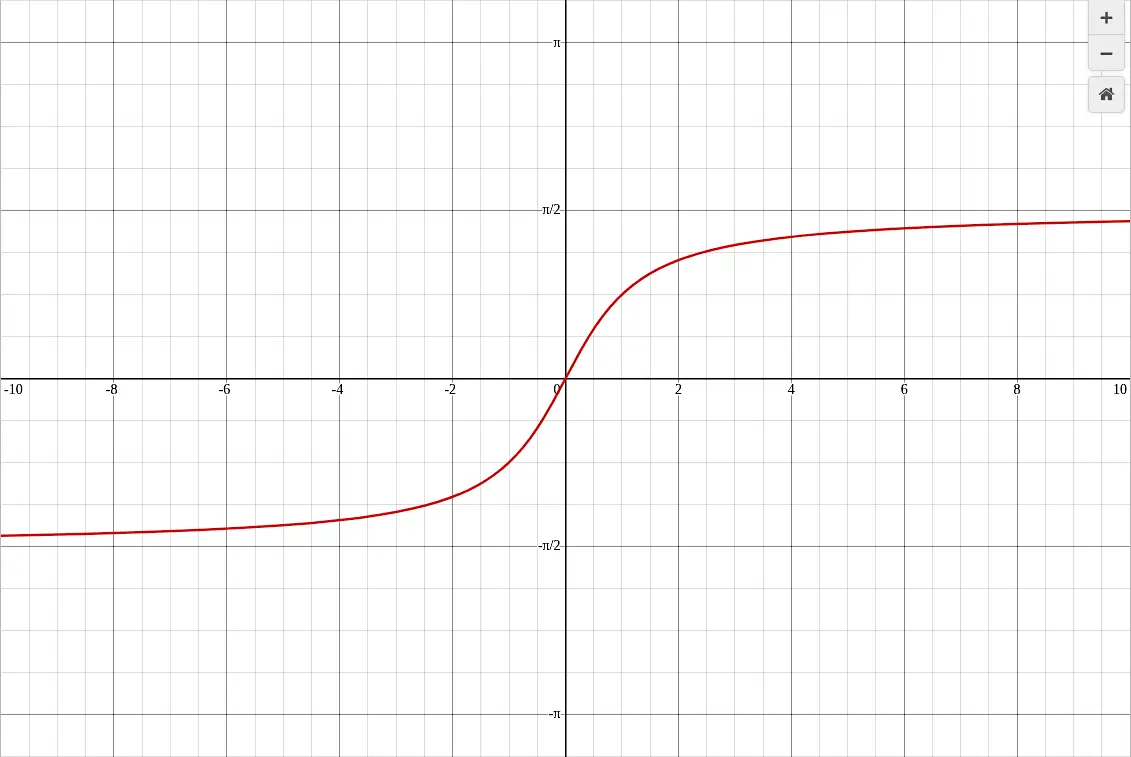
This graph of the arctangent function shows two horizontal asymptotes at and . As , the curve approaches the upper asymptote, and as , it approaches the lower asymptote. The image includes inverse trigonometric detail that exceeds the syllabus slightly but remains aligned with AP Calculus AB expectations. Source.
These outcomes depend entirely on limit behavior, not on algebraic form alone.
A sentence is required between definition or equation blocks before continuing further.
= Constant value approached as increases without bound
= Constant value approached as decreases without bound
These limit expressions emphasize that horizontal asymptotes are determined exclusively by end behavior, even when the function’s local features are more irregular.
Graphical Interpretation of Limits at Infinity
Interpreting limits visually helps students recognize horizontal asymptotes by observing whether the graph levels off as x moves toward large positive or negative values. The leveling tendency corresponds to the y-value that the curve nears, and this becomes the asymptotic value predicted by the limit notation.
Key Graphical Indicators
• The function’s output becomes increasingly stable as x grows large.
• Oscillations, if present, diminish toward a constant center value.
• The graph flattens and approaches a horizontal line.
• Distinct behaviors may appear on the left and right ends of the graph.
These interpretations reinforce the AP requirement to relate limit results to graphical asymptotic behavior and deepen conceptual understanding of how limits convey end behavior.
Analytical Strategies for Identifying Horizontal Asymptotes
Because AP Calculus AB expects students to determine horizontal asymptotes using limits at infinity, algebraic reasoning must support graphical observations. Through limit evaluation, students justify asymptotes rather than merely reading them from a graph.
Guiding Principles for Algebraic Determination
• Evaluate and independently.
• Recognize that end behavior depends on dominant terms for expression types such as rational, exponential, logarithmic, or trigonometric functions.
• Use appropriate limit laws or algebraic manipulation when necessary to clarify long-term behavior.
• Interpret constant limit values as asymptotes and nonconstant or unbounded limits as indicating no horizontal asymptote for that direction.
These procedures integrate limit laws with conceptual understanding, consistent with AP expectations that students connect algebraic and graphical representations.
Conceptual Significance in Mathematical Modeling
Horizontal asymptotes often appear in models where quantities stabilize over time or after significant growth. The limit framework allows students to express stabilization precisely using asymptotic language. Whether modeling velocity, population growth, or cooling processes, the horizontal asymptote represents the equilibrium state that the model approaches as inputs become very large. This captures the essence of the syllabus emphasis on relating constant limit values to asymptotic behavior.
By mastering limits at infinity and understanding how they determine horizontal asymptotes, students develop a deeper and more versatile view of functions’ long-term behavior.
Practice Questions
Question 1 (1–3 marks)
The function f is defined for all real x. It is known that the limit of f(x) as x approaches infinity is 4.
(a) State the equation of the horizontal asymptote of f. (1 mark)
(b) Explain in one sentence what this tells you about the end behaviour of f. (1–2 marks)
Question 1
(a) Award 1 mark for:
• y = 4
(b) Award up to 2 marks:
• 1 mark for stating that f(x) approaches 4 as x becomes very large.
• 1 further mark for describing that the graph levels off or tends towards the line y = 4 for large positive x.
Question 2 (4–6 marks)
The function g is defined by g(x) = (3x − 1) / (x + 2).
(a) Determine the limit of g(x) as x approaches infinity. (2 marks)
(b) Determine the limit of g(x) as x approaches negative infinity. (2 marks)
(c) Hence state all horizontal asymptotes of g, giving reasons. (1–2 marks)
Question 2
(a) Award 2 marks:
• 1 mark for stating that the leading terms dominate.
• 1 mark for correctly giving the limit as 3.
(b) Award 2 marks:
• 1 mark for correct reasoning involving dominant terms or division by x.
• 1 mark for correctly giving the limit as 3.
(c) Award up to 2 marks:
• 1 mark for identifying the horizontal asymptote y = 3.
• 1 additional mark for stating that the same limit in both directions confirms this is the only horizontal asymptote.
FAQ
A horizontal asymptote describes how a function behaves as x becomes extremely large in magnitude, not how it behaves for moderate or small values.
A function may cross its asymptote many times because the definition does not restrict its behaviour away from infinity. What matters is that the function approaches the same constant value as x tends to positive or negative infinity.
Rational functions have predictable end behaviour because the dominant terms in the numerator and denominator determine their long-range values.
Other functions, such as logarithmic or oscillatory functions, may not settle towards a constant. They might grow slowly without bound, oscillate indefinitely, or diverge in different ways, making horizontal asymptotes impossible.
Yes. Horizontal asymptotes depend on limits as x approaches positive and negative infinity separately.
A function’s long-term trend may differ to the left and right, especially if its algebraic structure or transformations behave asymmetrically.
Examples include certain inverse trigonometric functions or rational functions whose leading terms behave differently for negative inputs.
Common errors include:
• Confusing temporary flattening with true asymptotic behaviour.
• Assuming the function must never cross the asymptote.
• Misreading scale when the graph slowly approaches a value but appears level due to the axes.
Careful inspection of end behaviour, not mid-graph features, is crucial.
Horizontal asymptotes often represent a limiting value that a real-world system approaches over time or distance.
Examples include:
• Temperature approaching ambient conditions.
• Population growth levelling off near a carrying capacity.
• Velocity approaching a terminal speed.
In each case, the asymptote reflects a stable state that the system moves towards but may not physically reach.