

AP Syllabus focus:
‘Extend the concept of limits to limits at infinity, using them to describe the end behavior of functions as x becomes very large in the positive or negative direction.’
Limits at infinity describe how a function behaves as its input grows without bound, providing essential insight into long-term trends and the overall end behavior of functions.
Limits at Infinity
Understanding limits at infinity is central to analyzing how functions behave for extremely large positive or negative inputs. When we evaluate a limit as or , we are not looking for where the function ends—because it continues indefinitely—but rather the value the function’s output approaches. This behavior reveals patterns such as leveling off, unbounded growth, or decay.
When first discussing limits at infinity, it is important to connect the idea to the broader concept of a limit: investigating what value a function approaches, rather than what value it attains. Limits at infinity expand this notion to the “far ends” of the graph, allowing us to describe whether a function becomes arbitrarily large, settles near a constant value, or decreases without bound.
The Meaning of “End Behavior”
The end behavior of a function refers to how its output values behave as the input grows large in magnitude. End behavior focuses on trends rather than specific points and helps distinguish among different families of functions. It also provides a foundation for identifying horizontal asymptotes and comparing growth rates.
End Behavior: The long-term behavior of a function as approaches or , focusing on tendencies in rather than exact function values.
A function’s end behavior is typically represented graphically by how the curve extends toward the edges of the coordinate plane. Algebraically, it is described through limit notation, reflecting the value the function tends toward.
Limit Notation for End Behavior
Using limit notation emphasizes that the value approached is what matters, not whether it is ever reached. When we say , we are expressing that the function grows arbitrarily close to for sufficiently large .
= Function output
= Input variable approaching positive infinity
= Constant value the function approaches
This notation reinforces that limits at infinity help determine whether the function stabilizes near a horizontal line or continues to grow.
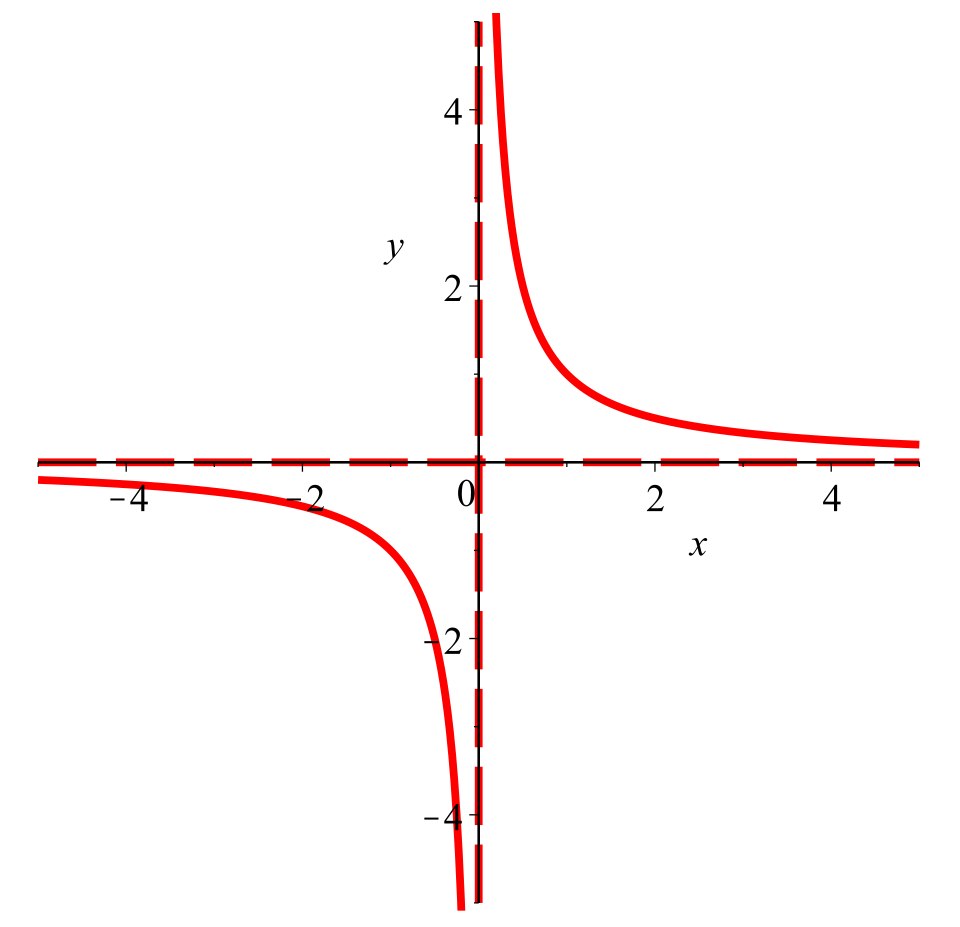
Graph of with a horizontal asymptote at and a vertical asymptote at . The arrows show that as , the curve gets closer to the line , illustrating a limit at infinity. The vertical asymptote indicates local unbounded behavior that extends slightly beyond this subsubtopic. Source.
Recognizing Different End Behaviors
While functions may display complex behavior near the origin or at particular points, their end behavior is often simpler and governed by dominant terms in their algebraic expressions. Common patterns include:
Approaching a constant value, often indicating a horizontal asymptote.
Increasing without bound as the input becomes large.
Decreasing without bound as the input becomes large in magnitude.
Oscillating while still approaching a limiting value.
These patterns provide a broad understanding of the categories into which many functions fall.
End Behavior of Common Function Families
Different types of functions exhibit predictably different behaviors at infinity. For AP Calculus AB, recognizing these patterns strengthens intuition and supports more advanced limit techniques.
Polynomial Functions
Polynomials exhibit end behavior driven by the term with the highest exponent. Lower-degree terms become negligible for large values of , creating a clear pattern of growth or decay based on the leading coefficient and degree.
Dominant Term: In a polynomial, the term with the highest power of , which determines the end behavior of the function as becomes large in magnitude.
Because this dominant term controls behavior at infinity, polynomials do not level off; they grow without bound or fall without bound depending on sign and degree.
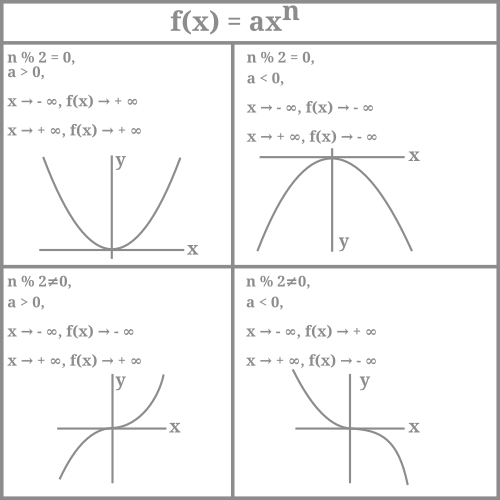
Four-panel diagram showing the end behavior of for even and odd degrees with positive and negative leading coefficients. Each panel illustrates how the graph behaves as , contrasting “both ends up,” “both ends down,” and opposite-tail patterns. The labels refer specifically to monomials, a slightly narrower case that still directly represents polynomial end behavior. Source.
Rational Functions
Rational functions show more variety in end behavior, as the degrees of the numerator and denominator determine whether the function tends to zero, approaches a constant ratio, or grows without bound. When the denominator’s degree exceeds the numerator’s, outputs shrink toward zero, revealing a horizontal asymptote at . When degrees match, the ratio of leading coefficients determines the value approached.
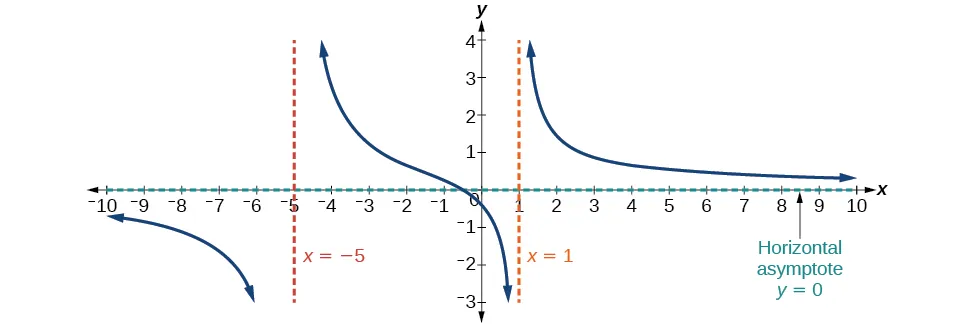
Graph of a rational function with vertical asymptotes at and and a horizontal asymptote at . The outer tails show the function approaching as , demonstrating end behavior dominated by a higher-degree denominator. The vertical asymptotes provide additional context about local behavior not essential to the subsubtopic. Source.
Between these scenarios, rational functions illustrate how limits at infinity reveal nuanced asymptotic behavior not easily observed through local analysis.
Exponential and Logarithmic Functions
Exponential functions of the form with grow extremely rapidly as and decay toward zero as . Their consistent pattern makes them useful for modeling many real-world processes where growth accelerates over time.
Logarithmic functions, by contrast, grow without bound but do so extremely slowly. Even as becomes large, the output increases only incrementally, creating distinctive end behavior that contrasts sharply with exponential growth.
Using Limits at Infinity to Describe End Behavior
Limits at infinity provide precise language to describe long-term behavior, enabling statements such as:
The function approaches a constant value.
The function increases or decreases without bound.
The function tends toward zero.
This approach allows for structured analysis of curves, supporting the interpretation of graphs, informing algebraic techniques, and connecting to broader concepts such as asymptotes and growth rates.
Practice Questions
Question 1 (1–3 marks)
The function g is defined by g(x) = 3x / (x + 2).
(a) Determine the limit of g(x) as x approaches infinity.
(b) State the horizontal asymptote of g.
Question 1
(a) 1 mark: Correct limit stated as 3.
• Award 1 mark for any correct reasoning showing that the coefficients of the highest powers determine the limit.
(b) 1 mark: Horizontal asymptote y = 3.
Question 2 (4–6 marks)
Consider the function h(x) = (5x^2 - 4) / (x - 1).
(a) Explain how you can determine the end behaviour of h(x) by examining the dominant terms.
(b) Find the limit of h(x) as x approaches infinity.
(c) A student claims that h has a horizontal asymptote. Determine whether this is correct, giving reasoning based on your answer in part (b).
Question 2
(a) 1 mark: States that the dominant terms are 5x^2 in the numerator and x in the denominator.
1 mark: Explains that for large x, h(x) behaves like (5x^2)/x = 5x.
(b) 1 mark: Correct limit identified as infinity.
• Accept statements such as “h(x) increases without bound”.
(c) 1 mark: Correctly states that no horizontal asymptote exists.
1 mark: Justifies the conclusion by referring to the unbounded limit found in (b).
FAQ
A function that truly approaches a constant will continue getting closer to that value as x increases, even across large scales.
Temporary flattening usually disappears when the function is examined over a wider domain.
To check:
• Compare values at increasingly large x.
• Inspect the dominant term: a non-zero constant is only approached when higher-degree terms cancel or vanish.
• Graph with an extended window to avoid misleading local flattening.
As x becomes large, any term with a lower power grows much more slowly. Even if its coefficient is large, its contribution becomes negligible.
For example, a term involving x squared will eventually outweigh linear or constant terms.
Dominant terms provide a simplified but accurate model for describing end behaviour without tracking every part of the expression.
Yes. A function may have different horizontal asymptotes as x approaches positive infinity and negative infinity.
This occurs when behaviour differs on opposite ends, such as when odd functions or rational expressions behave asymmetrically.
To identify them:
• Evaluate the limit as x approaches infinity.
• Evaluate the limit as x approaches negative infinity.
Different results correspond to different horizontal asymptotes.
When the numerator’s degree exceeds the denominator’s by exactly one, the function typically has a slant (oblique) asymptote rather than a horizontal one.
In such cases, the quotient grows linearly or according to the degree difference, meaning the function does not settle near a constant value.
The end behaviour follows the quotient from polynomial long division, not a horizontal line.
Oscillations do not prevent a limit unless they persist with full amplitude at large x.
If the oscillations shrink or become constrained within a narrowing band, the function may still approach a single value.
Typical indicators:
• Bounded oscillation with decreasing amplitude.
• A multiplicative factor that forces the oscillation toward zero.
• A graph that shows tightening waves converging toward a line.
