

AP Syllabus focus:
‘Use limits at infinity to compare how quickly functions grow or decay, such as comparing polynomial, exponential, and logarithmic functions.’
Understanding how different families of functions grow or decay is essential for interpreting end behavior. Limits at infinity provide a precise mathematical tool for comparing growth rates effectively.
Comparing Growth Rates Using Limits at Infinity
Comparing growth rates means determining which functions become larger or smaller more quickly as x approaches positive or negative infinity. This subsubtopic focuses on how limits at infinity allow us to rank functions such as polynomial, exponential, and logarithmic expressions according to their long-term behavior.
Why Growth Rate Comparisons Matter
Growth rate comparisons reveal which terms dominate an expression, allowing students to predict end behavior, simplify complex models, and understand asymptotic trends in calculus. When multiple function types appear together, determining the dominant term helps establish limits, horizontal asymptotes, or the relative size of quantities as x becomes very large.
Using Limits at Infinity for Comparison
A limit at infinity describes the value a function approaches as x increases or decreases without bound. Growth rates are compared by examining ratios of functions using limits such as
.
If this limit equals zero, the numerator grows more slowly; if it approaches infinity, the numerator grows more quickly.
Key Terminology
When comparing growth, the term dominant function refers to the function that grows fastest as x approaches infinity.
Dominant Function: A function whose values increase or decrease more rapidly than another function when both are considered as .
A single sentence here provides natural flow before introducing the structural hierarchy of function growth.
Hierarchy of Common Function Families
A fundamental ordering emerges when comparing standard function families:
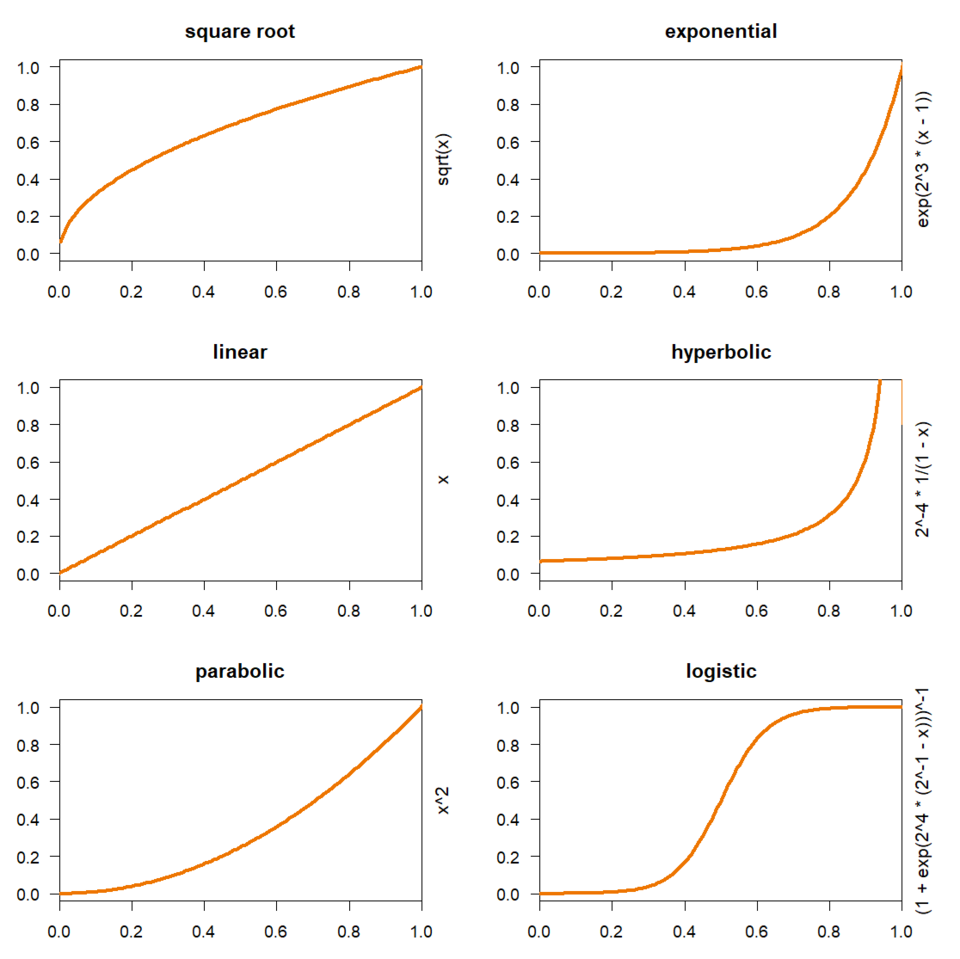
This figure compares several increasing functions on the same axes, illustrating how logarithmic, polynomial, and exponential functions grow at different rates as becomes large. The exponential curve rises sharply, while the logarithmic curve increases slowly, visually reinforcing the growth hierarchy. Extra curves provide additional context beyond the syllabus but remain consistent with the core comparison. Source.
Logarithmic functions (slowest growth)
Polynomial functions
Exponential functions (fastest growth)
This hierarchy means that exponentials overpower polynomials, and polynomials overpower logarithms, regardless of coefficients or specific bases (provided bases exceed 1 for growth).
Logarithmic Growth
Logarithmic functions, such as or , increase extremely slowly. Their slow rate means that any polynomial eventually exceeds their values as x becomes large.
Logarithmic Function: A function of the form , defined for , , representing the inverse of an exponential function.
A normal sentence follows to maintain spacing between structured blocks and to contextualize when logarithmic comparisons appear in calculus.
Polynomial Growth
Polynomial functions grow at rates determined by their degree, meaning the highest exponent dominates as x becomes large. Higher-degree polynomials grow faster than lower-degree ones, and positive leading coefficients ensure unbounded growth in the positive direction.
Polynomial Function: A function consisting of terms of the form , where is a nonnegative integer and is the coefficient of the highest-degree term.
This sentence reinforces that growth-rate comparisons simplify when the highest-degree term is isolated.
Exponential Growth
Exponential functions dominate nearly all other elementary functions due to their rapid rate of increase.
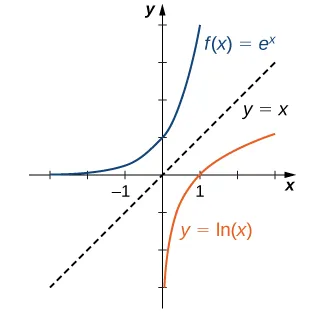
This graph displays the exponential function and the logarithmic function reflected across the line . The exponential curve grows rapidly for positive , while the logarithmic curve increases slowly and has a vertical asymptote at . Their symmetry illustrates the inverse relationship and highlights why exponentials dominate logarithms as . Source.
Exponential Function: A function of the form where , meaning the output increases by a constant factor for every unit increase in x.
A normal sentence here provides clarity that exponential decay (when ) also fits into the framework but involves decreasing rather than increasing behavior.
Using Ratios to Establish Dominance
Limits of ratios offer an algebraic method for confirming growth hierarchy:
If , then g grows faster.
If the limit equals infinity, f grows faster.
If the limit equals a finite nonzero constant, the functions grow at comparable rates.
= Result used to compare growth rates (zero, finite value, or infinity)
A normal sentence now explains how these results help classify behavior in more nuanced cases.
Typical Growth Comparisons in AP Calculus AB
Students frequently analyze:
vs. : logarithms grow more slowly than any polynomial.
vs. : polynomials grow more slowly than exponentials.
Competing polynomial terms: the highest-degree term governs growth.
Composite expressions: dominant terms determine end behavior even when combined with smaller-order components.
Processes for Comparing Growth Rates
Students can follow a structured approach when analyzing limits at infinity:
Identify the function families involved (logarithmic, polynomial, exponential).
Determine which family dominates based on the known hierarchy.
If necessary, compute a ratio limit using algebraic manipulation.
Interpret the limit to classify which function grows faster.
Apply the result to solve limit, asymptote, or end-behavior questions.
Growth Rate Comparisons in Mathematical Modeling
Many real-world contexts involve functions that model populations, financial trends, physical processes, or technological growth. Understanding relative growth rates helps determine whether a quantity increases slowly, steadily, or explosively as time progresses. Limits at infinity offer a rigorous mathematical framework for such interpretations, ensuring consistency across representations and supporting more advanced calculus techniques.
Practice Questions
Question 1 (1–3 marks)
As x approaches infinity, consider the functions f(x) = ln(x) and g(x) = x.
Which function grows faster as x becomes large? Justify your answer using limits at infinity.
Question 1
• 1 mark: Correctly states that g(x) = x grows faster than f(x) = ln(x).
• 1 mark: Uses a limit expression such as lim x→∞ ln(x)/x.
• 1 mark: Concludes that the limit equals 0, indicating that ln(x) grows more slowly.
Question 2 (4–6 marks)
Let f(x) = x^3 and h(x) = 2^x.
(a) Determine which function grows faster as x approaches infinity.
(b) Explain your reasoning by evaluating the limit of f(x) divided by h(x) as x approaches infinity.
(c) State what your result implies about the long-term behaviour of polynomial and exponential functions.
Question 2
• 1 mark: Identifies that h(x) = 2^x grows faster than f(x) = x^3.
• 1 mark: Writes an appropriate limit expression for comparing growth, such as lim x→∞ x^3 / 2^x.
• 1–2 marks: Correctly argues that the limit is 0, for example by stating that exponential functions increase more rapidly than polynomials.
• 1 mark: Clearly interprets the result as showing exponential domination over polynomial growth for large x.
• 1 mark: States that h(x) eventually exceeds f(x) for all sufficiently large x.
FAQ
Graphs can appear misleading because scaling choices compress or stretch curves, making slow or fast growth visually unclear.
Limits at infinity give a scale–independent mathematical comparison, allowing growth rates to be determined even when the functions eventually exceed any graphable range.
Yes. Two functions may grow at comparable rates if their ratio approaches a finite, non-zero constant.
This happens in cases such as:
Polynomial expressions with the same highest degree
Exponential functions with the same base
Logarithmic functions differing only by constant multiples
A constant multiplier changes the steepness of the graph but does not change the underlying growth category.
For example:
Multiplying a polynomial by 10 does not make it grow faster than an exponential.
Constants affect scale, not relative end behaviour.
Large coefficients can delay the point at which the exponential overtakes the polynomial, but they cannot change the eventual outcome.
Exponential functions involve repeated multiplication, whereas polynomials rely on repeated addition, leading to fundamentally different long-term behaviour.
No. Although logarithms increase without bound, they do so at an extremely slow rate.
Even very low-degree polynomials grow faster because each increase in x produces much larger changes relative to the incremental rise in a logarithmic function.
