AP Syllabus focus:
‘State the Intermediate Value Theorem for continuous functions on a closed interval and describe its meaning in terms of taking all intermediate values between two function values.’
The Intermediate Value Theorem provides a foundational guarantee about the behavior of continuous functions, ensuring they take on every intermediate value between two outputs across a closed interval.
Understanding the Intermediate Value Theorem
The Intermediate Value Theorem (IVT) is one of the most important results in introductory calculus because it formalizes an intuitive idea: a continuous function cannot “jump over” values. Instead, it must pass through all values between any two function outputs on a closed interval.
Intermediate Value Theorem (IVT): If a function is continuous on a closed interval and is any number between and , then there exists at least one number in such that .
This definition asserts both the requirement of continuity and the significance of the closed interval, which together guarantee the existence of a point where the function achieves an intermediate value.
Continuity as the Foundation
The theorem applies only to continuous functions, meaning the function has no breaks, jumps, or holes on the interval in question. Continuity ensures the function behaves predictably and does not skip any values.
Continuous Function on : A function with no breaks or jumps on the interval, meaning it can be drawn without lifting a pencil.
Because the IVT depends on continuity, the theorem also serves as a powerful diagnostic tool: if a function fails to take on an intermediate value, the function must not be continuous over the given interval.
The closed interval requirement reinforces that the function is defined and continuous at the endpoints, allowing the theorem to apply across the entire span from to .
Interpreting the Intuition Behind IVT
The intuition of the IVT is rooted in physical reasoning. If a continuous function models a quantity like temperature, elevation, or position, then transitioning from one value to another necessarily requires passing through all intermediate values. This perspective is particularly valuable in real-world contexts, where continuous change is assumed.
Key intuitive ideas include:
A continuous function moves through outputs smoothly.
Values between and are unavoidable if the function connects the two.
There may be more than one point where the intermediate value occurs; the theorem only guarantees existence, not uniqueness.
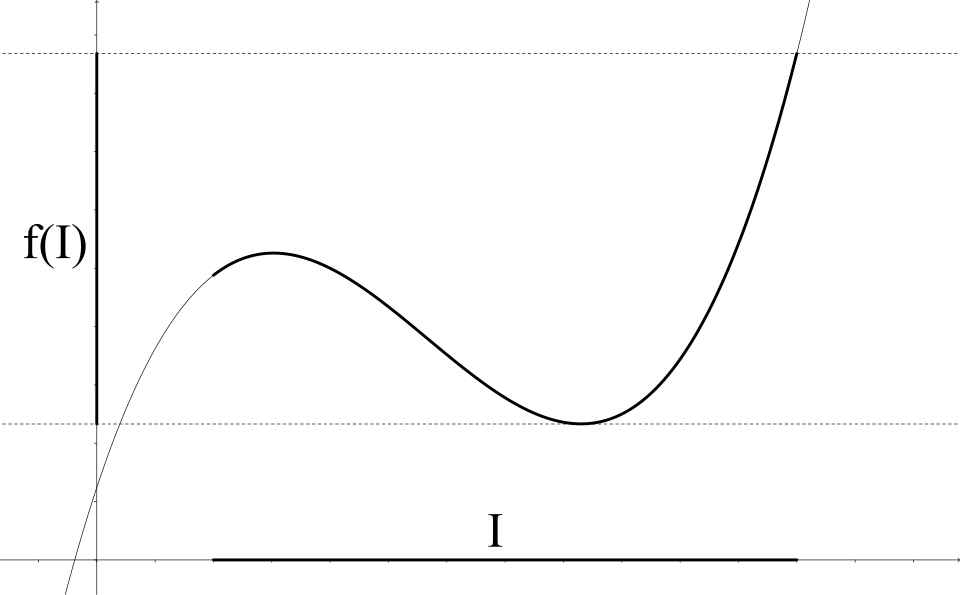
Illustration of a continuous function over an interval with a horizontal level between two function values. Because the graph is unbroken, it must intersect this intermediate level at some point . The diagram reinforces that a continuous function cannot “jump over” intermediate values. Source.
Why the IVT Requires Closed Intervals
The IVT explicitly applies to functions continuous on a closed interval . This guarantees that both endpoints are included, so a function beginning at and ending at forms an unbroken path across the entire domain.
Important implications:
If the interval were open, the endpoints might not be part of the domain, and the function might fail to reach the bounding values.
Closed intervals avoid ambiguity about behavior at the boundaries.
Continuity on ensures that each interior point behaves consistently, allowing the theorem to trace the full progression of the function.
Describing Intermediate Values
The phrase intermediate value refers to any number lying between two function outputs. These values form the bridge the function must cross.
Intermediate Value: Any number such that lies between and , regardless of which is greater.
Because may lie strictly between the outputs or coincide with them, the theorem accommodates a wide range of scenarios. It merely asserts existence of at least one value at which the function equals the intermediate value.
In applied settings, identifying intermediate values helps determine when certain events must occur—such as when a function crosses a specific threshold.
Applying the Statement of the Theorem
Although no worked examples appear here, it is important to understand the structure of how the IVT is used. Students typically rely on its statement to justify the presence of a solution or value within a specified interval.
A clear IVT-based justification generally includes:
Verifying the function is continuous on the stated closed interval.
Identifying two function values that lie on opposite sides of, or otherwise bound, the target value.
Concluding that the theorem guarantees at least one point where the function achieves that intermediate value.
These steps align closely with the formal statement of the theorem.
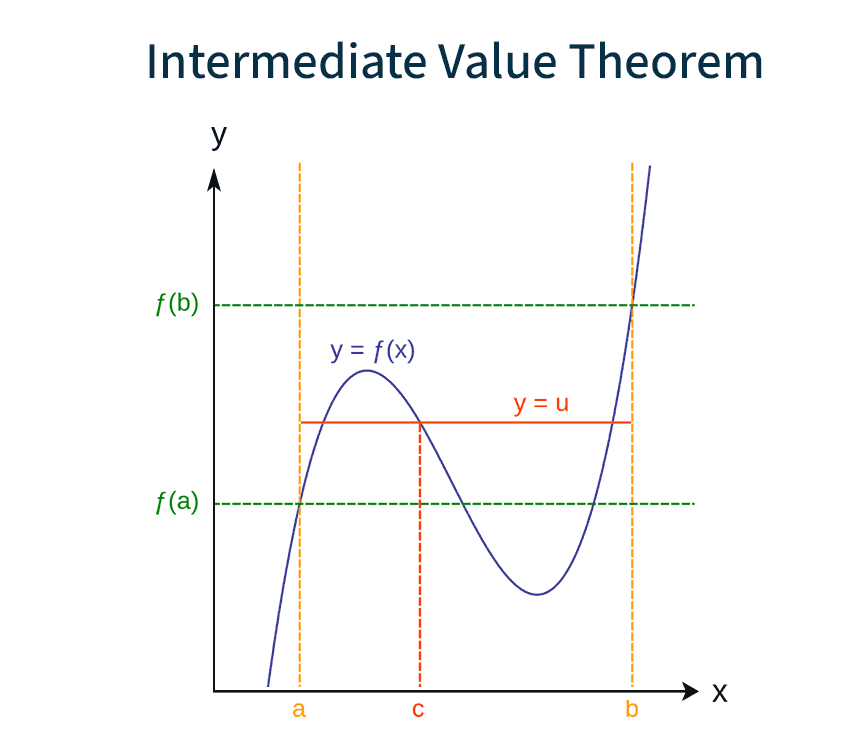
Graph of a continuous function on with endpoint values and and a horizontal line between them. The intersection at a point where visualizes how the Intermediate Value Theorem guarantees at least one such point in the interval. The hosting article also discusses additional applications such as roots, which exceed the scope of these specific notes. Source.
Situations Where IVT Supports Reasoning
While the theorem itself is purely theoretical, it is frequently applied in contexts involving continuous change. It provides a logical structure for asserting that something must happen somewhere within an interval.
Common uses include:
Demonstrating that an equation has at least one solution.
Claiming a function reaches a target value, even when the exact point is unknown.
Identifying when continuous models must pass through specific intermediate states due to physical constraints.
Through these uses, the IVT remains a foundational tool for reasoning about functions whose behavior unfolds smoothly across intervals.
Practice Questions
Question 1 (1–3 marks)
A function f is continuous on the closed interval [2, 6], with f(2) = –3 and f(6) = 5.
Explain why there must be at least one number c in [2, 6] such that f(c) = 0.
Question 1
• 1 mark: States or implies that f is continuous on a closed interval.
• 1 mark: Recognises that 0 lies between f(2) = –3 and f(6) = 5.
• 1 mark: Concludes that there exists at least one c in [2, 6] with f(c) = 0 by the Intermediate Value Theorem.
Question 2 (4–6 marks)
A function g is continuous on the closed interval [–4, 1]. It is known that g(–4) = 7 and g(1) = –2.
(a) State the Intermediate Value Theorem.
(b) Use the theorem to show that the equation g(x) = 4 has at least one solution in [–4, 1].
(c) A student claims that the equation g(x) = –5 must also have a solution in [–4, 1]. Determine whether this claim is justified, giving a clear reason.
Question 2
(a) (2 marks)
• 1 mark: States that if a function is continuous on a closed interval [a, b], then it takes every value between f(a) and f(b).
• 1 mark: Includes that there exists some c in [a, b] such that f(c) equals any intermediate value between f(a) and f(b).
(b) (2 marks)
• 1 mark: Identifies that 4 lies between g(–4) = 7 and g(1) = –2.
• 1 mark: Concludes that there is at least one solution to g(x) = 4 in [–4, 1] by the Intermediate Value Theorem.
(c) (2 marks)
• 1 mark: Notes that –5 does not lie between g(–4) = 7 and g(1) = –2.
• 1 mark: Correctly concludes that the Intermediate Value Theorem does not guarantee a solution to g(x) = –5 in [–4, 1], so the student’s claim is not justified.
FAQ
A closed interval ensures the function is defined and continuous at both endpoints, which guarantees that the values f(a) and f(b) are included as part of the function’s behaviour.
If the interval were open, the function might approach but never actually achieve one or both endpoint values, making it impossible to confirm that intermediate values lie strictly between them. This would weaken the guarantee provided by the theorem.
No. The theorem guarantees existence, not uniqueness.
A continuous function may cross the same intermediate value multiple times within the interval, especially if it oscillates or changes direction. The theorem does not provide information about how many such points exist, only that at least one must occur.
Not reliably. A single discontinuity breaks the guarantee that the function moves through all intermediate values.
However, the theorem can still apply on any subinterval where the function remains continuous. Identifying these subintervals is often useful if a function has isolated discontinuities.
Graphically, solving an equation such as f(x) = k involves finding where the graph crosses the horizontal line y = k.
The IVT ensures that if the graph lies on opposite sides of the line at two points in a continuous interval, it must cross that line at least once. This provides a theoretical justification for graphical root-finding.
Many physical quantities vary continuously, making them suitable candidates.
Examples include:
• Temperature changes across a day
• Water depth in a tank as it fills or empties
• Position of a moving object along a path
Such situations rarely involve abrupt jumps, so continuity is a reasonable assumption, allowing the IVT to support claims about intermediate states.