

AP Syllabus focus:
‘Represent limits analytically using notation like lim f(x) = L as x approaches c, interpreting this notation as describing nearby behavior of f, not necessarily its value at c.’
Understanding how to write and interpret limit notation is essential because it expresses how a function behaves near a point rather than at the point itself, supporting deeper reasoning about continuity and change.
Writing Limit Notation
Limit notation is designed to communicate the nearby behavior of a function. When we write a limit, we are not asserting anything about the function’s actual value at the point; instead, we are describing the value the function’s outputs approach as the inputs get arbitrarily close to a specified number.
The Structure of Standard Limit Notation
A typical expression such as contains specific components that convey how the inputs and outputs behave in relation to one another.
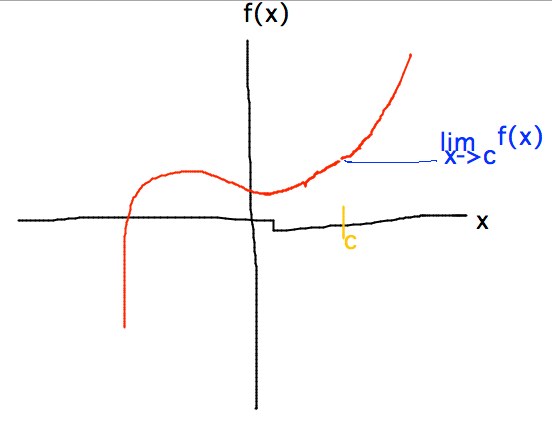
This diagram illustrates how the graph approaches a particular y-value as x approaches c, visually reinforcing that limit notation describes a trend rather than a point value. Source.
Limit Notation: A symbolic statement describing the value a function approaches as the input variable gets arbitrarily close to a specified number.
Limit notation requires attention to each part of the expression because each symbol carries meaning about proximity, behavior, and direction.
What the Arrows and Symbols Communicate
The arrow in limit notation indicates approach, not arrival. This distinction means the notation remains valid whether or not the function is defined at .
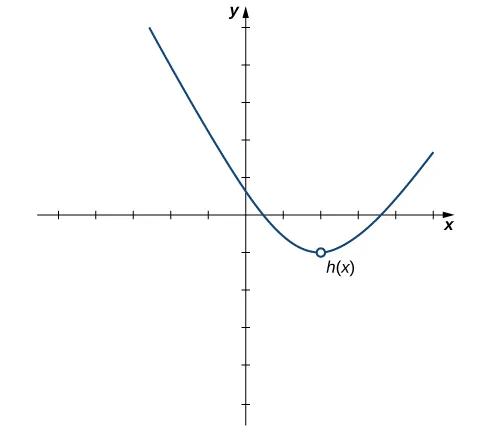
The graph shows a function with a hole at its minimum point, demonstrating that a limit can exist even when the function is not defined at that location. Source..
A function can fail to have a value at a point and still possess a well-defined limit there, emphasizing that limits describe tendencies rather than exact evaluations.
Reading Limit Notation Correctly
Interpreting limit notation involves translating symbolic expressions into verbal descriptions of function behavior. This skill ensures that mathematical statements accurately reflect the function’s local behavior.
Interpreting
This expression should be read as describing what happens to the values of as becomes arbitrarily close to , without requiring that ever equal . Students must avoid assuming that the value of the limit matches the value of the function at the point.
Approach (in limits): The idea that moves arbitrarily close to a number from either side without needing to equal that number.
This idea supports understanding situations where limits exist even when the function value does not align with the limiting behavior.
Interpreting Limits When the Function Is Not Defined at the Point
When reading limit expressions, it is crucial to recognize that the function may have a hole, a missing value, or a substituted point that differs from the expected limiting value. Limit notation isolates nearby behavior from the function’s actual definition, allowing a broader interpretation of continuity and discontinuity.
Distinguishing Between Function Values and Limit Values
A frequent source of confusion is the assumption that must equal whenever . Limit notation never implies equality between these quantities; it merely describes what the function approaches.
Why Function Values May Differ from Limit Values
Graphical or algebraic representations may reveal that a function is redefined at a point, or that no function value exists there.
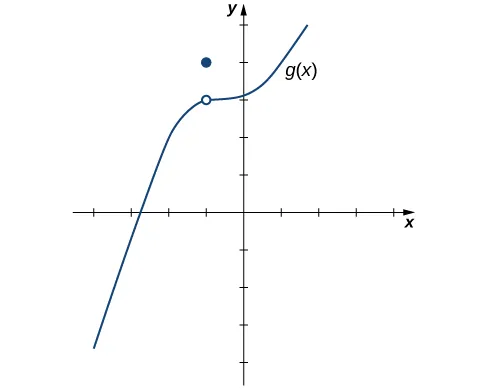
This figure contrasts the limit of a function with its actual assigned value at a point, showing that the curve approaches one height while the defined function value sits elsewhere. Source.
Nearby Behavior: How a function behaves for inputs close to, but not necessarily equal to, the point of interest.
Nearby behavior helps students focus on what limit notation is designed to express—behavior in a neighborhood of the point rather than the point itself.
Expressing Directional Behavior
Although two-sided limit notation is common, limit notation can also indicate directional approach, which strengthens one’s ability to interpret detailed changes in function behavior.
Right-Hand and Left-Hand Notation
Expressions such as and specify approach from the left or right, respectively. These forms of notation refine statements about behavior by distinguishing the direction of input movement.
One-Sided Limit: A limit that describes the value a function approaches as the input approaches a point from only one direction—either from below or from above the point.
Directional notation becomes especially important when analyzing situations where the function’s left-hand and right-hand behavior differ.
Best Practices for Writing and Interpreting Limit Notation
Limit notation is a concise language for describing behavior, so precision is essential. Students should ensure they select the correct symbols and interpret them with attention to the function’s tendencies.
Key Practices
Use limit notation only to describe nearby behavior, not explicit function values.
Include the arrow expression to clarify the variable’s movement.
Interpret the limit value as the target value approached by .
Distinguish carefully between and .
Use one-sided notation when the context requires directional specificity.
Mastery of writing and reading limit notation lays the groundwork for understanding continuity, derivatives, and many core ideas in calculus.
Practice Questions
Question 1 (1–3 marks)
A function f is shown in a graph where the curve approaches the y-value 2 as x approaches 1, but the function value at x = 1 is defined to be 5.
(a) Write the value of lim f(x) as x approaches 1.
(b) Explain briefly why your answer is correct, referring to the behaviour of the graph.
Question 1
(a) 1 mark:
• Correct limit value stated as 2.
(b) 2 marks:
• 1 mark for explaining that the graph approaches the y-value 2 as x gets close to 1.
• 1 mark for stating that the limit depends on nearby behaviour, not the function’s value at x = 1.
Question 2 (4–6 marks)
A function g is defined as follows:
g(x) = (x + 3)(x − 2) for all x except x = 2.
At x = 2, the function is defined to be g(2) = 10.
(a) State the value of lim g(x) as x approaches 2.
(b) Explain, using correct limit notation, why the limit exists even though g(2) is not equal to this limit.
(c) Write a correct interpretation of the statement lim g(x) as x approaches 2 equals L in words, referring to the nearby behaviour of the function.
Question 2
(a) 1 mark:
• Correct limit value stated as the value of (x + 3)(x − 2) at x = 2, which is 5.
(b) 3 marks:
• 1 mark for stating that the limit is determined by the values of g(x) close to 2.
• 1 mark for correctly using limit notation to express the limit statement.
• 1 mark for explaining that the limit can exist even if g(2) is defined differently.
(c) 2 marks:
• 1 mark for describing that as x approaches 2, g(x) approaches L, regardless of the value of g(2).
• 1 mark for explicitly referring to the idea that x does not need to equal 2 for the limit to describe the function’s behaviour.
FAQ
Limit notation describes how a function behaves arbitrarily close to a point, not at the point itself. This allows the notation to apply even when the function is undefined or redefined at x = c.
This separation is helpful because it isolates the underlying trend of the function from any exceptional or isolated behaviour that might occur at the point.
A two-sided limit is written simply as lim f(x) as x approaches c, which implies approaching from both directions.
One-sided limits include a plus or minus sign:
• c− indicates approaching c from the left
• c+ indicates approaching c from the right
These symbols ensure clarity when the function behaves differently on each side.
Limit notation provides an unambiguous symbolic structure that applies to all functions, including those with complicated or non-visual behaviour.
Informal descriptions can vary in phrasing, but notation forces the writer to specify:
• the function involved
• the point of approach
• the intended limiting value
This precision is essential for later work involving derivatives and rigorous arguments.
Yes. For example, a two-sided limit and two separate one-sided limits may all convey the same trend if the left-hand and right-hand behaviours agree.
However, using different forms can emphasise different information — one-sided notation highlights directional behaviour, while two-sided notation asserts that both directions lead to the same value.
Misreading limit notation can lead to assuming the function’s value at the point matters to the limit, which is often false in discontinuous graphs.
Accurate interpretation helps distinguish:
• what the graph approaches
• what the graph actually equals
• whether the behaviour is consistent on both sides
This clarity prevents errors when analysing discontinuities and prepares students for continuity arguments.
