

AP Syllabus focus:
‘Interpret statements written in limit notation by connecting them to graphical, numerical, and verbal descriptions of function behavior near a point, not relying only on formulas.’
Understanding how to interpret analytic limit notation helps reveal a function’s nearby behavior, allowing students to connect symbolic expressions to graphical trends and numerical patterns.
Interpreting Analytic Limit Notation
Analytic limit notation communicates how a function behaves near a point rather than what the function equals at that point. When students see an expression such as , the notation is describing an approach, not a substitution. This perspective is central to early calculus and underpins later ideas about continuity and derivatives, making careful interpretation essential.
What Limit Notation Communicates
A written limit gives a verbal description of behavior, specifying what is getting close to as gets arbitrarily near a specific number . It does not claim that exists or that . Instead, the notation highlights the trend of nearby values, which is often clearer when linked to graphs or tables of values.
Limit at a Point: The value a function approaches as the input approaches a specific number, regardless of whether the function attains that value.
Interpreting analytic limit statements requires distinguishing between function value and approaching value, as these may differ significantly in piecewise or discontinuous contexts.
Connecting Notation to Verbal Descriptions
Analytic notation should always be translatable into meaningful language. A limit statement like means: “As gets arbitrarily close to 3, the values of get arbitrarily close to 5.” When students convert notation to words, they reinforce the idea of approach without necessarily reaching, which avoids the common misconception that limits require substitution.
Bullet points can help capture the layered interpretation of a limit statement:
The input value approaches a number .
The output values move toward a single number .
The function’s value at may be equal to , not equal to , or even undefined.
The notation describes nearby behavior, not behavior at the point itself.
These verbal interpretations prepare students to connect notation to multiple representations and to reason about limits without relying exclusively on algebraic expressions.
Linking Notation to Graphical Behavior
Graphs visually demonstrate the meaning of analytic limit notation by showing how behaves around . To interpret analytic notation graphically, students should focus on the y-values approached rather than the plotted point at . This supports the understanding that the limit depends on what the function is doing close to that point, even if the graph has a hole or jump.
When interpreting from a graph:
Look at the left-hand behavior, observing the outputs for approaching .
Examine the right-hand behavior, observing the outputs for approaching .
Confirm both sides approach the same y-value .
Ignore the actual plotted value at , since the limit concerns surrounding behavior.
One-Sided Limit: The value a function approaches as the input approaches a point from only one direction, either the left or the right.
Understanding these graphical cues helps students validate analytic limit statements and recognize when a limit does not match the function's value.
Graphs visually demonstrate the meaning of this notation: as you move along the curve closer to x=cx = cx=c from either side, the yyy-values should settle near LLL.
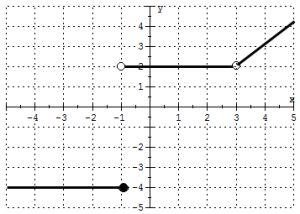
Graph of a piecewise function with an open circle where the function is not defined and a filled point at a different height. The graph illustrates that the limit as xxx approaches a point is determined by the values approached from each side, even when f(c)f(c)f(c) is missing or different. Parts of the graph away from the highlighted open and closed circles include extra detail not required by the syllabus and can be de-emphasized when teaching. Source.
Linking Notation to Numerical Patterns
Tables of values also provide a complementary perspective on analytic limit notation. When interpreting notation numerically, students analyze patterns in function values as approaches from both sides. Numerical interpretation is especially useful when formulas are difficult to manipulate or when graphs are not provided.
To translate analytic notation into numerical reasoning:
Identify -values close to but not equal to .
Observe how the corresponding values behave as moves closer to .
Determine whether values appear to settle near a single number that matches the analytic limit statement.
Recognize inconsistencies—such as divergence or differing left-hand and right-hand trends—as indicators that the limit notation may not describe the function accurately.
These numerical patterns reinforce the interpretation of limit notation as a statement about approach, not exactness.
Integrating Multiple Representations Through Analytic Notation
A powerful interpretation of analytic limit notation comes from synthesizing symbolic, graphical, and numerical viewpoints. This synthesis allows students to confirm whether the analytic statement accurately reflects the function's true behavior. It also encourages flexible thinking, a crucial skill in calculus.
Students should be able to:
Translate into precise verbal explanations.
Use a graph to justify that the behavior near aligns with the analytic claim.
Reference numerical evidence as further support when needed.
Identify when an analytic statement contradicts graphical or numerical patterns.
Through this integrated approach, analytic limit notation becomes more than a symbolic expression; it becomes a concise summary of how a function behaves near a specific point, supported by multiple forms of evidence.
If the left-hand and right-hand limits are not equal, we write that the limit limx→cf(x)\lim_{x\to c} f(x)limx→cf(x) does not exist (DNE), even if each one-sided limit individually exists.
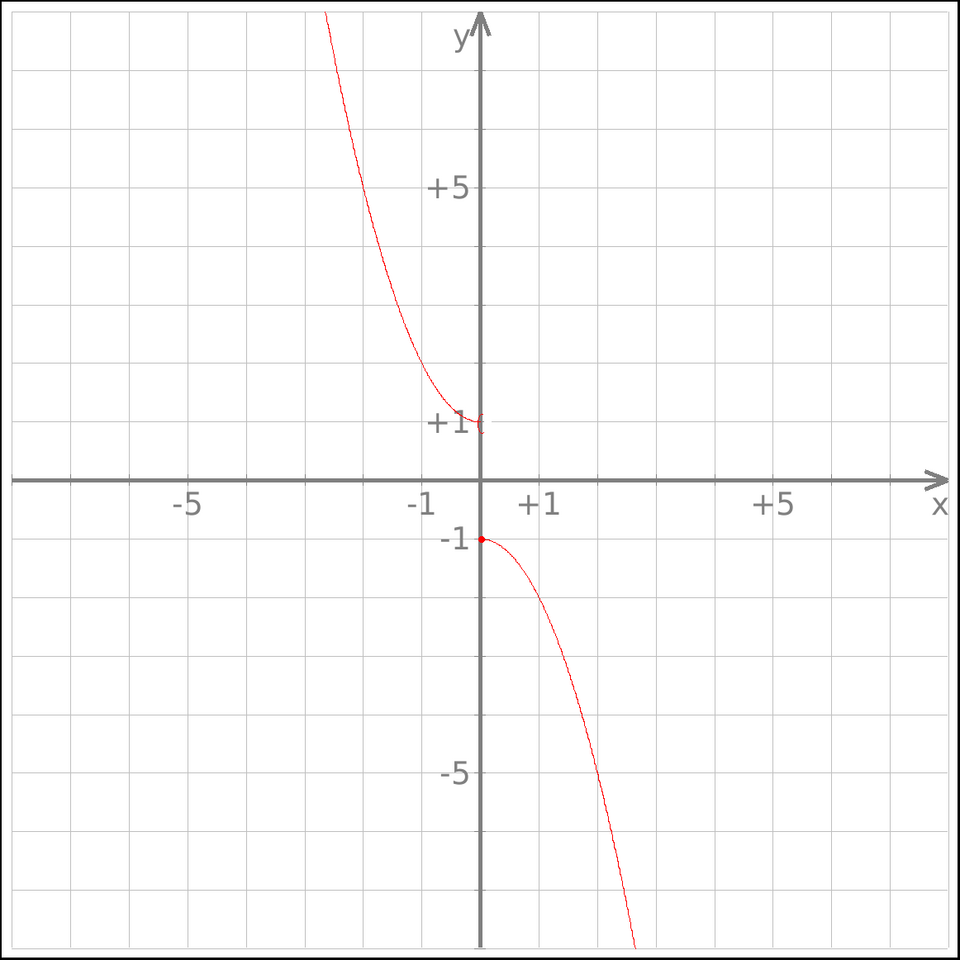
Graph of a function with a jump discontinuity: as xxx approaches a point from the left, the graph approaches one yyy-value, while from the right it approaches a different value. This visually encodes the notation limx→c−f(x)\lim_{x\to c^-} f(x)limx→c−f(x) and limx→c+f(x)\lim_{x\to c^+} f(x)limx→c+f(x) and shows why the combined limit limx→c\lim_{x\to c}limx→c does not exist. Additional portions of the curve beyond the jump appear in the diagram but are not required by the syllabus. Source.
Practice Questions
Question 1 (1–3 marks)
The limit statement
lim as x approaches 2 of f(x) = 5
is given.
Explain in words what this statement means about the behaviour of f(x) near x = 2.
Question 1
Full marks: 2–3 marks for a clear explanation that:
• The values of f(x) get arbitrarily close to 5 as x gets arbitrarily close to 2. (1 mark)
• The statement concerns the behaviour near x = 2, not necessarily the value f(2). (1 mark)
• Optional precision or clarity about approach without reaching earns a third mark. (1 mark)
Partial: 1 mark for a partially correct idea but lacking clarity (e.g., simply stating “f(x) equals 5 at 2”, which is incomplete).
Question 2 (4–6 marks)
A function g is shown on a graph with the following features:
• As x approaches 1 from the left, the y-values approach 3.
• As x approaches 1 from the right, the y-values also approach 3.
• The point (1, 6) is plotted as a filled dot on the graph.
(a) Using the information above, state the value of
lim as x approaches 1 from the left of g(x).
(1 mark)
(b) State the value of
lim as x approaches 1 from the right of g(x).
(1 mark)
(c) Determine the two-sided limit
lim as x approaches 1 of g(x),
and explain your reasoning.
(2 marks)
(d) State whether g(1) equals the same value as the limit. Explain briefly how this relates to the interpretation of limit notation.
(1–2 marks)
Question 2
(a)
lim as x approaches 1 from the left of g(x) = 3. (1 mark)
(b)
lim as x approaches 1 from the right of g(x) = 3. (1 mark)
(c)
Since both one-sided limits equal 3, the two-sided limit is 3. (1 mark)
Reason given that matching one-sided limits imply the two-sided limit exists and equals this common value. (1 mark)
(d)
g(1) = 6, which does not equal the limit of 3. (1 mark)
Explanation that limit notation describes the behaviour of g near x = 1, not its actual value at x = 1. (1 mark)
FAQ
Check whether the graph shows the function approaching the stated value from both sides of the target x-value.
If the graph includes removable holes, jumps, or steep changes, ensure you are focusing on the nearby y-values rather than the plotted point itself.
When the graph is coarse or scaled awkwardly, zooming or redrawing may be required to judge the approach accurately.
Because the concept of a limit concerns trends, not pointwise evaluation. A function might be undefined, misdefined, or discontinuous at c and still possess a legitimate limit there.
Limit notation isolates the idea of approaching behaviour so that mathematical statements remain valid even when the actual function value is unhelpful or irrelevant.
Students often assume:
• f(c) must exist for the limit to exist.
• The limit equals the value shown at the plotted point.
• Only algebraic manipulation is needed, ignoring graphs or tables.
Correct interpretation requires separating the symbol f(c) from the behaviour of f(x) nearby.
Look for patterns in the values as x approaches the target from both sides.
Consistent convergence towards a single number supports the analytic limit statement.
If values oscillate, diverge, or stabilise at different numbers depending on direction, the statement is inconsistent.
Both continuity and derivatives rely on understanding how a function behaves as x approaches a point.
Continuity requires matching a limit with a function value, and derivatives are defined using a limit of rates of change.
Accurate interpretation skills ensure students can recognise when limits describe genuine mathematical behaviour rather than isolated numeric coincidences.
