AP Syllabus focus:
‘Describe a limit as the value a function approaches as x gets arbitrarily close to a number c, without requiring x to equal c, focusing on nearby function values.’
A limit describes how a function behaves near a specific input, emphasizing the value the function approaches rather than the exact value it takes at that point.
Understanding the Informal Idea of a Limit at a Point
A limit at a point focuses on what value a function’s output gets close to as the input approaches some number c. This perspective highlights nearby behavior, not the function’s value exactly at c, which may differ or may not even be defined. The key idea is that we study how f(x) behaves when x is arbitrarily close to c, meaning as close as we want but not necessarily equal to c. This approach supports the broader goal in calculus of understanding change, prediction, and behavior without depending on perfect information at a single point.
Approaching a Point Without Reaching It
A limit captures the notion of “getting closer and closer” to a target value.
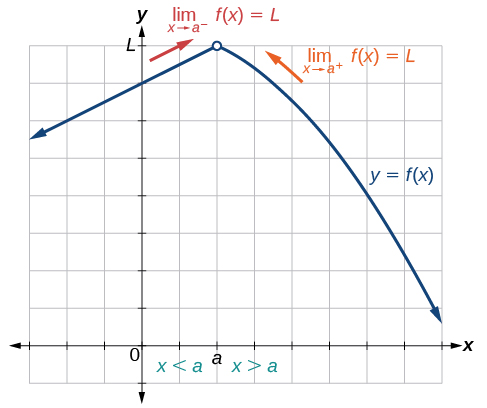
This graph illustrates a limit at x=ax = ax=a by showing that as xxx approaches aaa from both sides, the function values approach the same height LLL, reinforcing the informal idea of approaching rather than reaching the point. Source.
When we say that a function approaches a value L as x approaches c, we are describing a trend: the function values move toward L, even if they never exactly reach it. What matters is not the value at the point but the pattern of values near the point.
Limit at a Point: The value that a function’s outputs approach as the inputs get arbitrarily close to a specific number c.
This viewpoint allows calculus to describe continuous change even in situations where direct substitution is impossible or misleading.
A function does not need to be defined at c for the limit as x → c to exist. This distinction makes limits powerful tools for analyzing missing points, discontinuities, or unusual behaviors.
Nearby Values and Function Behavior
Understanding limits requires careful attention to function values on both sides of the point of interest. Because x can approach c from the left or the right, the function may exhibit different tendencies depending on the direction of approach. The limit exists only if the function approaches the same value from both sides, reinforcing the importance of evaluating behavior in a neighborhood around c.
Important ideas to emphasize:
We examine values of x that are close to c, but not equal to c.
The limit reflects what the function tends toward, not necessarily what it equals.
Nearby behavior may reveal a consistent pattern even when the function has jumps, holes, or undefined points.
Focusing on Behavior Instead of Point Values
The specification emphasizes that the definition of a limit does not require x = c, which is central to understanding continuity later. A limit describes how a function behaves near a point, independent of:
whether the function is defined at that point
whether the function has a different function value at that point
whether the function jumps or has a hole at that point
This separation between behavior near a point and behavior at the point is foundational in calculus.
Representing the Limit Informally
Informally, we write that f(x) approaches L as x approaches c using limit notation. While formal symbolic representation appears in other subsubtopics, an intuitive sense of the notation is vital here: it expresses a trend, not an equality. The phrase “as x gets arbitrarily close**” reflects the essential idea that we observe the function’s response to inputs increasingly near c, emphasizing the dynamic nature of change.
A single sentence must appear here between blocks to maintain required formatting.
= Function value depending on input
= Input value that x approaches
= Value that f(x) approaches
Conceptual Components of the Informal Definition
The informal definition involves several key components that help describe how limits operate at a point:
Approach: Inputs get closer and closer to c.
Trend: Outputs move toward a specific value L.
Independence from exact value: The function at c does not influence the limit.
Local behavior: Only behavior near c matters, not the behavior far away.
These ideas collectively support a flexible understanding of functions, allowing students to explore discontinuities, complex graphs, and dynamic behavior with confidence.
Why Nearby Behavior Matters
By focusing on neighboring values rather than the function’s value at the point:
We obtain a more stable and reliable measure of behavior.
We can characterize motion, growth, and change even when data is incomplete or noisy.
We develop a conceptual foundation for derivatives, which rely on limits to quantify instantaneous change.
Key Takeaways for Developing Intuition
Limits describe approached values, not necessarily achieved values.
The function’s actual value at the point does not affect the limit.
Behavior arbitrarily close to the point determines the limit.
Thinking in terms of approaching helps model dynamic change in real-world contexts.
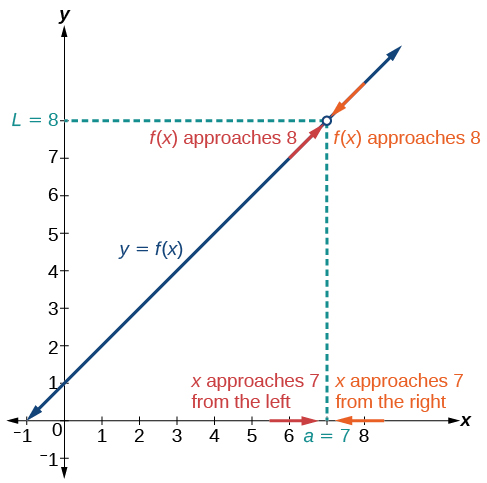
This graph highlights that the function values approach 8 as xxx approaches 7 from both sides, even though the point at x=7x = 7x=7 is open, illustrating that a limit depends on nearby behavior rather than the function’s exact value at that point. Source.
Practice Questions
Question 1 (1–3 marks)
The graph of a function f is shown to have a hole at x = 2. As x approaches 2, the values of f(x) get arbitrarily close to 5.
(a) State the value of the limit of f(x) as x approaches 2.
(b) Explain briefly why the existence of the hole does not affect the limit.
Question 1
(a) 1 mark
• Correctly states the limit as 5.
(b) 1–2 marks
• 1 mark for stating that limits depend on values near the point, not at the point itself.
• 1 mark for explaining that the hole at x = 2 does not change the trend of f(x) approaching 5.
Question 2 (4–6 marks)
A function g is defined for all x not equal to 4. The table below shows selected values of g(x) for inputs close to x = 4.
x: 3.8 3.9 3.99 4.01 4.1 4.2
g(x): 7.2 7.1 7.01 6.99 6.9 6.8
(a) Using the information in the table, determine what value g(x) appears to approach as x approaches 4.
(b) Explain, using the idea of nearby behaviour, why this value represents the limit of g as x approaches 4.
(c) g is not defined at x = 4. Explain why this does not prevent the limit from existing.
Question 2
(a) 1–2 marks
• 1 mark for identifying that the values approach approximately 7.
• A second mark if the candidate clearly justifies this by referring to values from both sides of x = 4.
(b) 1–2 marks
• 1 mark for describing that as x gets close to 4 from both sides, g(x) gets close to 7.
• 1 mark for explicitly referring to the concept of approaching or nearby behaviour.
(c) 1–2 marks
• 1 mark for stating that the limit is independent of whether the function is defined at the point.
• 1 mark for explaining that only the behaviour close to x = 4 determines the limit.
FAQ
Approaching a value describes how the outputs behave near a point, not at the point itself. Substitution only tells you the value at the point, assuming it exists.
A limit focuses on patterns in function values as the input moves arbitrarily close, which can reveal behaviour that substitution cannot detect, especially when the function is undefined or discontinuous at the point.
For a limit to exist at a point, the function must approach the same value from both the left and right.
Considering both sides ensures that the behaviour is consistent and not hiding a jump or mismatch that would prevent the limit from existing.
Yes. Even without formal notation, observing nearby values may reveal situations in which no single value is approached.
Typical indicators include:
• Left and right behaviours approaching different values
• Rapid oscillation near the point
• The function growing without bound
It allows students to interpret trends even when exact values cannot be measured directly.
In physical contexts such as motion, temperature change, or population growth, data are often incomplete or imprecise, so analysing the values as they get close to a moment can provide meaningful insight into underlying behaviour.
Yes. Limits are determined solely by behaviour in an arbitrarily small neighbourhood around the point.
A function may be complicated or irregular in the wider domain, but as long as it settles toward a single value when approaching the point, the limit exists.