

AP Syllabus focus:
‘Use limit laws to find limits of quotients and composite functions when appropriate, assuming denominators do not approach zero and inner function limits exist.’
Understanding how limit laws extend to quotients and composite functions allows us to evaluate many limits algebraically, provided key conditions on denominators and inner functions are met.
Limit Laws for Quotients
When evaluating limits involving quotients, we rely on the principle that if the limits of the numerator and denominator both exist and the denominator’s limit is nonzero, then the limit of the quotient exists and equals the quotient of the limits.
Conditions for Applying Quotient Limit Laws
Before applying quotient laws, it is essential to examine the structure of the function and verify that no part of the expression violates required assumptions. These assumptions ensure the result reflects valid limiting behavior rather than undefined or indeterminate conditions.
Quotient Limit Law: If and exist and , then .
This law guarantees that a limit involving division mirrors the familiar arithmetic rule for dividing real numbers, but only under strict conditions.
Key Requirements When Working with Quotients
Analyzing these requirements helps avoid misapplication of the law, especially when the denominator approaches zero.
Existence of numerator limit: The numerator must approach a finite or infinite limit.
Existence of denominator limit: The denominator must have a limit that exists.
Nonzero denominator limit: The denominator’s limit must not equal zero, ensuring the quotient remains defined.
Awareness of indeterminate forms: Expressions such as or are not resolved by the quotient law and require alternative strategies.
These points highlight how structural properties of a function influence the feasibility of using quotient limit rules.
The quotient law is part of a broader family of limit laws that describe how limits interact with algebraic operations like sums, products, and powers.
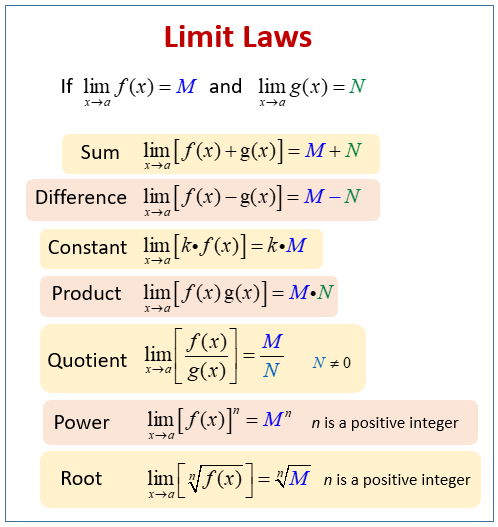
This chart summarizes the standard limit laws, including the quotient law and its key requirement that the denominator’s limit be nonzero. It visually emphasizes how the quotient rule fits within the broader collection of algebraic limit rules. The diagram also includes additional limit laws beyond those needed here, which support further study. Source.
Limit Laws for Composite Functions
Composite functions demand careful analysis because the behavior of an inner function affects the validity of substituting limits into an outer function.
Understanding Composite Function Limits
When evaluating , the limit depends on the ability to transmit limiting information through layers of functional composition.
Composite Limit Law: If and is continuous at , then .
This principle allows substitution of the inner limit into the outer function, but only when the continuity of the outer function guarantees stability of evaluation near the limit.
A sentence is needed here to create required spacing before introducing any further structured material.
Conditions Required for Composite Limits
The structural relationship between the inner and outer functions determines whether composition simplifies the limit.
Inner limit existence: A well-defined limit for as approaches must exist.
Continuity of the outer function: Continuity at the resulting inner limit value allows substitution without altering the limiting behavior.
Stable domain behavior: The output of must remain within the domain where behaves consistently near the limit point.
These conditions highlight how composition can preserve or disrupt predictable limiting behavior.
When Composite Rules Apply Naturally
Many familiar families of functions—including polynomials, exponentials, logarithms, and trigonometric functions—are continuous on their domains, making them particularly well suited for composite limit rules. When the outer function belongs to one of these families and the inner limit lies within the appropriate domain, substitution becomes straightforward.
Situations Requiring Caution with Composite Limits
Even when both inner and outer functions appear well behaved, subtle issues may prevent application of the composite limit law.
Discontinuity of the outer function at the inner limit: If is not continuous at , the result may differ drastically from .
Undefined inner outputs: When approaches values where is not defined, the limit cannot be evaluated using the composition rule.
Piecewise outer functions: Special attention is needed when the outer function changes definition near , since continuity must be verified rather than assumed.
These considerations emphasize that function behavior near limit points is often more significant than global functional behavior.
When applying the composite limit law, you must look carefully at the graph of the outer function near the inner limit value to see whether it is continuous there or whether one-sided behavior creates a problem.
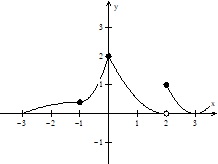
This graph illustrates how the limiting value of the inner function may fall at a point where the outer function is not continuous, affecting the validity of the composite limit law. It highlights the need to analyze one-sided behavior around the relevant input value. Some numeric detail in the figure extends beyond this subsubtopic but remains aligned with typical AP Calculus expectations. Source.
Integrating Quotient and Composite Limit Reasoning
Evaluating complex limits frequently involves expressions that intertwine quotient structures and composite functions. In such cases, it becomes essential to verify conditions for both types of limit laws.
Strategic Checklist for Combined Situations
Students can approach these limits systematically by ensuring that every component satisfies the assumptions underlying the rules being applied.
Confirm inner and outer limit behaviors separately before combining laws.
Check for denominators approaching zero both inside composite functions and across quotient structures.
Use continuity strategically to justify substitution where appropriate.
Be alert to domain restrictions that may disrupt limit evaluation in layered expressions.
By attending to these structural factors, students ensure that algebraic limit techniques remain mathematically valid and fully consistent with foundational limit laws.
Practice Questions
Question 1 (1–3 marks)
The functions f and g satisfy the following limits as x approaches 2:
lim f(x) = 6
lim g(x) = 3
Given that g(2) is not equal to 0, determine the value of
lim [ f(x) / g(x) ] as x approaches 2.
Justify why the quotient limit law applies.
Question 1
• Correct substitution of limits into the quotient: 6 / 3 (1 mark)
• Correct final limit value: 2 (1 mark)
• Justification that the quotient limit law applies because the limits of numerator and denominator both exist and the denominator’s limit is non-zero (1 mark)
Question 2 (4–6 marks)
Let h(x) = sqrt( 4 + k(x) ), where k is a function such that lim k(x) = 5 as x approaches 1.
(a) State the value of lim h(x) as x approaches 1.
(b) Explain clearly why the composite function limit law applies in this situation.
(c) Suppose instead that h(x) = 1 / k(x). State the condition required for lim h(x) to exist as x approaches 1, and explain what would prevent the quotient limit law from applying.
Question 2
(a)
• Correct limit value: sqrt(9) = 3 (1 mark)
(b)
• Correct reasoning that because the inner limit exists (k approaches 5) and the outer function sqrt(x) is continuous at x = 9, substitution is valid (1 mark)
• Clear statement that continuity ensures the limit of the composite equals the composite of the limits (1 mark)
(c)
• States the required condition: the limit of k(x) as x approaches 1 must not be zero (1 mark)
• Explains that if the denominator approaches zero, the quotient limit law cannot be applied, because division by zero or an undefined expression would occur (1 mark)
FAQ
The quotient law can fail when the individual limits of the numerator or denominator do not exist, even if the denominator stays away from zero.
It may also fail in cases where one or both functions oscillate near the point of interest, preventing the limit of the quotient from settling to a single value.
Finally, if either function is defined piecewise with conflicting one-sided behaviour, the quotient limit may not exist even though division is still defined.
Check whether the outer function is continuous at the inner limit value. If not, you must examine left- and right-hand behaviour separately.
A useful fast check is:
• If the outer function involves jumps, absolute values, or piecewise definitions near the input value, inspect one-sided behaviour.
• If the graph of the outer function has a hole or a point replaced by another value, one-sided limits usually need verification.
Continuity guarantees that small changes in the input to the outer function produce small, predictable changes in its output. Without continuity, the behaviour of the composite can shift abruptly.
This means the inner function may approach a value smoothly, but the outer function could respond with a sudden jump, making the composite limit impossible to determine by substitution alone.
Yes, but only if the inner function never actually approaches the discontinuity from the side that causes the jump.
For example, if the outer function has a one-sided discontinuity at a value L, and the inner function approaches L solely from the side where the outer function behaves smoothly, the composite limit may still exist.
However, this scenario is rare in exam problems and must be checked carefully.
Before applying any limit laws, simplify the expression as far as possible. This can remove unnecessary complexity and avoid misleading behaviour.
Useful strategies include:
• Simplifying nested expressions to expose the true inner function.
• Cancelling factors that create artificial discontinuities.
• Rewriting complicated expressions so that continuity of the outer function becomes more apparent.
These steps help reveal whether limit laws can be applied directly or whether further structural analysis is required.
