AP Syllabus focus:
‘Apply algebraic limit theorems to compute limits of sums, differences, and products by taking limits term by term when individual limits exist.’
Understanding how to evaluate limits using algebraic limit laws allows us to analyze function behavior efficiently by breaking expressions into simpler components and examining their individual limiting behavior.
Limit Laws for Sums, Differences, and Products
The limit laws provide essential tools for determining the limit of a complex expression by examining its parts. When the limits of individual components exist, these rules allow direct computation of the limit of a combined expression, greatly simplifying analysis and supporting deeper conceptual understanding in calculus.
The Idea Behind Term-by-Term Limits
These limit laws rely on the intuitive idea that if each part of an expression settles toward a predictable value near a point, then the entire expression will settle accordingly. This supports the syllabus requirement of applying algebraic limit theorems to evaluate limits of sums, differences, and products based on individual limits.
Apply algebraic limit theorems to compute limits of sums, differences, and products by taking limits term by term when individual limits exist.
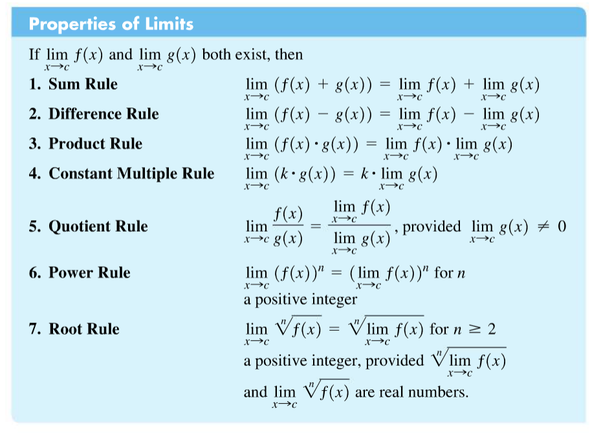
This table summarizes the main algebraic limit laws, including the sum, difference, and product rules. Each rule shows how a limit distributes over the corresponding algebraic operation when the individual limits exist. The chart also includes additional rules not required by the subsubtopic but commonly taught together for context. Source.
The Limit Law for Sums
The sum law states that the limit of a sum is the sum of the individual limits, provided those limits exist.
Sum Law: If and exist, then .
This law reflects how functions behave additively near a point. If two functions each approach stable values, their combined behavior also stabilizes in a predictable way. This is a foundational rule for evaluating limits of polynomial and other composite expressions.
The Limit Law for Differences
Closely related to the sum law, the difference law states that limits distribute over subtraction in the same manner, again assuming the individual limits exist.
Difference Law: If and exist, then .
This law is essential when analyzing expressions containing subtracted terms, such as those appearing in rate-of-change formulas, algebraic simplifications, and function comparisons.
A key idea is that subtraction does not introduce any additional complexity beyond what arises in the individual functions. As long as both functions approach finite values, their difference also approaches a finite and computable value.
The Limit Law for Products
The product law ensures that limits behave predictably under multiplication, enabling evaluation of more complex expressions such as factored forms or functions defined through proportional relationships.
Product Law: If and exist, then .
This property is crucial when evaluating polynomial limits, where expressions naturally arise from repeated multiplication of simpler components. The product law also supports the algebraic manipulations explored later in the limits curriculum, such as factoring and simplifying expressions to remove indeterminate forms.
Conditions for Applying Limit Laws
These limit laws rely on a central condition: the individual limits must exist before applying the rule. If either function fails to approach a finite value, the combined limit cannot be evaluated using these laws alone. Key considerations include:
Confirming the domain of each function near the point of interest.
Ensuring no undefined expressions occur, such as division by zero.
Recognizing when additional algebraic techniques must be used before applying limit laws.
The laws are reliable only when the component limits behave regularly. If a function oscillates or grows without bound, the laws cannot automatically guarantee the existence of the combined limit.
Using the Laws to Simplify Expressions
When evaluating limits of complex expressions, it is often helpful to break them into components using algebraic structure. Useful strategies include:
Splitting sums into individual terms to evaluate separately.
Distributing limits across subtracted expressions.
Rewriting products into simpler factors whose limits are easier to compute.
Identifying constant factors, which can be pulled outside limit expressions using standard limit properties.
Recognizing when expressions can be reorganized to expose sum, difference, or product structure.
These strategies highlight how the laws support efficient problem-solving by reducing complicated expressions to manageable parts.
In practice, we repeatedly apply the sum, difference, and product laws to break a complicated limit into simpler limits until each piece can be evaluated directly.
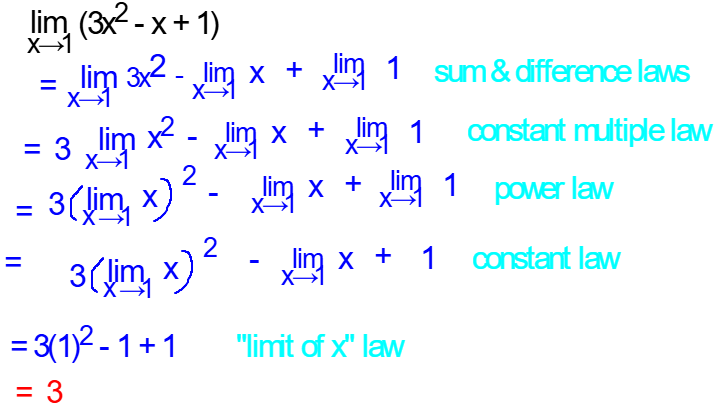
This worked diagram illustrates how a single limit expression is decomposed using the algebraic limit laws. The original limit is rewritten as a combination of simpler limits, each evaluated using basic facts such as the limit of a constant. The example includes full algebraic detail that extends slightly beyond the verbal explanation but reinforces the term-by-term process described in the notes. Source.
Interactions with Other Limit Tools
Although sum, difference, and product laws form a foundation for algebraic limit computation, they also work in coordination with other rules developed across the unit. Students will eventually combine these laws with:
Quotient laws, when denominators approach nonzero limits.
Continuity properties, allowing substitution into continuous functions.
Algebraic manipulation techniques, such as factoring and rationalizing expressions.
Strategic approaches, such as identifying the structure of a limit expression before selecting an evaluation method.
These relationships reinforce why mastering the three laws in this subsubtopic is essential for later success in calculus, especially in understanding derivatives as limits of difference quotients.
Practice Questions
Question 1 (1–3 marks)
The functions f and g have the following limits as x approaches 2:
lim f(x) = 5
lim g(x) = –3
Evaluate the limit of 2f(x) – 4g(x) as x approaches 2.
Question 1 (3 marks total)
• 1 mark for correctly substituting the individual limits into the expression.
• 1 mark for correct calculation of 2f(x) = 2(5) = 10.
• 1 mark for correct calculation of –4g(x) = –4(–3) = 12, and combining to give 22.
Final answer: 22
Question 2 (4–6 marks)
Let the functions p and q satisfy the following limits as x approaches –1:
lim p(x) = 7
lim q(x) = 2
(a) Using limit laws, evaluate the limit of p(x)q(x) – 3p(x).
(b) The function r is defined by r(x) = p(x) + 4q(x). Using your previous results where appropriate, find the value of the limit of r(x)p(x) as x approaches –1.
(c) Explain briefly why the procedures in parts (a) and (b) are justified under the limit laws for sums, differences, and products.
Question 2 (6 marks total)
(a) (3 marks)
• 1 mark for correctly applying the product law to obtain 7 × 2 = 14.
• 1 mark for correctly evaluating –3p(x) as –3 × 7 = –21.
• 1 mark for combining results: 14 – 21 = –7.
(b) (2 marks)
• 1 mark for evaluating r(x) = p(x) + 4q(x) = 7 + 4(2) = 15.
• 1 mark for applying the product law to r(x)p(x): 15 × 7 = 105.
(c) (1 mark)
• 1 mark for clearly stating that each individual limit exists, and therefore the limit laws for sums, differences, and products allow term-by-term evaluation of the expressions used.
FAQ
Limit laws rely on predictable behaviour of each component function near a point. If one part fails to approach a finite value, the combined expression may behave erratically.
When a limit does not exist due to divergence or oscillation, applying sum, difference, or product laws can produce incorrect or unsupported results.
This ensures that limit manipulation remains logically sound and mathematically justified.
Yes, provided both individual limits exist. A zero limit simply means the product limit will also be zero when multiplied by a finite value.
Caution is needed only when zero appears in operations that could create ambiguity, such as quotients. For products, zero causes no special complication.
Yes. Constant multiples can always be pulled outside a limit because constants do not vary with x.
This allows expressions to be simplified by:
• extracting numerical factors before applying other limit laws
• reducing multi-term expressions into manageable parts
• isolating function behaviour from numerical scaling
Polynomials are built exclusively from sums, differences, and products of powers of x. These operations align perfectly with the corresponding limit laws.
Because each individual term has a straightforward limit, polynomials can be evaluated term by term without additional algebraic manipulation.
Frequent errors include:
• assuming a limit exists simply because each component appears well behaved
• applying product or sum laws to expressions containing undefined values at the limit point
• forgetting that behaviour near a point, not at the point, governs limit evaluation
Ensuring all component limits exist before combining them prevents most misapplications.