AP Syllabus focus:
‘Estimate the derivative at a point by drawing or imagining a tangent line on the graph of f and approximating its slope, or by analyzing slopes of nearby secant lines.’
Estimating derivatives from graphs requires interpreting the instantaneous rate of change by visually assessing how a function behaves near a specific point. These notes develop the graphical intuition essential for transitioning from average to instantaneous change.
Understanding Graph-Based Derivative Estimation
Estimating a derivative from a graph hinges on recognizing that the derivative at a point represents the slope of the tangent line drawn to the curve at that point. Because graphs display continuous change visually rather than algebraically, students must analyze curvature, directional trends, and local linearity.
When referring to a tangent line, we mean the line that “just touches” the curve at one point and matches its immediate direction.
Tangent Line: A line that touches a curve at one point and has the same instantaneous direction as the curve at that point.
A graph also allows visual comparison between a tangent line’s slope and nearby secant lines, which connect two points on the curve and show average rate of change. This relationship helps students approximate derivatives when perfect tangents are difficult to draw or estimate precisely.
Connecting Local Linearity to Tangent Slope
A key idea when estimating derivatives from graphs is local linearity, the principle that differentiable functions appear almost linear when sufficiently zoomed in around a point. Recognizing this helps students refine tangent approximations by focusing on the neighborhood closest to the point of interest.
Local Linearity: The property that a differentiable function resembles a straight line when viewed very close to a specific point on its graph.
This understanding supports the practice of estimating slopes visually or numerically from the graph.
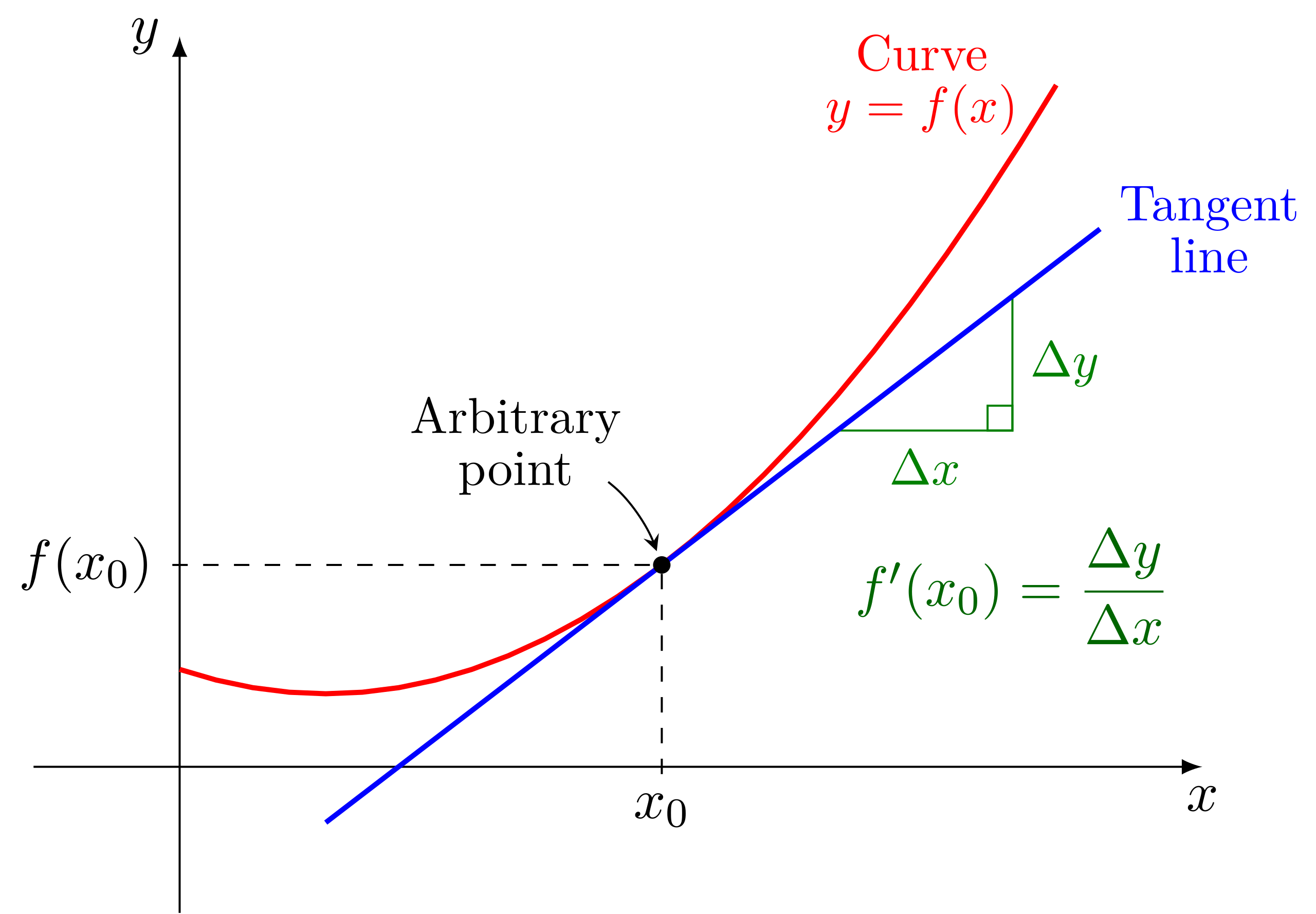
A curve is shown together with its tangent line at a single point, illustrating how the derivative at that point is represented by the slope of the tangent. The tangent line shares the same instantaneous direction as the curve at the point of contact. The axes allow visualization of how changes in relate to corresponding changes in along the tangent. Source.
Approaches to Estimating Derivatives Graphically
Drawing or Imagining a Tangent Line
To approximate the derivative at a point by visual inspection, students rely on constructing or imagining a tangent line that best fits the local behavior of the graph.
Key features to assess include:
Direction: Whether the curve is increasing or decreasing at the point.
Steepness: How rapidly the function rises or falls.
Curvature: Whether the graph bends upward or downward, influencing tangent placement.
When a tangent line is drawn, the derivative at the point corresponds to its slope.
= Vertical change along the tangent line
= Horizontal change along the tangent line
After identifying a reasonable tangent line, students use the graph’s scale markings to approximate this slope numerically, ensuring consistency with visible increments on the axes.
Inferring Tangent Slope from Nearby Secant Lines
In situations where a tangent is difficult to visualize, students may analyze slopes of secant lines drawn through the point of interest and nearby points.
Important ideas associated with this approach:
The secant line’s slope approximates the average rate of change over an interval.
As the second point moves closer to the target point, the secant slope better approximates the instantaneous rate of change.
Converging secant slopes suggest the existence of a derivative at the point.
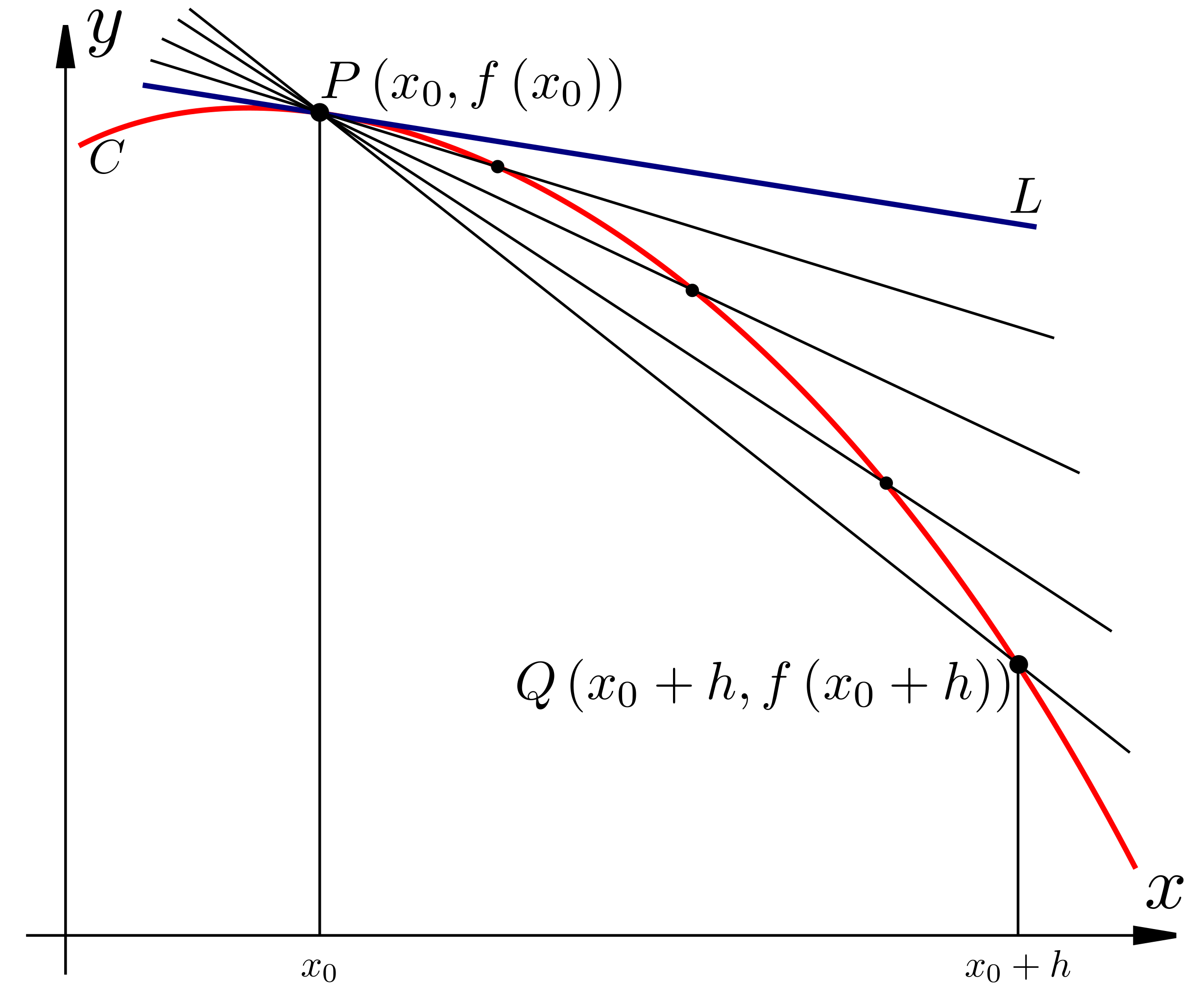
The graph shows a curve , a tangent line , and several secant lines connecting to . As decreases, the secant slopes approach the slope of the tangent, illustrating how instantaneous rate of change emerges from average rates. Additional labels such as , , and provide visual clarity on the difference quotient even though this detail slightly exceeds the study notes’ minimal requirements. Source.
To use this strategy effectively, students select points close to the target point on both sides, ensuring the approximation captures the function’s local behavior.
Choosing a Method on a Given Graph
Students should evaluate which estimation approach is most appropriate for a particular graph by considering:
Graph resolution: Whether the axes provide fine enough increments to measure slopes reliably.
Smoothness of the function near the point: Smooth intervals favor tangent line estimation; irregular regions may require secant comparisons.
Scale distortions: Unequal units on axes may mislead the eye, making careful reading essential.
Visual Cues for Interpreting Derivatives
Understanding how derivatives manifest graphically deepens intuition and strengthens estimation skills.
Key visual cues include:
Positive derivative: Graph slopes upward from left to right.
Negative derivative: Graph slopes downward from left to right.
Zero derivative: Tangent line is horizontal, often corresponding to local maxima, minima, or saddle points.
Large magnitude derivative: The graph is very steep; secant line approximations may require closer points for accuracy.
Changes in concavity: Although concavity does not determine the derivative’s value, it influences how the tangent line hugs the curve.
Recognizing these cues helps students verify whether their estimated slope is reasonable.
Enhancing Accuracy in Graph-Based Estimation
To produce reliable derivative estimates from graphs, students should maintain a systematic strategy:
Use multiple visual checks: compare tangent slope estimates with slopes of nearby secant lines.
Consider symmetry: symmetric curves often yield predictable tangent behaviors at symmetric points.
Stay within a small neighborhood: the smaller the interval, the closer the approximation reflects instantaneous change.
Confirm consistency: re-evaluate estimates using alternative points or viewpoints on the same graph.
These techniques contribute to developing strong intuition as students build fluency in graphical differentiation.
Practice Questions
Question 1 (1–3 marks)
A graph of a differentiable function f is shown. At x = 2, the graph appears smooth and increasing. A tangent line is drawn at the point (2, 3). Using the graph’s scale markings, the tangent line rises approximately 1.5 units in y for every 1 unit increase in x.
Estimate f′(2) and explain what this value represents in the context of the graph.
Question 1 (1–3 marks)
• 1 mark: Correctly reads the slope from the graph as approximately 1.5 (allow answers in the range 1.3 to 1.7 depending on interpretation).
• 1 mark: States that f′(2) is approximately 1.5.
• 1 mark: Explains that this value represents the instantaneous rate of change or the slope of the tangent to the graph at x = 2.
Total: 3 marks.
Question 2 (4–6 marks)
The graph of a function g is shown. The point A on the graph has coordinates (1, 4).
(a) Draw or imagine a tangent line at A. Using the graph, estimate the slope of this tangent line.
(b) Two nearby points on the curve are given: B = (0.8, 3.6) and C = (1.2, 4.5).
Use the slopes of the secant lines AB and AC to refine your estimate of g′(1).
(c) Explain briefly why the secant line estimates support or contradict your original tangent-based estimate.
Question 2 (4–6 marks)
(a)
• 1 mark: Makes a reasonable estimate of the tangent slope at A (answers around 1 to 1.2 acceptable).
• 1 mark: States the estimate clearly.
(b)
• 1 mark: Computes or states the secant slope AB = (3.6 − 4) / (0.8 − 1) = 2.
• 1 mark: Computes or states the secant slope AC = (4.5 − 4) / (1.2 − 1) = 2.5.
(Allow numerical variation if graph-based interpretations differ.)
• 1 mark: Uses these values to refine the derivative estimate (e.g., suggests g′(1) is roughly between 2 and 2.5).
(c)
• 1 mark: Provides a valid explanation comparing the tangent-based estimate to the secant-based values, noting whether they support or contradict the initial estimate and why (e.g., curvature or inaccuracies in sketching the tangent).
Total: 6 marks.
FAQ
Graphical estimates are inherently approximate because precision depends on scale, line thickness, and how clearly the curve is drawn.
A well-drawn graph with consistent axis markings can usually give a reliable estimate to one significant figure.
However, estimates become less accurate when the graph is steep, highly curved, or uses uneven scaling on the axes.
Improving accuracy involves:
• Zooming in on the region if the graph allows.
• Using a straight edge to refine the tangent line placement.
• Comparing slopes from several nearby secant lines.
A tangent estimate becomes unreliable when the graph shows:
• Rapid changes in curvature near the target point, making a single tangent difficult to place.
• A cusp-like shape or sharp bend, where no well-defined tangent exists.
• Thick or imprecise drawing lines that obscure the exact point of contact.
In such cases, secant line slopes tend to give more dependable information than forced tangent placement.
Using points from both the left and the right reveals whether the slopes converge to a consistent value.
If both secant slopes approach the same number, the derivative likely exists and the estimate is stable.
If they differ significantly, the function may be changing too quickly, or the derivative may fail to exist at that point.
This two-sided comparison helps identify asymmetry, hidden corners, or misleading behaviour from a single-sided estimate.
Concavity affects how the curve bends around the tangent line, making the tangent appear to sit above or below the graph in nearby regions.
This bending can make tangent placement visually tricky because:
• In concave-up regions, the curve rises away from the tangent more quickly.
• In concave-down regions, the curve dips beneath it.
Understanding concavity helps judge whether a drawn tangent aligns well with the curve at the point of interest.
A coarse grid limits access to precise rise-over-run measurements, but accuracy can still be improved by:
• Extending the tangent line well beyond the point of tangency so its slope becomes clearer relative to the grid.
• Choosing two widely separated points on the tangent that fall on grid intersections.
• Averaging several rough estimates to reduce visual error.
These methods help counteract the loss of detail in low-resolution or small-scale graphs.